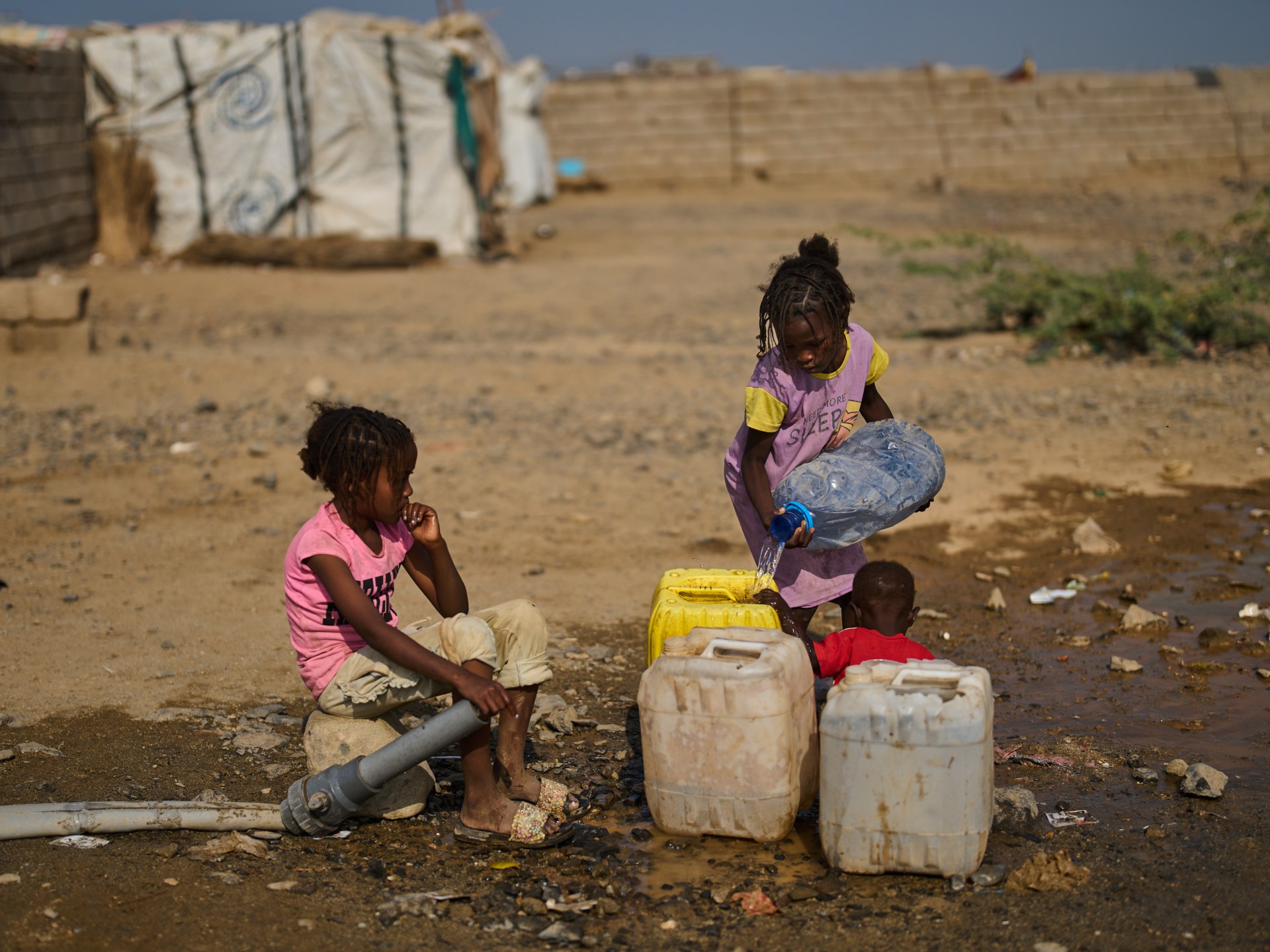
Both a lack of access to food and health facilities will ultimately lead to death for many, warned the Norwegian Refugee Council.Internally displaced Sudanese children collect water at the Al Heshan camp in Sudan" class="entity-link entity-location" data-entity-id="9948" data-entity-type="location">Port Sudan [File: Bernat Armangue/AP]Published On 14 May 2026More than 40 percent of Sudan’s population is facing acute hunger, according to a report by a global hunger monitor, the three-year civil war having created one of the world’s worst humanitarian crises.Nearly 19.5 million Sudanese people are facing such dire circumstances, the United Nations-backed Integrated Food Security Phase Classification (IPC) said on Thursday.Recommended Stories list of 4 itemslist 1 of 4The crisis in Sudan is much worse than what is acknowledgedlist 2 of 4Why have peace efforts failed to end conflict in Sudan?list 3 of 4Fighting in Sudan’s Blue Nile State displaces thousandslist 4 of 4No Exit From El Fasherend of listSudan’s three-year civil war, between the Sudanese Armed Forces (SAF) and its rival Rapid Support Forces (RSF) paramilitary group, which has killed hundreds of thousands of people and displaced millions in the country, has also begot tremendous levels of hunger and famine.The IPC report stated that 14 areas in the country’s North Darfur, South Darfur, and South Kordofan states remain at risk of famine, where 135,000 people face “catastrophic” levels of hunger.Those areas include the cities of el-Fasher and Kadugli, judged last year to be experiencing famine largely as a result of sieges by the RSF.But in October, the RSF completed their takeover of el-Fasher, largely emptying the city, while this year the army broke the siege of Kadugli.As a result of the hunger crisis, families have been forced into “very negative coping mechanisms”, said Grace Oongee, from the Norwegian Refugee Council.“We’ve had reports of families who’ve been forced to eat leaves, who’ve been forced to eat animal feed, even reports of families breaking into slaughterhouses that have been closed down just to get the skin of the animals to be able to eat and to survive,” Oonge told Al Jazeera, speaking from the city of Sudan" class="entity-link entity-location" data-entity-id="9948" data-entity-type="location">Port Sudan.Both a lack of access to food and health facilities will ultimately lead to death for many, she warned.Some of the figures from the IPC report and others, she added, may not be a true representation of what is actually happening on the ground due to restrictions on access.“Ongoing hostilities – especially around major supply routes, such as El Obeid in North Kordofan – and the possibility of renewed siege-like conditions continue to heighten risks,” the IPC said in a statement.Some 825,000 children are expected to suffer from severe acute malnutrition as insecurity, access restrictions, and budget cuts have made aid deliveries to many parts of the country difficult, the global monitor also said.Last year, the IPC’s report estimate was slightly higher, stating that 21.2 million people faced acute hunger, compared with this report’s 19.5 million.‘An invisible crisis’Drone warfare has seemed to replace ground campaigns as the leading mode of warfare in Sudan.Fighting rages on in the Kordofan region, as well as Blue Nile State, with drones killing at least 880 civilians since January, according to the UN’s human rights office.Drones have also targeted civilian infrastructure, including markets, hospitals, and power stations.Sudan’s rainy season, which begins around July and coincides with the leaner planting season, is expected to also worsen conditions.Parts of North Darfur hosting those fleeing from el-Fasher are also at risk of famine, including Tina, Um Baru, and Kernoi, which have seen drone attacks, as well as fighting, as the RSF consolidates its control of the area.The US-Israel war on Iran also threatens to worsen the situation, raising food, fuel, and fertiliser prices and making a successful harvest later this year less likely.“I think Sudan is becoming an invisible crisis, and which is why we need to continue echoing the message and continue sharing the horrors of the current situation on the ground – it’s more than just the numbers,” said Oonge.
SRCAl Jazeera
LANGEN
LEANCenter
WORDS654
ENT12
THU · 2026-05-14 · 18:23 GMTBRIEF NSR-2026-0514-76329
NSR-2026-0514-76329News Report·EN·Human Interest
Acute hunger grips nearly 20 million people in war-battered Sudan, says IPC
Nearly 20 million people in Sudan, over 40% of the population, are facing acute hunger due to the ongoing three-year civil war between the Sudanese armed forces and the Rapid Support Forces. A United Nations-backed report by the Integrated Food Security Phase Classification (IPC) stated that 14 areas, including North Darfur, South Darfur, and South Kordofan states, are at risk of famine, with 135,000 people experiencing "catastrophic" hunger levels.
Al Jazeera StaffAl JazeeraFiled 2026-05-14 · 18:23 GMTLean · CenterRead · 3 min
Al JazeeraFIG 01
Reading time
3min
Word count
654words
Sources cited
3cited
Entities identified
12entities
Quality score
100%
§ 01
Briefing Summary
AI-generatedNEWSAR · AI
Nearly 20 million people in Sudan, over 40% of the population, are facing acute hunger due to the ongoing three-year civil war between the Sudanese armed forces and the Rapid Support Forces. A United Nations-backed report by the Integrated Food Security Phase Classification (IPC) stated that 14 areas, including North Darfur, South Darfur, and South Kordofan states, are at risk of famine, with 135,000 people experiencing "catastrophic" hunger levels. Families are resorting to extreme measures to survive, such as eating leaves and animal feed, and the lack of access to both food and healthcare facilities is expected to lead to widespread deaths. The true extent of the crisis may be underestimated due to ongoing hostilities restricting access to affected regions.
Confidence 0.90Sources 3Claims 5Entities 12
§ 02
Article analysis
Model · rule-basedFraming
Human Interest
Conflict
Tone
Mixed Tone
AI-assessed
CalmNeutralAlarmist
Factuality
0.80 / 1.00
Factual
LowHigh
Sources cited
3
Well sourced
FewMany
§ 03
Key claims
5 extracted01
825,000 children are expected to suffer from severe acute malnutrition.
statisticIPC report
Confidence
1.00
02
14 areas in North Darfur, South Darfur, and South Kordofan states are at risk of famine, with 135,000 people facing 'catastrophic' hunger.
statisticIPC report
Confidence
1.00
03
More than 40 percent of Sudan’s population is facing acute hunger due to the three-year civil war.
statisticIPC report
Confidence
1.00
04
Nearly 19.5 million Sudanese people are facing acute hunger, according to the UN-backed Integrated Food Security Phase Classification (IPC).
statisticIntegrated Food Security Phase Classification (IPC)
Confidence
1.00
05
Families are resorting to eating leaves, animal feed, and animal skin to survive due to the hunger crisis.
quoteGrace Oongee (Norwegian Refugee Council)
Confidence
0.90
§ 04
Full report
3 min read · 654 words§ 05
Entities
12 identifiedKey playerOppositionContextPositiveNeutralNegative
Organizations5
§ 06
Keywords & salience
10 termsacute hunger
1.00
humanitarian crisis
0.90
civil war
0.80
famine
0.70
sudan
0.60
food access
0.50
displaced people
0.40
norwegian refugee council
0.40
ipc
0.40
health facilities
0.40
§ 07
Topic connections
Interactive graph Network visualization showing 51 related topics
View Full Graph Person Organization Location Event|Click node to navigate|Edge numbers = shared articles