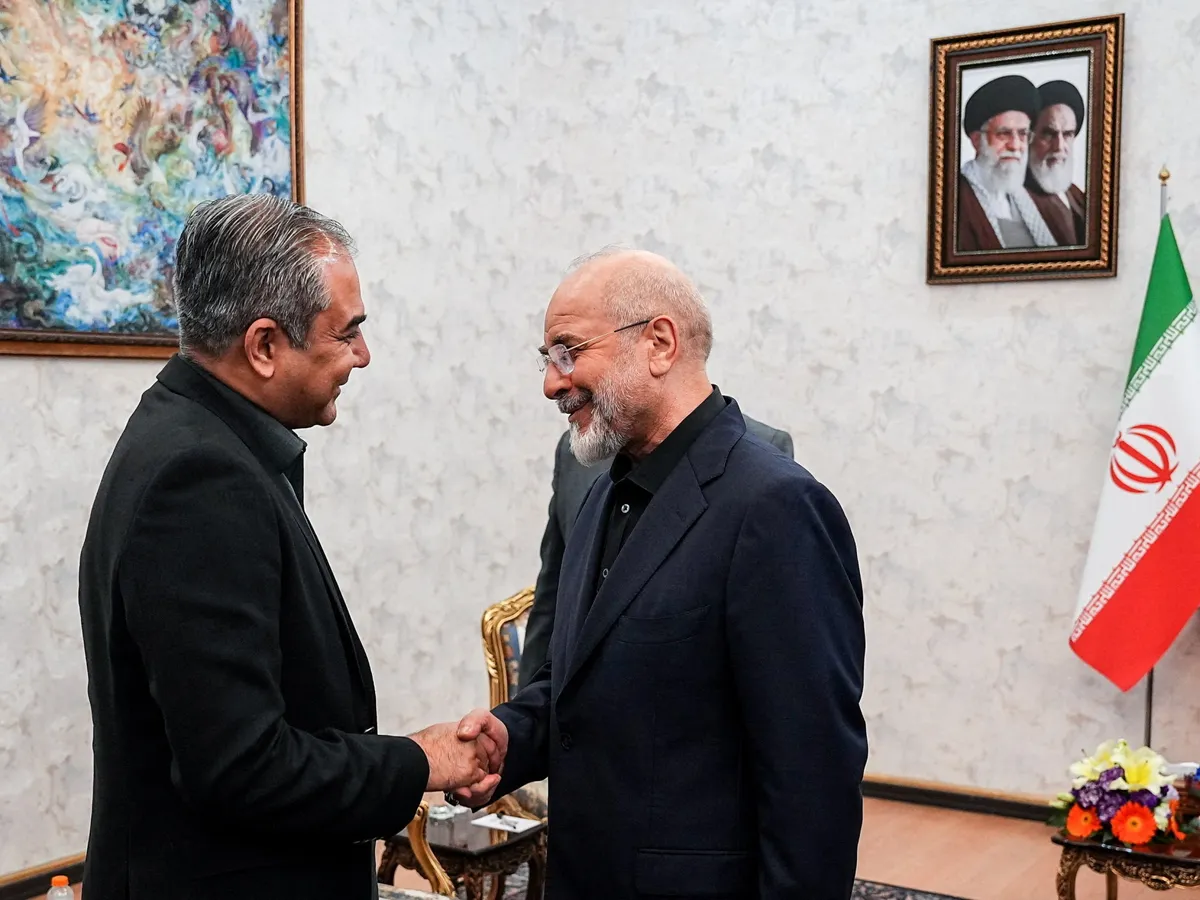
Tehran and Washington exchange proposals through Pakistan while military escalation increasingly shadows diplomatic efforts.Iranian Parliament Speaker Mohammad Bagher Ghalibaf meets with Pakistan's Interior Minister Mohsin Naqvi, in Tehran, Iran on May 17, 2026 [Handout/Iranian Parliament Speaker Office via Reuters]Published On 18 May 2026Islamabad, Pakistan – Pakistan is scrambling to keep channels of diplomacy open between the United States and Iran, amid escalating rhetoric from both sides, and growing signals from Washington that it is prepared to restart attacks that have been on pause since an April 8 ceasefire in the US-Israel war on Iran.Pakistan’s Interior Minister Mohsin Naqvi arrived in Tehran on Saturday for a two-day visit, meeting President Masoud Pezeshkian, Interior Minister Eskandar Momeni and Parliament Speaker Mohammad Bagher Ghalibaf as Islamabad scrambled to prevent ceasefire negotiations from collapsing altogether. Ghalibaf has also been Iran’s chief negotiator in peace talks with the US to end the war, which began on February 28.Recommended Stories list of 4 itemslist 1 of 4Could a leadership change undo Israel’s international isolation?list 2 of 4Drone strike sparks fire on perimeter of UAE’s Barakah nuclear power plantlist 3 of 4‘Won’t be anything left’: Trump issues threat to Iran amid stalled talkslist 4 of 4Al Jazeera reports from Hormuz Island as Iran says it controls the straitend of listYet on Sunday, as Naqvi continued talks with Iranian officials, US President Donald Trump issued a warning on Truth Social: “For Iran, the Clock is Ticking, and they better get moving, FAST, or there won’t be anything left of them. TIME IS OF THE ESSENCE!”Over the weekend, Trump also met his top national security team, including Vice President JD Vance, Secretary of State Marco Rubio, CIA Director John Ratcliffe, Defence Secretary Pete Hegseth and special envoy Steve Witkoff.Tehran’s version of events, however, has sharply differed from Washington’s public posture.At his weekly press conference on Monday, Iranian Foreign Ministry spokesman Esmaeil Baghaei said that despite Trump publicly calling Iran’s response “totally unacceptable” last week, Washington had sent “a set of revised points and considerations” through Pakistani mediators.Iran had reviewed them and responded through the same channel. “The process is continuing through Pakistan,” Baghaei said. Later, Iran’s state-run Tasnim news agency said that Iran’s submission to Pakistan — to be transmitted to the US — included a 14-point proposal.Yet tensions have continued to mount. Over the weekend, drones struck an electrical generator outside the perimeter of the Barakah Nuclear Energy Plant in the United Arab Emirates. Saudi Arabia separately said it intercepted three drones launched from Iraqi airspace.Pakistan’s Foreign Ministry on Monday condemned the Barakah strike as “a grave violation of international law” and urged all parties to “exercise maximum restraint”.The developments underscored how far diplomacy has deteriorated since the ceasefire came into effect 40 days ago.Both sides have exchanged proposals, rejected each other’s core demands, and increasingly shifted to the language of military escalation, with renewed hostilities now a real possibility, according to analysts.US President Donald Trump, right, speaks with Chinese President Xi Jinping while leaving after a visit to the Zhongnanhai Garden in Beijing, China, May 15, 2026 [Evan Vucci/Pool via Reuters]The proposal breakdownFollowing the April 8 ceasefire and the collapse of talks in Islamabad on April 11-12, Washington and Tehran continued exchanging proposals through Pakistani intermediaries.On April 28, Iran submitted a 14-point counterproposal calling for a permanent end to hostilities within 30 days, a US withdrawal from areas near its borders, the lifting of a US naval blockade, the release of frozen assets, war reparations, and a new mechanism governing the Strait of Hormuz. Nuclear issues were explicitly excluded.Washington responded early May with its own plan. Its central demands included a 20-year moratorium on uranium enrichment, the transfer abroad of Iran’s stockpile of highly enriched uranium, estimated at roughly 400kg (882 pounds) enriched to 60 percent, and the dismantling of nuclear facilities at Natanz, Isfahan and Fordow.Confirming receipt of the US proposal at the time, Baghaei stressed that Iran’s own plan focused solely on ending the conflict.“The plan we have presented is centred on ending the war. There are absolutely no details regarding the country’s nuclear issues in this proposal,” he said.Tehran took 10 days to respond. Iran’s written response offered to transfer some enriched uranium to a third country while postponing nuclear negotiations until after a permanent ceasefire. But Trump dismissed it as “totally unacceptable”.Baghaei reiterated Tehran’s position on Monday.“This is absolutely not a topic we negotiate or compromise on. Iran’s right to enrichment has been recognised under the NPT,” he said, referring to the Nuclear Non-Proliferation Treaty, which Israel, the other aggressor in the war along with the US, has not signed.Iran also laid out five preconditions for any renewed talks: an end to hostilities on all fronts, including Lebanon; sanctions relief; the release of frozen assets; war compensation; and recognition of Iran’s sovereignty over the Strait of Hormuz.Javad Heiran-Nia, an international relations analyst based in Tehran, told Al Jazeera the dispute over sequencing was fundamental rather than tactical.Iran wanted the Hormuz issue resolved first to prevent Washington from using the naval blockade as leverage during future nuclear negotiations, he said.“The US wants nuclear talks from the very beginning so that it can maintain the naval blockade during negotiations and keep it as an effective card,” he said.“This is a deep structural gap: Iran is seeking a long-term insurance policy following the US withdrawal from the JCPOA in 2018, while Washington wants to use military and sanctions pressure to obtain maximum concessions,” the analyst added, referring to the Joint Comprehensive Plan of Action, the 2015 nuclear deal that global powers had reached with Iran, before Trump walked out of it.Ilhan Niaz, professor of history at Quaid-e-Azam University in Islamabad, said both sides had strategic reasons to remain entrenched.“Iran is now stronger because of the war than it could have ever hoped to become under a continuation of the previous set of containment policies [of the US],” he told Al Jazeera. “Iran will hold out for terms congruent with reality, and the US will hold out for terms compatible with the preservation of its superpower prestige.”Pakistan’s role under strainNaqvi was the third senior Pakistani official to visit Tehran in recent weeks, following army chief Field Marshal Asim Munir’s late April trip and an earlier joint visit by Munir and Naqvi.Heiran-Nia warned that Pakistan was approaching a critical threshold.“Pakistan is on the verge of shifting from being an indispensable channel to an option ignored by both sides,” he told Al Jazeera. “Once Iran and the US engage through other channels such as Oman or Qatar, or conclude that Pakistan is unable to impose its will on either side, Islamabad’s role will become marginal.”Mehran Kamrava, professor of international relations at Georgetown University in Qatar, however, pushed back on that assessment.“The collapse of the ceasefire would not necessarily mean Pakistan would be ignored by either side,” he told Al Jazeera. “Pakistan is critically important diplomatically as a source of contact and communication.”The divide between Washington and Tehran was wide and the animosities deep, he said, but that did not diminish Islamabad’s position. “It remains a key channel regardless of how the military situation evolves,” the Doha-based analyst said.
SRCAl Jazeera
LANGEN
LEANCenter
WORDS1 189
ENT12
MON · 2026-05-18 · 16:09 GMTBRIEF NSR-2026-0518-77262
NSR-2026-0518-77262News Report·EN·Diplomatic
Pakistan’s mediation faces limits as Iran-US tensions deepen
Pakistan is attempting to mediate between the United States and Iran amidst escalating tensions and the potential for renewed military conflict. Iranian and US officials are exchanging proposals through Pakistani intermediaries, with Iran's Parliament Speaker Mohammad Bagher Ghalibaf meeting Pakistan's Interior Minister Mohsin Naqvi in Tehran.
Abid HussainAl JazeeraFiled 2026-05-18 · 16:09 GMTLean · CenterRead · 5 min
Al JazeeraFIG 01
Reading time
5min
Word count
1 189words
Sources cited
4cited
Entities identified
12entities
Quality score
100%
§ 01
Briefing Summary
AI-generatedNEWSAR · AI
Pakistan is attempting to mediate between the United States and Iran amidst escalating tensions and the potential for renewed military conflict. Iranian and US officials are exchanging proposals through Pakistani intermediaries, with Iran's Parliament Speaker Mohammad Bagher Ghalibaf meeting Pakistan's Interior Minister Mohsin Naqvi in Tehran. Despite these diplomatic efforts, US President Donald Trump issued a stern warning to Iran, while Iran claims Washington sent revised proposals. Tensions are further heightened by drone attacks in the UAE and Saudi Arabia, which Pakistan has condemned. The ongoing negotiations, which began after an April 8 ceasefire, involve proposals on ending hostilities and addressing Iran's nuclear program, though both sides have rejected each other's core demands.
Confidence 0.90Sources 4Claims 5Entities 12
§ 02
Article analysis
Model · rule-basedFraming
Diplomatic
Conflict
Tone
Mixed Tone
AI-assessed
CalmNeutralAlarmist
Factuality
0.70 / 1.00
Factual
LowHigh
Sources cited
4
Well sourced
FewMany
§ 03
Key claims
5 extracted01
US President Donald Trump issued a warning to Iran stating, 'For Iran, the Clock is Ticking, and they better get moving, FAST, or there won’t be anything left of them.'
quoteDonald Trump
Confidence
1.00
02
Drones struck an electrical generator outside the Barakah Nuclear Energy Plant in the UAE, and Saudi Arabia intercepted drones from Iraq.
factual
Confidence
0.90
03
Iranian Foreign Ministry spokesman Esmaeil Baghaei stated that Washington had sent 'a set of revised points and considerations' through Pakistani mediators.
quoteEsmaeil Baghaei
Confidence
0.90
04
Pakistan is mediating between the US and Iran amid escalating rhetoric and potential military action.
factual
Confidence
0.90
05
Iran's state-run Tasnim news agency reported that Iran's submission to Pakistan included a 14-point proposal for the US.
factualTasnim news agency
Confidence
0.80
§ 04
Full report
5 min read · 1 189 words§ 05
Entities
12 identifiedKey playerOppositionContextPositiveNeutralNegative
People9
§ 06
Keywords & salience
10 termspakistan mediation
1.00
iran-us tensions
1.00
diplomatic efforts
0.90
military escalation
0.80
ceasefire negotiations
0.70
escalating rhetoric
0.60
donald trump
0.50
us-israel war
0.50
mohsin naqvi
0.40
mohammad bagher ghalibaf
0.40
§ 07
Topic connections
Interactive graph Network visualization showing 51 related topics
View Full Graph Person Organization Location Event|Click node to navigate|Edge numbers = shared articles