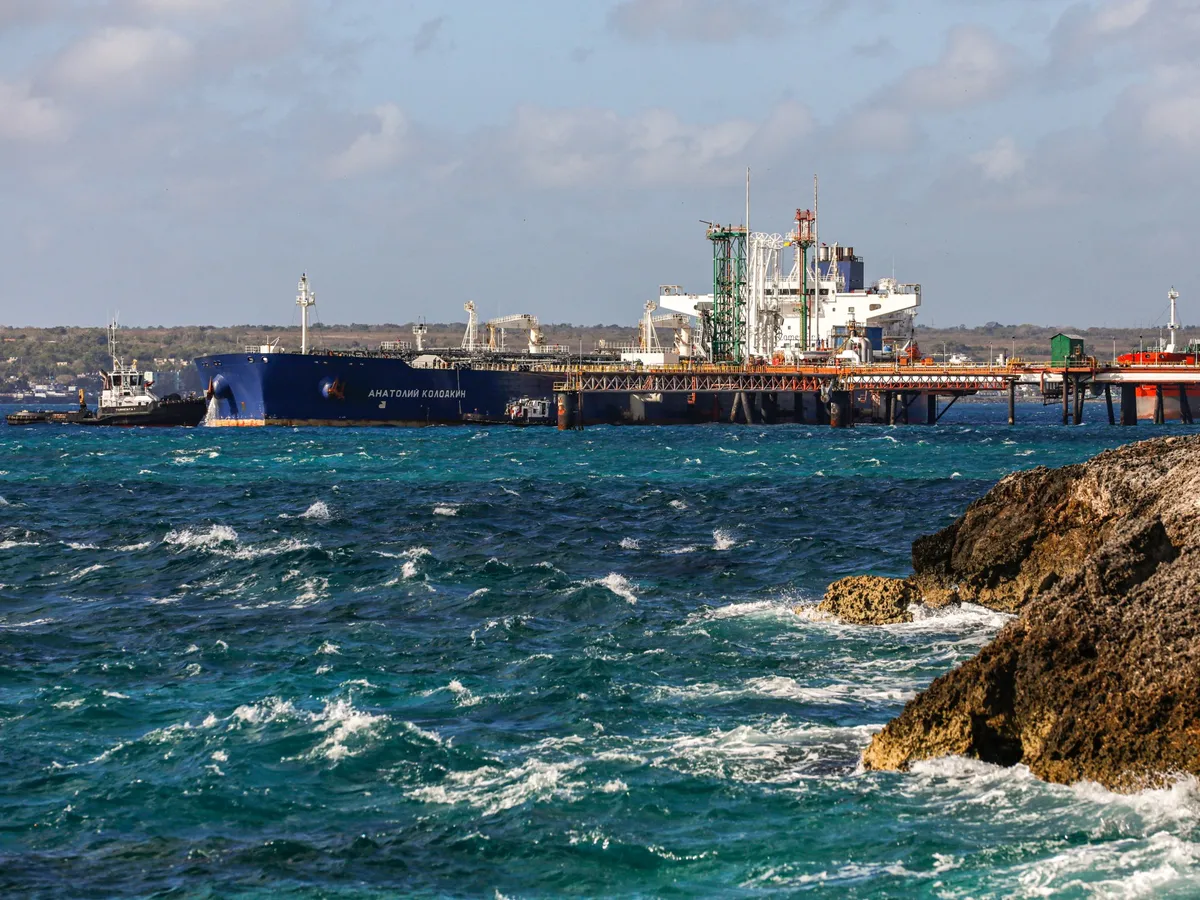
EXPLAINERThe US has extended its waiver on sanctioned Russian oil until June 17.Russian oil tanker Anatoly Kolodkin at the oil terminal in the port of Matanzas, Cuba [File: Yamil Lage/AFP]Published On 19 May 2026The United States has announced another 30-day extension of a sanctions waiver for countries buying Russian oil and petroleum products currently already loaded on tankers at sea, as global energy markets have been roiled by the US-Israel war on Iran.In a post on X on Monday, Treasury Secretary Scott Bessent announced that the US would issue the extension “to provide the most vulnerable nations with the ability to temporarily access Russian oil currently stranded at sea”. It will last until June 17.Recommended Stories list of 3 itemslist 1 of 3Ukrainian drone attacks on Russia kill at least fivelist 2 of 3Russian drone hits Chinese ship off Ukraine before Putin meets Xi Jinpinglist 3 of 3‘China holds the cards’: Why Putin’s visit to Beijing after Trump mattersend of list“This extension will provide additional flexibility, and we will work with these nations to provide specific licenses as needed. This general license will help stabilize the physical crude market and ensure oil reaches the most energy-vulnerable countries,” he wrote.“It will also help reroute existing supply to countries most in need by reducing China’s ability to stockpile discounted oil,” he added.The US issued its first 30-day sanctions waiver for Russian oil and petroleum products in March in a bid to stabilise global energy markets after crude oil prices surged above $100 per barrel in the wake of US-Israeli strikes on Iran. In April, Bessent told The Associated Press news agency that Washington had no plans to renew the waiver.But energy markets have failed to stabilise amid ongoing negotiations for a peace proposal between the US and Iran, as well as the closure of the Strait of Hormuz, a vital waterway through which about 20 percent of global oil and gas is shipped during peacetime, and the US naval blockade of Iranian ports. The closure of the strait, which is the only sea route from the Gulf to the open ocean, has “walled in” 20 million barrels of Gulf oil per day, George Voloshin, an independent energy analyst based in Paris, told Al Jazeera in March.Furthermore, European sanctions on Russian oil – imposed since the start of the 2022 invasion of Ukraine – remain in place.Will the US waiver extension help stabilise the energy market? What does this mean for Russia? Here’s what we know:How much Russian oil is at sea?According to analytics firm Kpler, there is currently about 113 million barrels of oil or liquid volume (Mbbl) of Russian crude and condensate loaded on ships and at sea. Russian crude oil in transit is approximately 106Mbbls.Johannes Rauball, a senior crude analyst at Kpler, told Al Jazeera that floating storage of Russian crude – oil held on stationary tankers awaiting buyers or further shipping instructions – has declined significantly since the start of the year from a high of about 19Mbbls in late January to 7Mbbls now.“In recent months, Russian crude exports have been pressured by ongoing Ukrainian drone strikes, which have disrupted export infrastructure and reduced shipping capacity,” he said. As a result, Russian crude production has averaged roughly 9.1 million barrels per day (bpd), below its OPEC+ quota of approximately 9.5 million bpd, he added.Who is buying Russian oil?Despite these challenges, Moscow has continued to export oil, with India and China as consistent purchasers. This is despite US President Donald Trump claiming to have extracted a promise from Indian Prime Minister Narendra Modi to stop buying Russian oil in October last year. Moscow exported 1.62 million bpd of crude to India in September, roughly one-third of the country’s oil imports.However, last month, Kpler noted, Russian oil exports to India stood at more than 2 million bpd compared with 1.72 million bpd the month before. Exports to China dropped a little from 1.3 million bpd, but remained strong at 1.05 million bpd.On Monday, Sujata Sharma, joint secretary at India’s Ministry of Petroleum and Natural Gas, told reporters that New Delhi had been buying Russian oil before Washington’s waiver on the sanctioned oil. “Regarding the American waiver on Russia, I would like to emphasise that we have been purchasing from Russia earlier … before waiver also, during waiver also and now also,” she said.She stressed that India does not face an oil shortage.“Waiver or no waiver, it will not affect our supplies, and all efforts have been taken to that effect,” Sharma said.In a May 18 briefing note, Kpler analyst Sumit Ritolia wrote that it is difficult to see India materially stepping back from Russian crude even if sanctions are reimposed.“The issue is increasingly about supply security and economics rather than sanctions optics … With Middle Eastern flows still facing logistical uncertainty, Russian crude continues to offer advantages through pricing and relatively stable non-SoH (stock on hand) logistics,” he wrote.With the sanctions waiver now extended, Anna Zhminko, market analyst at maritime analytics company Vortexa, told Al Jazeera that Russian oil exports to other countries are also likely to grow.“We could see some occasional arrivals of Russian crude to other Asian countries, for example, Brunei, Indonesia, Philippines, but ultimately India and China will remain the largest buyers of Russian oil even under the waiver,” she said.What do the sanction waivers mean for Russia?When the first US sanction waiver came into place in March, there was a scramble at sea for Russian oil cargoes. That month, Bloomberg reported that at least seven tankers carrying Russian oil had changed course mid-voyage from China to India, citing data from Vortexa, the data analytics group.Then, Indian media quoted Rakesh Kumar Sinha, special secretary in the Ministry of Ports, Shipping and Waterways, confirming that the Aqua Titan, a Russian oil-laden tanker originally destined for China, was expected to arrive at New Mangalore Port on March 21, having been chartered by Mangalore Refinery and Petrochemicals Limited (MPCL).This redirection of oil from China to India, which had been preparing last year to buy less Russian oil under pressure from the Trump administration, works in Moscow’s favour, Zhminko said, as it means it can do more trade over a shorter distance.“Before the Middle East conflict, India tried to diversify away from Russian oil. Thereby, we saw a build in oil on water and larger volumes going to China,” she explained. “But going from Russia to China vs India is significantly longer, which complicated their logistics.”Russia has not directly commented on Bessant’s latest announcement, but in March, when the first waiver was announced, Kremlin spokesman Dmitry Peskov said the Trump administration’s move was aimed at stabilising world energy markets.“In this respect, our interests coincide,” he said.However, Ukraine and European allies have criticised Washington’s decision, saying the waivers are helping Russia’s economy by boosting oil revenues.On Monday, after the Trump administration’s recent announcement, US Senators Jeanne Shaheen (New Hampshire) and Elizabeth Warren (Massachusetts) blasted the move as an “indefensible gift” to Russian President Vladimir Putin, the Reuters news agency reported.“Every additional dollar the Kremlin earns from this license helps Putin finance his illegal war against Ukraine and kill innocent Ukrainians,” they said in a statement. They added that the US sanctions relief was also not driving down petrol prices at home or stabilising global energy markets.According to the International Energy Agency, in April, Russia’s overall crude exports increased by 250,000bpd, reaching 4.9 million bpd. Since the war on Iran began, the price of Brent crude – the global benchmark – has soared from $66 per barrel to well above $100. On Tuesday, it was trading at about $110.
SRCAl Jazeera
LANGEN
LEANCenter
WORDS1 265
ENT12
TUE · 2026-05-19 · 13:40 GMTBRIEF NSR-2026-0519-77527
NSR-2026-0519-77527Analysis·EN·Economic Impact
US extends sanctions waiver on Russian oil: Why it matters
The US has extended a sanctions waiver for countries purchasing Russian oil and petroleum products currently at sea until June 17. This extension aims to provide vulnerable nations with temporary access to this oil and stabilize the physical crude market.
Priyanka ShankarAl JazeeraFiled 2026-05-19 · 13:40 GMTLean · CenterRead · 6 min
Al JazeeraFIG 01
Reading time
6min
Word count
1 265words
Sources cited
2cited
Entities identified
12entities
Quality score
100%
§ 01
Briefing Summary
AI-generatedNEWSAR · AI
The US has extended a sanctions waiver for countries purchasing Russian oil and petroleum products currently at sea until June 17. This extension aims to provide vulnerable nations with temporary access to this oil and stabilize the physical crude market. The waiver was initially implemented in March due to surging global energy prices following US-Israel strikes on Iran, and its renewal is influenced by ongoing geopolitical tensions and the closure of the Strait of Hormuz. Approximately 113 million barrels of Russian oil are currently at sea. Major buyers like India and China continue to purchase Russian oil, with India stating the waiver does not affect its existing supplies.
Confidence 0.90Sources 2Claims 5Entities 12
§ 02
Article analysis
Model · rule-basedFraming
Economic Impact
Diplomatic
Tone
Measured
AI-assessed
CalmNeutralAlarmist
Factuality
0.70 / 1.00
Factual
LowHigh
Sources cited
2
Limited
FewMany
§ 03
Key claims
5 extracted01
European sanctions on Russian oil remain in place since the 2022 invasion of Ukraine.
factual
Confidence
1.00
02
The extension aims to provide vulnerable nations temporary access to Russian oil stranded at sea.
factualUS Treasury Secretary Scott Bessent
Confidence
1.00
03
The US has extended its waiver on sanctioned Russian oil until June 17.
factualUS Treasury Secretary Scott Bessent
Confidence
1.00
04
About 113 million barrels of Russian crude and condensate are currently loaded on ships at sea.
statisticKpler
Confidence
0.90
05
The closure of the Strait of Hormuz has "walled in" 20 million barrels of Gulf oil per day.
factualGeorge Voloshin
Confidence
0.80
§ 04
Full report
6 min read · 1 265 words§ 05
Entities
12 identifiedKey playerOppositionContextPositiveNeutralNegative
Locations7
§ 06
Keywords & salience
8 termsrussian oil
1.00
sanctions waiver
1.00
energy markets
0.90
us-iran war
0.80
vulnerable nations
0.70
strait of hormuz
0.60
global energy
0.50
ukraine invasion
0.40
§ 07
Topic connections
Interactive graph Network visualization showing 51 related topics
View Full Graph Person Organization Location Event|Click node to navigate|Edge numbers = shared articles