This undated photograph released by the United Arab Emirates’ state-run WAM news agency shows the under-construction Barakah nuclear power plant in Abu Dhabi’s Western desert. (Arun Girija/Emirates Nuclear Energy Corporation/WAM via AP, File) Updated [hour]:[minute] [AMPM] [timezone], [monthFull] [day], [year] DUBAI, United Arab Emirates (AP) — The drones that targeted the United Arab Emirates’ Barakah nuclear power plant all came from Iraq, the country’s Defense Ministry said Tuesday, likely signaling that Iranian-backed Shiite Militias launched the assault. Such militias launched repeated drone attacks targeting Gulf Arab states after Israel and the United States began their war against Iran back on Feb. 28. Militias in the past have provided Iran a means by which to deflect blame over such attacks. There were no reported injuries or radiological release at Barakah after the attack, which Emirati officials said hit a generator on the facility’s perimeter. The UAE, which has hosted air defenses and personnel from Israel, recently accused Iran of launching drone and missile attacks even after its ceasefire with the U.S. began April 8.U.S. President Donald Trump said Tuesday he’s willing to give Iran a few days to make progress in peace negotiations before the United States resumes military strikes. Trump said Monday he was pulling back from plans to launch strikes Tuesday. He has repeatedly set deadlines for Tehran and then backed off.Tensions have risen over the Strait of Hormuz, a vital energy waterway gripped by Iran while its ports remain under a U.S. naval blockade. A maritime data firm reported Tuesday that ship traffic through the strait more than doubled last week, but still remains a fraction of its pre-war levels. Trump refrains from setting firm deadline for Iran negotiationsTrump told reporters at the White House he “was an hour away from making the decision” to launch a new round of strikes and end the fragile ceasefire before he called off the attack Monday.Trump didn’t set a firm deadline for Iran on Tuesday, at first saying he was giving Tehran “two or three days.” He then said Iran could have until “maybe early next week.”Trump on Monday announced he was holding off on military strikes planned for Tuesday because “serious negotiations” were underway to end the war. 1 MIN READ 3 MIN READ 2 MIN READ Key sticking points include the United States’ insistence that Iran reopen the Strait of Hormuz to commercial shipping.There’s also broad disagreement over Iran’s nuclear program. Trump has said he wants to remove highly enriched uranium from the Iran and prevent it from developing nuclear weapons. Iran says its nuclear program is for peaceful purposes. Iraqi government condemns strikes on UAENo group has claimed responsibility for the attack on the UAE nuclear plant, though Iran and its proxies had been suspected.Iraqi government spokesman Bassem al-Awadi, without addressing the Emirati Defense Ministry’s report, issued a statement saying that Baghdad “expresses its strong condemnation of the recent drone attacks targeting the UAE.”“We also emphasize the importance of effective regional and international cooperation to prevent any escalation or harm to the stability of the region, or any targeting of the security and sovereignty of sisterly and friendly nations,” al-Awadi added. There were three other drones that targeted the country over the last two days, the Emirati Defense Ministry added, without elaborating on their targets. Saudi Arabia, which had also condemned the nuclear plant attack, later said it had intercepted three drones that entered from Iraqi airspace. The $20 billion Barakah nuclear power plant was built by the UAE with the help of South Korea and went online in 2020. It is the only nuclear power plant in the Arab world and can provide a quarter of the energy needs in the UAE, a federation of seven sheikhdoms that is home to Dubai.Earlier Tuesday, a prominent Emirati diplomat elliptically criticized regional countries over the attacks the country has faced.“The confusion of roles during this treacherous Iranian aggression is baffling, encompassing the Gulf Arab region’s surrounding states,” Anwer Gargash wrote on X. “The victim’s role has merged with that of the mediator, and vice versa, while the friend has turned into a mediator instead of being a steadfast ally and supporter.” Firm says ship traffic increased last week through the Strait of HormuzAccording to the Lloyd’s List Intelligence maritime data firm, a total of 54 ships transited the strait the week of May 11, more than double the 25 vessels counted the week before. Traffic through the strait remains a trickle compared to before the war, when 130 or more vessels passed it each day.Last week’s traffic included 10 China-owned ships after Tehran said it would permit some Chinese vessels to transit, Lloyd’s said Tuesday on X. Two were carrying cooking gas headed for India.Iran has imposed a murky vetting scheme for vessels trying to leave the Persian Gulf, which in some cases has included demanding payment and excludes US and Israeli vessels. Iran depends on China as the sole remaining major customer for its heavily sanctioned oil. India is suffering a politically sensitive shortage of cooking gas supplies and has secured passage for some of its ships through diplomatic intervention with Iran. ___Price reported from Washington. AP journalists David McHugh in Frankfurt, Germany, and Russ Bynum in Savannah, Georgia, contributed. Gambrell is the news director for the Gulf and Iran for The Associated Press. He has reported from each of the Gulf Cooperation Council countries, Iran and other locations across the world since joining the AP in 2006.
SRCAssociated Press (AP)
LANGEN
LEANCenter
WORDS910
ENT10
TUE · 2026-05-19 · 14:53 GMTBRIEF NSR-2026-0519-77574
NSR-2026-0519-77574News Report·EN·National Security
UAE says drones that targeted Barakah nuclear power plant came from Iraqi territory
The United Arab Emirates' Defense Ministry stated that drones targeting the Barakah nuclear power plant originated from Iraq, suggesting the involvement of Iranian-backed Shiite militias. The attack, which occurred on the facility's perimeter and hit a generator, caused no reported injuries or radiological release.
By
JON GAMBRELL and MICHELLE PRICEAssociated Press (AP)Filed 2026-05-19 · 14:53 GMTLean · CenterRead · 4 min
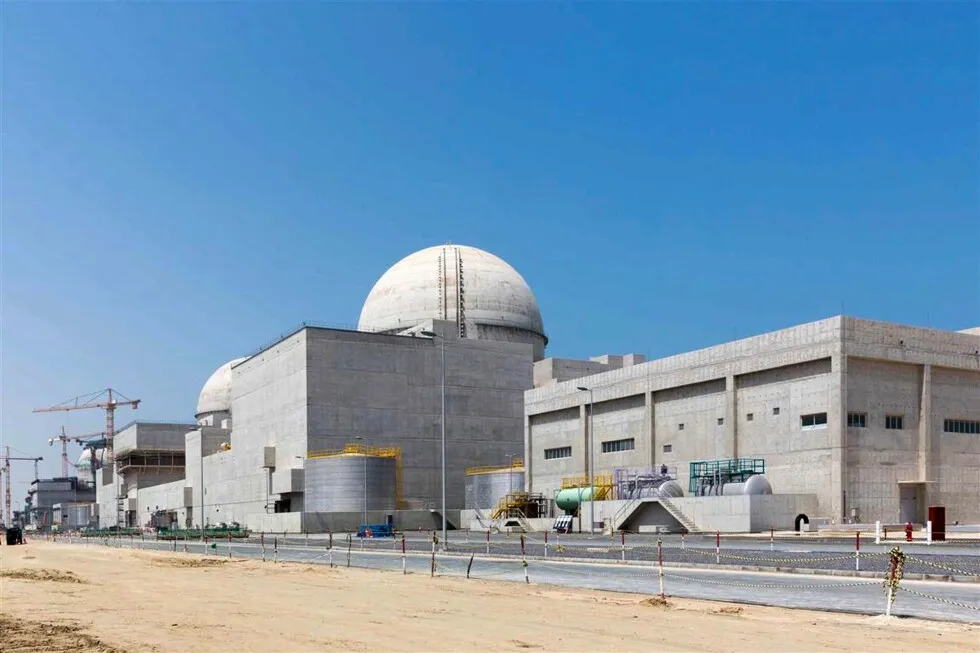
Associated Press (AP)FIG 01
Reading time
4min
Word count
910words
Sources cited
3cited
Entities identified
10entities
Quality score
100%
§ 01
Briefing Summary
AI-generatedNEWSAR · AI
The United Arab Emirates' Defense Ministry stated that drones targeting the Barakah nuclear power plant originated from Iraq, suggesting the involvement of Iranian-backed Shiite militias. The attack, which occurred on the facility's perimeter and hit a generator, caused no reported injuries or radiological release. This incident follows repeated drone attacks on Gulf Arab states, suspected to be linked to Iran. Saudi Arabia also reported intercepting drones from Iraqi airspace. The Barakah plant, the Arab world's only nuclear facility, was built with South Korean assistance and became operational in 2020. An Emirati diplomat criticized regional countries for their roles amidst what they described as Iranian aggression.
Confidence 0.90Sources 3Claims 5Entities 10
§ 02
Article analysis
Model · rule-basedFraming
National Security
Conflict
Tone
Measured
AI-assessed
CalmNeutralAlarmist
Factuality
0.70 / 1.00
Factual
LowHigh
Sources cited
3
Well sourced
FewMany
§ 03
Key claims
5 extracted01
There were no reported injuries or radiological release at Barakah after the attack.
factualEmirati officials
Confidence
0.95
02
U.S. President Trump is willing to give Iran a few days to make progress in peace negotiations before the United States resumes military strikes.
factualU.S. President Donald Trump
Confidence
0.90
03
Drones that targeted the UAE's Barakah nuclear power plant originated from Iraq.
factualUAE Defense Ministry
Confidence
0.90
04
Iraqi government spokesman issued a statement condemning strikes on UAE.
factualIraqi government spokesman Bassem al-Awadi
Confidence
0.85
05
The drone attack likely signals that Iranian-backed Shiite militias launched the assault.
factualAssociated Press (AP)
Confidence
0.70
§ 04
Full report
4 min read · 910 words§ 05
Entities
10 identifiedKey playerOppositionContextPositiveNeutralNegative
Organizations2
§ 06
Keywords & salience
10 termsbarakah nuclear power plant
1.00
iran
0.90
drones
0.80
united arab emirates
0.80
iraq
0.70
iranian-backed shiite militias
0.70
strait of hormuz
0.60
military strikes
0.50
peace negotiations
0.40
u.s. naval blockade
0.40
§ 07
Topic connections
Interactive graph Network visualization showing 51 related topics
View Full Graph Person Organization Location Event|Click node to navigate|Edge numbers = shared articles