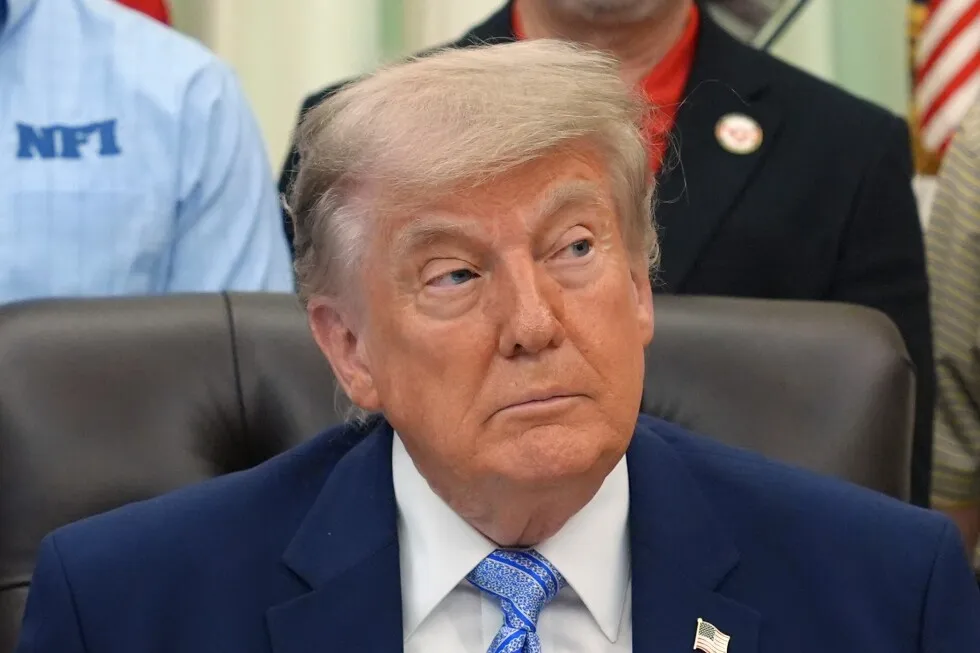
President Donald Trump attends an event about loosening a federal refrigerant rule, in the Oval Office at the White House, Thursday, May 21, 2026, in Washington. (AP Photo/Jacquelyn Martin) Updated [hour]:[minute] [AMPM] [timezone], [monthFull] [day], [year] WASHINGTON (AP) — President Donald Trump on Thursday said the U.S. will send an additional 5,000 troops to Poland, stirring confusion following weeks of changing statements from Trump and his administration about reducing — not increasing — the American military footprint in Europe.The Trump administration has said it was reducing levels in Europe by about 5,000 troops, and U.S. officials confirmed about 4,000 service members were no longer deploying to Poland. Trump’s social media announcement raises more uncertainty for European allies that have been blindsided by the changes as the administration has complained about NATO members not shouldering enough of the burden of their own defense and failing to do more to support the Iran war.“Based on the successful Election of the now President of Poland, Karol Nawrocki, who I was proud to Endorse, and our relationship with him, I am pleased to announce that the United States will be sending an additional 5,000 Troops to Poland,” Trump said on Truth Social. Trump and the Pentagon have said in recent weeks that they were drawing down at least 5,000 troops in Germany after Chancellor Friedrich Merz said the U.S. was being “humiliated” by the Iranian leadership and criticized what he called a lack of strategy in the war. Trump then told reporters at the beginning of the month that the U.S. would be “cutting a lot further than 5,000.” As of last week, some 4,000 troops from the Army’s 2nd Armored Brigade Combat Team, 1st Cavalry Division were no longer en route to Poland. The Associated Press reported that the canceled deployment was part of an effort to comply with Trump’s order to reduce the number of troops in Europe. A deployment to Germany of personnel trained to fire long-range missiles also was halted. Democratic and Republican lawmakers alike criticized the reductions as sending the wrong signal both to allies and Russian President Vladimir Putin during the 4-year-old war in Ukraine. Republican Rep. Don Bacon of Nebraska said during a congressional hearing that he spoke with Polish officials and they were “blindsided.” He called the decision “reprehensible” and said it was “an embarrassment to our country what we just did to Poland.”Chief Pentagon spokesman Sean Parnell said Tuesday that it was “a temporary delay” of the deployment of U.S. forces to Poland, which he called a “model U.S. ally.” He said it was a result of the U.S. reducing the number of brigade combat teams assigned to Europe from four to three and indicated the Pentagon still needed to decide which troops to station where.It was not clear whether that meant the brigade would resume its deployment to Poland, if additional troops on top of that rotational deployment could be added, or whether there would still be a drawdown of U.S. troops in Europe but from a different country. The Pentagon referred requests for comment to the White House, which did not immediately respond to messages seeking clarity.U.S. defense officials expressed confusion Friday about Trump’s new announcement. ‘’We just spent the better part of two weeks reacting to the first announcement, We don’t know what this means either,’' said one official. Both spoke on condition of anonymity to discuss sensitive military matters. Defense Secretary Pete Hegseth and Defense Undersecretary Elbridge Colby both spoke with their Polish counterparts this week. Polish Prime Minister Donald Tusk had said Wednesday that he was happy to hear “Washington’s declaration that Poland will be treated as it deserves.”As of Tuesday, U.S. Gen. Alexus Grynkewich, commander of both American and NATO forces in Europe, told reporters in Brussels that “it will be 5,000 troops coming out of Europe.”Trump’s announcement came as Secretary of State Marco Rubio was on his way to Sweden to meet with his NATO counterparts, who have been questioning the Trump administration’s policies on reduced U.S. troop levels in Europe.“There seems to be no process to deliberating policies like troop withdrawals and deployments at the top,” said Ian Kelly, a retired career diplomat who served as U.S. ambassador to Georgia during the Obama and first Trump administrations and now teaches international relations at Northwestern University in Illinois. Kelly said Rubio may have a tough time in explaining Trump’s wild swings to Europeans who are craving certainty and consistency even if they might disagree.“These are not well thought out decisions,” Kelly said. “These are impulsive decisions based on Trump’s whims or what his advisors think are Trump’s whims.”___ Associated Press writer Michelle L. Price and Emma Burrows in London contributed to this report.
SRCAssociated Press (AP)
LANGEN
LEANCenter
WORDS785
ENT12
FRI · 2026-05-22 · 07:23 GMTBRIEF NSR-2026-0522-78339
NSR-2026-0522-78339News Report·EN·Political Strategy
Trump says he’s sending 5,000 more troops to Poland, stirring confusion about US presence in Europe
President Donald Trump announced on social media that the U.S. will send an additional 5,000 troops to Poland.
By
BEN FINLEY and MATTHEW LEEAssociated Press (AP)Filed 2026-05-22 · 07:23 GMTLean · CenterRead · 4 min
Associated Press (AP)FIG 01
Reading time
4min
Word count
785words
Sources cited
5cited
Entities identified
12entities
Quality score
100%
§ 01
Briefing Summary
AI-generatedNEWSAR · AI
President Donald Trump announced on social media that the U.S. will send an additional 5,000 troops to Poland. This statement contradicts recent administration and Pentagon communications indicating a reduction of approximately 5,000 troops from Europe, including the cancellation of a deployment of 4,000 service members to Poland. The announcement has caused confusion among U.S. defense officials and European allies, who have expressed being blindsided by the shifting U.S. military posture in Europe. This comes amid broader complaints from the administration about NATO members not contributing enough to their own defense. Experts suggest these decisions appear impulsive and lack a clear process, creating uncertainty for allies.
Confidence 0.90Sources 5Claims 5Entities 12
§ 02
Article analysis
Model · rule-basedFraming
Political Strategy
National Security
Tone
Mixed Tone
AI-assessed
CalmNeutralAlarmist
Factuality
0.70 / 1.00
Factual
LowHigh
Sources cited
5
Well sourced
FewMany
§ 03
Key claims
5 extracted01
The Pentagon described the situation as a 'temporary delay' of deployment to Poland.
quoteSean Parnell (Pentagon spokesman)
Confidence
1.00
02
President Donald Trump announced the U.S. will send an additional 5,000 troops to Poland.
quoteDonald Trump
Confidence
1.00
03
Lawmakers criticized the troop reductions as sending the wrong signal to allies and Russia.
factualDemocratic and Republican lawmakers
Confidence
0.90
04
About 4,000 service members were no longer deploying to Poland as part of troop reduction efforts.
factualU.S. officials
Confidence
0.90
05
The Trump administration had previously stated it was reducing troop levels in Europe by about 5,000.
factualU.S. officials
Confidence
0.90
§ 04
Full report
4 min read · 785 words§ 05
Entities
12 identifiedKey playerOppositionContextPositiveNeutralNegative
People5
Organizations1
§ 06
Keywords & salience
10 termsus troops in europe
1.00
donald trump
0.90
poland troop deployment
0.90
military presence
0.80
nato allies
0.70
troop reduction
0.60
european defense burden
0.50
pentagon
0.50
ukraine war
0.40
iran war
0.40
§ 07
Topic connections
Interactive graph Network visualization showing 51 related topics
View Full Graph Person Organization Location Event|Click node to navigate|Edge numbers = shared articles