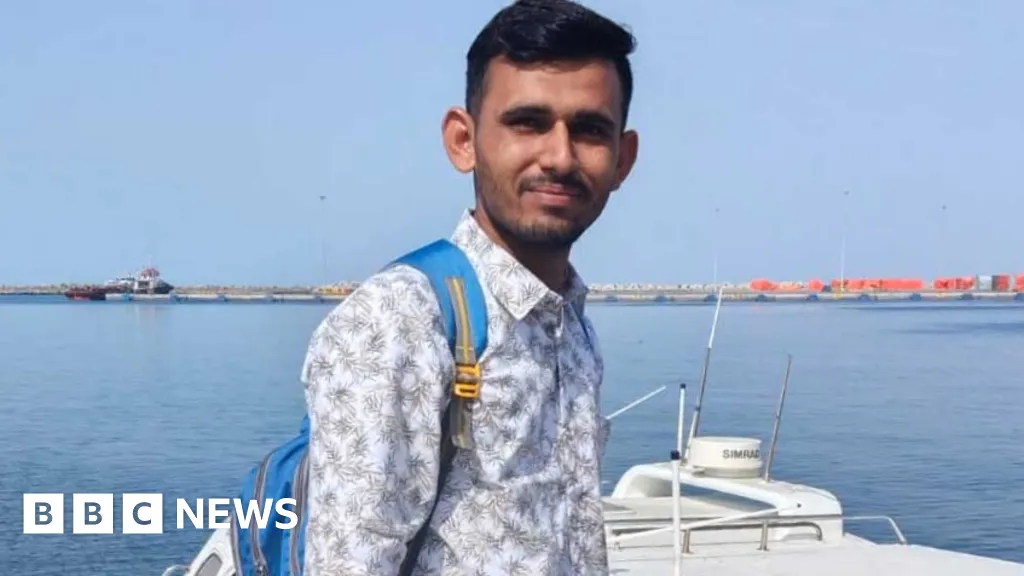
'He became like a brother'Family of Dalip RathoreDalip Rathore was working in the engine room of the Skylight when the ship was struckThe Oman Navy launched a rescue operation within an hour of the attack and pulled survivors from the water. But not everyone could be accounted for."As soon as I realised Dalip wasn't there, that's when it hit me," Sunil said. "I started panicking. I kept thinking: how will I answer to his family?"Dalip Rathore, 25, had joined Skylight the day after Sunil. India is one of the biggest suppliers of seafarers to the global shipping industry but Dalip and Sunil discovered they were from neighbouring villages in Rajasthan and soon became close friends."There were network issues on the ship, so we couldn't call home very often," Sunil said. "In those moments, Dalip was there for me. He became like a brother."Hours before the strike, Dalip had taken over Sunil's watch in the engine room - the area hit by the missile.Dalip and the ship's captain, Ashish Kumar, were both killed in the attack. While some of the captain's remains were recovered, Dalip's body has never been found.Stranded in the Strait of HormuzTheir story is part of a wider crisis that has been unfolding in the Strait of Hormuz. At the beginning of the war, Tehran swiftly responded to strikes by blocking the Strait and with it a crucial route for 20% of the world's oil and liquified natural gas.Maritime intelligence firm Kpler told BBC Verify 38 commercial vessels have been hit in and around the Strait since the start of the conflict. Their data shows 24 ships were hit by Iran and four by the US, with the rest unconfirmed.The war has left many hundreds of ships unable to get through the strait. More than 20,000 seafarers are currently stuck in the Gulf, according to the International Maritime Organization.Under maritime law, shipowners are responsible for the welfare and repatriation of their crews. If shipowners fail to act, responsibility can then fall to the vessel's flag state and, ultimately, port authorities.Many ship owners have been organising supplies for their crews who are stranded in the strait, using small boats to deliver food and essentials to vessels at anchorage. Others, however, have been left with very little.Since the conflict escalated, the the International Transport Workers' Federation (ITF), a union that supports seafarers in distress, says it has received more than 2,000 calls for help from people on a variety of commercial ships that have been trapped in and near the Strait.The problems include unpaid wages, contract disputes, difficulties getting home, and shortages of basic supplies such as food and water.Mohamed Arrachedi, the ITF's network coordinator for the Arab world and Iran, says some crews are effectively stranded at sea.He shared voice notes with the BBC from three seafarers currently anchored on a small boat off the coast of Oman.In the recordings, the men plead for help, saying they are running low on provisions and have not heard from the shipowner for months."Unfortunately, the industry as a whole has not succeeded in eradicating this cancer that is the abandonment of seafarers," said Arrachedi.The ITF defines abandonment as cases where shipowners walk away from crews, leaving them unpaid, stranded, and without essentials such as food, water or medical care. A total of 6,223 seafarers were abandoned across 409 ships last year. It's a small proportion of the 100,000-strong fleet of merchant vessels' operating around the world, but the union says it's a worrying trend.Rex PereiraRex Pereira was left onboard his ship for months David Loosley from Bimco, one of the world's largest international shipping associations, said that while the industry operates under international regulations, there are "isolated instances where standards are not fully upheld, with serious consequences for seafarer welfare"."Geopolitical conflicts significantly heighten the risks faced by those at sea," he added.While many seafarers stuck in the region have not been abandoned, the conflict has made an already precarious situation even more dangerous for those who are.Rex Pereira, 28, from Mumbai, was not on Skylight but was recruited by the same agents as Sunil. He said he had endured appalling conditions at sea for more than four months before the war broke out. He said their drinking water was contaminated with diesel, that much of the food they had to eat was expired, and shared pictures of dirty brown water that he said the crew were told to wash with.Despite his request to leave the vessel within days of boarding, he received no response to his calls for help. Rex PereiraRex Pereira took pictures of the water the crew had to wash with and drink Instead, he was kept at sea for months. When the war started he was stationed off the coast of Iraq and witnessed missiles being fired close by.By the time it was struck, Skylight was both uninsured and effectively stateless."Because there's no insurance, there would be no compensation," says Michelle Bockmann, a maritime analyst at Windward."You're left to the shipowner's conscience. Can you find the shipowner? Usually in these cases, they're nowhere to be seen. They deliberately structure ownership through layers of companies in countries where it's extremely difficult to identify who is ultimately behind the ship."For Dalip's family, the lack of insurance could have devastating consequences.Under maritime law, commercial vessels are required to carry insurance to cover crew deaths and injuries. Without it, families can struggle to secure compensation.According to Sunil, before boarding Skylight, he was told by a recruiting agent in India that the ship was insured."I was told that all the documents were in place and there is insurance," he said.Placing seafarers on an uninsured ship is a breach of maritime law.
SRCBBC News - World
LANGEN
LEANCenter
WORDS947
ENT12
SAT · 2026-05-23 · 23:24 GMTBRIEF NSR-2026-0524-78745
NSR-2026-0524-78745News Report·EN·Human Interest
I survived a missile strike in the Strait of Hormuz, but my friend has not been found
Sunil Puniya survived a missile strike on the oil tanker Skylight in the Strait of Hormuz, but his friend Dalip Rathore, 25, remains missing. The attack occurred at the start of the Iran war, which has disrupted shipping in the crucial Strait.
BBC News - WorldFiled 2026-05-23 · 23:24 GMTLean · CenterRead · 4 min
BBC News - WorldFIG 01
Reading time
4min
Word count
947words
Sources cited
3cited
Entities identified
12entities
Quality score
100%
§ 01
Briefing Summary
AI-generatedNEWSAR · AI
Sunil Puniya survived a missile strike on the oil tanker Skylight in the Strait of Hormuz, but his friend Dalip Rathore, 25, remains missing. The attack occurred at the start of the Iran war, which has disrupted shipping in the crucial Strait. The Oman Navy rescued survivors, but Rathore's body was not recovered. The conflict has led to hundreds of commercial vessels being hit and over 20,000 seafarers stranded in the Gulf, facing issues like unpaid wages and shortages of supplies. While shipowners are responsible for crew welfare, some have failed to act, leading to seafarers being effectively abandoned at sea, a problem the International Transport Workers' Federation is addressing.
Confidence 0.90Sources 3Claims 4Entities 12
§ 02
Article analysis
Model · rule-basedFraming
Human Interest
Conflict
Tone
Mixed Tone
AI-assessed
CalmNeutralAlarmist
Factuality
0.70 / 1.00
Factual
LowHigh
Sources cited
3
Well sourced
FewMany
§ 03
Key claims
4 extracted01
Dalip Rathore and Captain Ashish Kumar were killed in a missile strike on the ship Skylight in the Strait of Hormuz.
factual
Confidence
1.00
02
The International Transport Workers' Federation has received over 2,000 calls for help from trapped seafarers.
statisticInternational Transport Workers' Federation
Confidence
0.90
03
More than 20,000 seafarers are currently stuck in the Gulf due to the conflict.
statisticInternational Maritime Organization
Confidence
0.90
04
38 commercial vessels have been hit in and around the Strait of Hormuz since the start of the conflict.
statisticKpler
Confidence
0.90
§ 04
Full report
4 min read · 947 words§ 05
Entities
12 identifiedKey playerOppositionContextPositiveNeutralNegative
Organizations5
§ 06
Keywords & salience
10 termsstrait of hormuz
1.00
missile strike
0.90
seafarers
0.90
maritime crisis
0.80
global shipping industry
0.70
oil and liquified natural gas
0.60
commercial vessels
0.50
rescue operation
0.50
maritime law
0.40
international transport workers' federation
0.40
§ 07
Topic connections
Interactive graph Network visualization showing 51 related topics
View Full Graph Person Organization Location Event|Click node to navigate|Edge numbers = shared articles