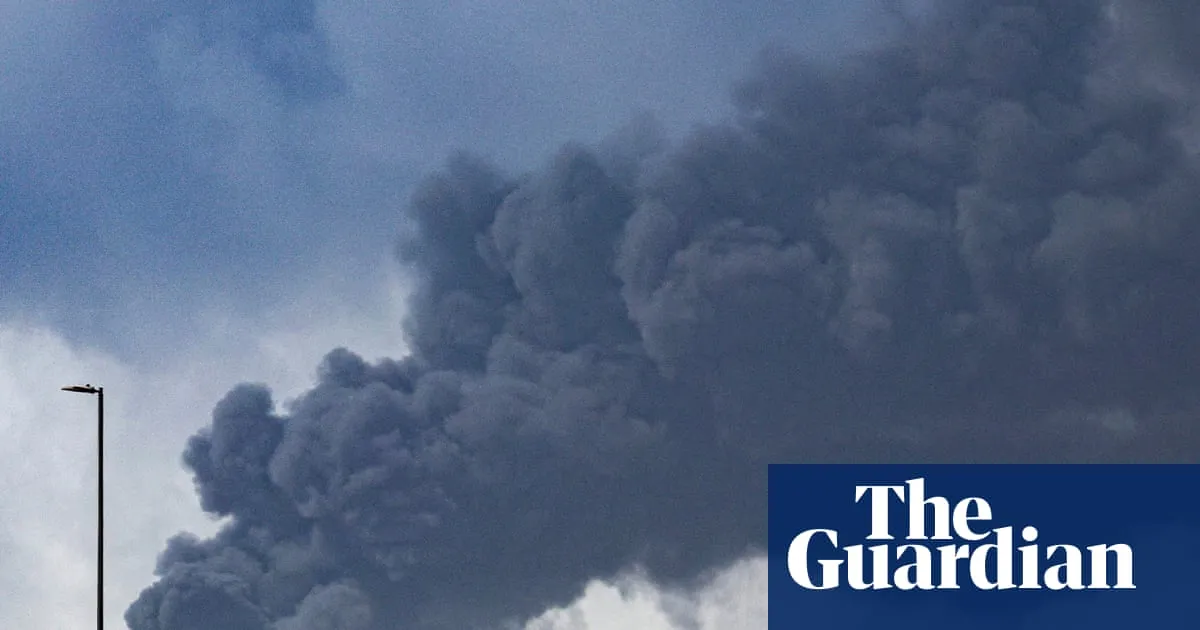
Smoke rises above Jebel Ali port in Dubai on 1 March. Experts say the Gulf was shocked at the extent to which the US protected Israel first against Iranian attacks. Photograph: EPA View image in fullscreen Smoke rises above Jebel Ali port in Dubai on 1 March. Experts say the Gulf was shocked at the extent to which the US protected Israel first against Iranian attacks. Photograph: EPA Analysis Shock of Iran-war" class="entity-link entity-event" data-entity-id="38748" data-entity-type="event">Iran war unites Middle East rivals in pushing Trump towards peace Saeed Shah in Islamabad Region adapting to diminished US power after Washington fails to land knockout blow on Tehran or safeguard allies The shock of the Iran-war" class="entity-link entity-event" data-entity-id="38748" data-entity-type="event">Iran war and its fallout has driven rivals in the Middle East to get behind a peace deal, pushing the Trump administration to accept a tentative agreement in the face of furious opposition from Israel and its supporters in Washington. The diplomatic efforts come as the region is reshaping to adapt to diminished US power after Washington’s inability to land a knockout blow on Iran, force the opening of the Strait of Hormuz or safeguard its Gulf allies. Tehran has few friends in the region, but the regime’s survival has meant that its neighbours have had to find an accommodation. Andreas Krieg, an associate professor at Kings College London, said the Gulf was shocked at the degree to which Washington protected Israel first against Iranian drones and missiles, despite the trillions of dollars of Gulf investment pouring into the US. “We’re probably seeing the final days of American empire in the Middle East,” he said. “Across the Gulf, there is complete disillusionment with American influence and the ability of America to lead.” The provisional deal was agreed at the end of last week after Pakistani and Qatari officials travelled to Iran in a final push for an outline agreement between Tehran and Washington. In a call with Trump on Saturday, leaders from a group of eight Muslim-majority nations urged him to accept a deal that would end the war, reopen the Strait of Hormuz, and relaunch negotiations on Iran’s nuclear programme. The same countries lost the argument in Washington to the Benjamin Netanyahu before the war, but now they have managed to outweigh the Israeli prime minister – who spoke to Trump on the same day – with the US president declaring that the deal was “largely negotiated”. Trump said last week that Netanyahu “will do whatever I tell him to do” on Iran. An analysis piece published on Monday in the Times of Israel was headlined: “Israel began the Iran-war" class="entity-link entity-event" data-entity-id="38748" data-entity-type="event">Iran war as a partner of the US — and is ending it on the sidelines”. The United Arab Emirates, which had reportedly urged fellow Gulf countries to join the war against Iran and carried out its own airstrikes, swung behind the peace deal alongside Saudi Arabia, Qatar, Jordan, Bahrain, Pakistan, Turkey and Egypt. The regional consensus-building process appeared to repair some of the bitter rivalry for influence between the UAE and Saudi Arabia, with several phone calls between their rulers taking place in recent weeks. View image in fullscreen An anti-US billboard in Tehran Donald Trump and the Strait of Hormuz. Photograph: Abedin Taherkenareh/EPA Masood Khan, a former Pakistani ambassador to the US, said Islamabad’s success had been bringing other countries into the peace process. Turkey, Egypt, Saudi Arabia and Qatar worked their own channels in support of the effort. “Pakistan could not have taken a solo flight,” he said. “It needed to cover its flanks to make its mediation much more credible.” The US presence in the Middle East, spread across more than a dozen bases, is expected to remain. But countries are reaching out to additional security partners in the region and beyond, with Europe set to take a bigger role. During the war, Pakistan sent troops and fighter jets to defend Saudi Arabia, while Egyptian soldiers and planes were stationed in the UAE, Cairo’s biggest financial backer. There is also talk of striking non-aggression agreements with Iran. Abdul Khaleq Abdullah, a political science professor in the UAE, said his country had wanted to see Iran with no missiles and drones, no proxies and no nuclear activity, but that ultimately proved unattainable. “The UAE is a very pragmatic country,” he said. “Iran remains a big menace, but it is no longer the imperial Iran that we’ve seen over the last 20 years.” He said a new Middle East was emerging with Turkey, Israel and the Gulf states competing to fill the vacuum left by a weakened Tehran. One emerging axis centres on Saudi Arabia and Pakistan, which signed a mutual defence pact last year. There have been talks to bring Turkey, Qatar and Egypt into that arrangement, which has been called a “Muslim Nato”. On the other side is an alliance between the UAE, India, Israel and the US, known as the I2U2 group. HA Hellyer, a senior associate fellow at the Royal United Services Institute thinktank in London, said the region had calculated that regime change in Tehran was too risky because it could bring a collapse of the state and chaos, something that only Israel wanted. It had also become clear to Trump that the war would not deliver what he wanted, so the region did not so much persuade him to accept a deal as allowed him to say that he had overwhelming regional support, he said. “This is no longer a defence architecture built solely around the United States. Gulf states are increasingly preparing for the possibility that Washington may not be there when they need it most,” Hellyer said. Explore more on these topics US-Israel war on Iran Iran US foreign policy United Arab Emirates Saudi Arabia Qatar Jordan analysis Share Reuse this content
SRCThe Guardian - World News
LANGEN
LEANCenter-Left
WORDS960
ENT12
MON · 2026-05-25 · 13:06 GMTBRIEF NSR-2026-0525-79037
NSR-2026-0525-79037Analysis·EN·Conflict
Shock of Iran war unites Middle East rivals in pushing Trump towards peace
Following a recent Iran war, Middle Eastern rivals have united to push for a peace deal, influencing the Trump administration to accept a tentative agreement despite Israeli opposition. This shift reflects a regional adaptation to diminished US power, evidenced by Washington's inability to decisively impact Iran or fully protect its allies.
Saeed Shah in IslamabadThe Guardian - World NewsFiled 2026-05-25 · 13:06 GMTLean · Center-LeftRead · 4 min
The Guardian - World NewsFIG 01
Reading time
4min
Word count
960words
Sources cited
2cited
Entities identified
12entities
Quality score
100%
§ 01
Briefing Summary
AI-generatedNEWSAR · AI
Following a recent Iran war, Middle Eastern rivals have united to push for a peace deal, influencing the Trump administration to accept a tentative agreement despite Israeli opposition. This shift reflects a regional adaptation to diminished US power, evidenced by Washington's inability to decisively impact Iran or fully protect its allies. The survival of the Iranian regime has compelled its neighbors to seek accommodation. Pakistani and Qatari officials played a key role in facilitating the outline agreement between Tehran and Washington. Several Muslim-majority nations urged President Trump to accept the deal, which aims to end the war, reopen the Strait of Hormuz, and restart nuclear program negotiations. This regional consensus-building appears to be mending rivalries, with countries like the UAE and Saudi Arabia now supporting the peace initiative.
Confidence 0.90Sources 2Claims 5Entities 12
§ 02
Article analysis
Model · rule-basedFraming
Conflict
Diplomatic
Tone
Mixed Tone
AI-assessed
CalmNeutralAlarmist
Factuality
0.40 / 1.00
Mixed
LowHigh
Sources cited
2
Limited
FewMany
§ 03
Key claims
5 extracted01
Andreas Krieg believes this marks the final days of American empire in the Middle East due to disillusionment.
quoteAndreas Krieg
Confidence
1.00
02
Andreas Krieg states the Gulf was shocked by the US prioritizing Israel's protection over Gulf investments.
quoteAndreas Krieg
Confidence
1.00
03
A provisional deal was agreed after Pakistani and Qatari officials met with Iran.
factual
Confidence
0.80
04
The shock of the Iran war has driven Middle East rivals to push for a peace deal, influencing the Trump administration.
factual
Confidence
0.80
05
The region is adapting to diminished US power after Washington's inability to defeat Iran or safeguard allies.
factual
Confidence
0.70
§ 04
Full report
4 min read · 960 words§ 05
Entities
12 identifiedKey playerOppositionContextPositiveNeutralNegative
People3
Locations8
§ 06
Keywords & salience
8 termsiran war
1.00
middle east peace
0.90
us power
0.80
strait of hormuz
0.70
iran nuclear program
0.60
gulf allies
0.50
us-iran relations
0.50
american empire
0.40
§ 07
Topic connections
Interactive graph Network visualization showing 51 related topics
View Full Graph Person Organization Location Event|Click node to navigate|Edge numbers = shared articles