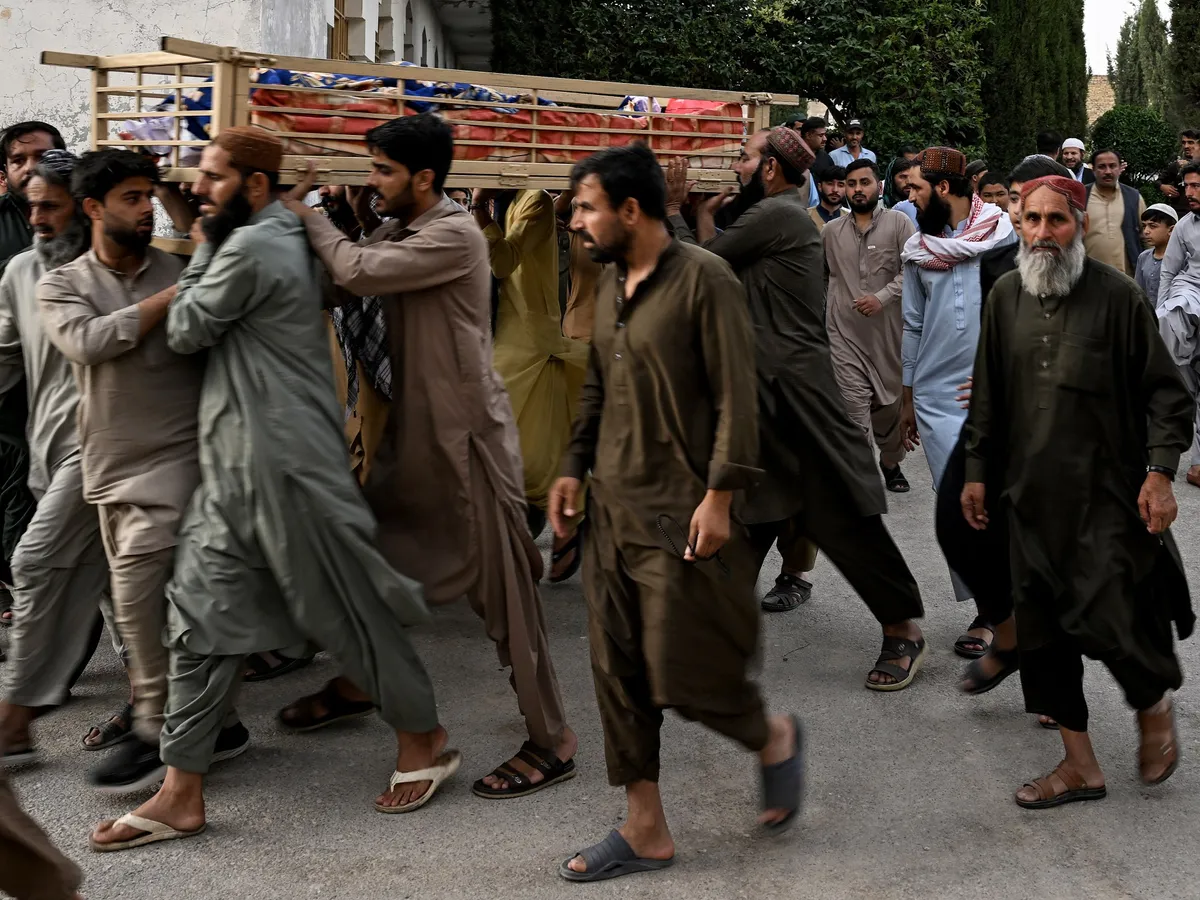
EXPLAINERDeadly blast in Pakistan marks uptick in Balochistan separatist violence.Published On 25 May 2026At least 24 people were killed and more than 50 injured when a suicide car bomb detonated on a train carrying soldiers in Quetta, capital of the southwestern Pakistani province of Balochistan, on Sunday.The attack came amid Pakistan’s Prime Minister Shehbaz Sharif’s four-day visit to China, and the day before his meeting in Beijing with China’s President Xi Jinping, marking 75 years of diplomatic ties between the two nations.Pakistan is among an exclusive group of countries China regards as an “all-weather strategic partner”, with ties featuring close economic, trade and security cooperation.Responsibility for the train attack was claimed by the Balochistan-liberation-army" class="entity-link entity-organization" data-entity-id="133087" data-entity-type="organization">Balochistan Liberation Army (BLA), an armed Baloch separatist group which, apart from calling for an independent state, also strongly objects to large-scale Chinese investment in the region.While the BLA has long carried out attacks that have killed civilians and members of the security forces in Balochistan and beyond, there has been a recent uptick in such incidents.We examine what is behind this increase in attacks:What happened in Sunday’s attack?Reporting from the scene, Al Jazeera’s Kamal Hyder said several houses and buildings adjacent to the railway line were severely damaged in the blast, which caused train carriages to overturn and catch fire.According to local media reports, a state of emergency was declared at public hospitals in Quetta, with doctors and other medical staff ordered to remain on duty.Footage shared online showed charred vehicles and train carriages lying on their sides, with thick plumes of black smoke rising into the sky.Pakistan has experienced several attacks by separatist groups in recent months. The attacks have increased in ferocity and have also targeted Chinese workers amid protests over Beijing-backed infrastructural projects in Balochistan.As part of the China-Pakistan-economic-corridor" class="entity-link entity-organization" data-entity-id="117221" data-entity-type="organization">China-Pakistan Economic Corridor project – one of the main arms of China’s “Belt and Road Initiative” designed to improve trading routes – China’s Xinjiang region has been connected to Pakistan’s deep-sea Gwadar port on the Arabian Sea in Balochistan.Pakistani Prime Minister Sharif condemned Sunday’s train attack in Quetta in a post on X.“Such cowardly acts of terrorism cannot weaken the resolve of the people of Pakistan. We remain steadfast in our determination to eliminate terrorism in all its forms and manifestations,” he said.He added that while initial reports indicated a suicide bombing, this has not been officially confirmed. If it is, Yunas Samad, an emeritus professor of South Asian Studies at the University of Bradford in the UK, told Al Jazeera, “this would reflect tactics that insurgent organisations in the region have increasingly adopted over recent years”.“There are also persistent claims regarding the circulation of sophisticated weaponry originating from stockpiles left behind after the US withdrawal from Afghanistan,” he said.Are we seeing a new phase of armed separatist attacks in Balochistan?According to research gathered by the independent, Islamabad-based think tank Pakistan Institute for Peace Studies, Balochistan recorded at least 254 attacks in 2025 – roughly 26 percent more than in 2024.A December 2025 report published by independent conflict monitor Armed Conflict Location and Event Data (ACLED) found that separatists had also intensified attacks and pressure on security forces. The report said the number of attacks using improvised explosive devices (IEDs) and grenades, mainly targeting convoys and police stations, grew by more than 65 percent in the first 11 months of 2025, compared to the same time period in 2024.The Global Terrorism Index (GTI) report this year found that there has been more Baloch armed group activity in Pakistan in 2025 as well. The GTI is an annual report published by the Australia-based independent think tank Institute for Economics and Peace (IEP).Its 2026 report states that the BLA was responsible for Pakistan’s largest terror attack of 2025 – when the Jaffar Express, a train travelling from Quetta to Peshawar, was hijacked in March.The BLA claimed responsibility and reported that six military personnel had been killed. Hundreds of people were taken hostage from the train, which was carrying 400 passengers.“What can reasonably be said is that, following the earlier coordinated attack on the Jaffar Express, the Pakistani authorities appear to have intensified security measures around transport infrastructure, military personnel and key lines of communication,” Samad, of Bradford University, told Al Jazeera.“The fact that this latest incident nevertheless occurred may suggest that militant groups retain a significant operational capability despite those efforts,” he noted.The group stunned Pakistan’s security establishment in 2022 when it stormed army and navy bases. In August 2024, militants carried out coordinated attacks across Balochistan, including highway assaults in which passengers were pulled from buses and shot after identity checks.“While statistics in such conflicts are always contested and should be treated cautiously, they do indicate that the intensity of the conflict has not significantly diminished,” Samad said.“Whether this constitutes an entirely ‘new phase’ is perhaps too strong a conclusion at present. However, it does appear to indicate a degree of resurgence in militant capability and confidence among sections of the Baloch insurgency.”Who are the BLA and major Baloch armed groups?The BLA, which has a suicide squad called the Majeed Brigade, says it is fighting for the independence of Balochistan, a province located in Pakistan’s southwest and bordering Afghanistan to the north and Iran to the west.It is the largest of several ethnic separatist groups that have been fighting the federal government for decades. Balochistan’s mountainous border region serves as a safe haven and training ground for both Baloch separatist fighters and Islamist armed groups.The BLA often targets infrastructure and security forces in Balochistan, but has also struck in other areas – most notably the southern port city of Karachi.The BLA has deployed women suicide bombers, including in an attack on Chinese nationals in Karachi, and was designated a “foreign terrorist organisation” by the United States in August 2025 in a move welcomed by the Pakistani government. Analysts say BLA is particularly known for its ability to recruit young, often well-educated fighters.The group, separately, was at the centre of tit-for-tat strikes in 2024 between Iran and Pakistan over what each said were armed group bases on each other’s territory, which brought the neighbours to the brink of war.What is the Baloch cause?Home to about 15 million of Pakistan’s roughly 240 million people, according to the 2023 census, Balochistan is the country’s poorest region despite its wealth of natural resources, including coal, gold, copper and gas.These resources generate significant revenue for the federal government – unfairly, according to the BLA, which wants Balochistan’s natural wealth to belong to its people and rejects federal control over resource extraction and security.The province is Pakistan’s largest by area, but smallest by population. It has a long Arabian Sea coastline, not far from the Gulf’s Strait of Hormuz oil shipping lane.Balochistan is also home to one of Pakistan’s major deep-sea ports at Gwadar, a crucial trade corridor for China’s $65bn investment in the China-Pakistan-economic-corridor" class="entity-link entity-organization" data-entity-id="117221" data-entity-type="organization">China-Pakistan Economic Corridor (CPEC), a wing of President Xi Jinping’s Belt and Road Initiative.The province is home to key mining projects, including Reko Diq, which is operated by Canadian mining giant Barrick Gold and is believed to be one of the world’s largest gold and copper mines.China also operates a gold and copper mine in Balochistan.The province – which was annexed by Pakistan in 1948, six months after partition from India in August 1947 – has a long history of marginalisation. It has since experienced at least five separatist uprisings.Separatist sentiment was particularly high in the 2000s, around the time the BLA emerged. Analysts of Baloch resistance movements say it was led by Balach Marri, the son of veteran Baloch nationalist leader Nawab Khair Bakhsh Marri.After the government of military ruler Pervez Musharraf killed prominent Baloch nationalist leader Nawab Akbar Bugti in 2006, the separatist movement escalated.Rebel fighters have targeted Pakistan’s army and Chinese interests, in particular the strategic port of Gwadar on the Arabian Sea, accusing Beijing of helping Islamabad to exploit the province. Fighters have killed Chinese citizens working in the region and attacked Beijing’s consulate and language centre in Karachi.More recently, the BLA has also attacked civilians and migrant labourers from other provinces, a shift that officials say marks an escalation in tactics.Pakistan accuses India and Afghanistan of backing Baloch armed fighters, an allegation both countries deny.“Baloch separatist groups themselves have, at times, sought to internationalise their cause and last year publicly appealed for diplomatic recognition by India,” Samad said.“However, establishing clear evidence of direct state support is considerably more difficult, and much of the discussion in this area remains politically contested.”Hundreds of Baloch activists, many of them women, have protested in Islamabad and Balochistan over alleged abuses by security forces – accusations the government denies.Over time, the BLA has set itself apart as a group explicitly committed to Balochistan’s full independence from Pakistan. Unlike more moderate Baloch nationalist parties, which press politically for greater provincial autonomy, the BLA has consistently rejected compromise.Why is this significant now?Regional stability and international investmentThe attack comes as Prime Minister Sharif meets with China’s President Xi in Beijing to discuss economic and security cooperation – something the BLA is strongly opposed to.The movement could pose a challenge to Pakistan’s attempts to retain Chinese and American investment, experts say, if it reveals a deeper instability.The Baloch separatist movement is one of the major unresolved questions over Pakistan’s statehood. It is a constant reminder of the challenges of the Pakistani state to stay united, they say.“More broadly, the persistence of insurgency has had implications for Pakistan’s wider political system,” Samad explained. “Security concerns in Balochistan have increasingly shaped governance and political discourse, strengthening the role of the military and security establishment in national affairs and undermining the democratisation process.”“Internationally, the issue matters because Pakistan remains a nuclear-armed state of enormous strategic importance,” Samad told Al Jazeera.“While speculation about state fragmentation is highly premature, any significant escalation in internal instability in a country with nuclear capabilities inevitably attracts international concern. For that reason alone, developments in Balochistan are likely to remain closely watched both regionally and globally.”Another major issue is that geological assessments suggest Balochistan contains 12 of the 17 rare-earth minerals on the periodic table. Rare earths are critical minerals used to manufacture a vast array of modern items, including batteries, clocks, wiring, military hardware, smartphones and semiconductors, among other technological products.Since the start of his second term, US President Donald Trump has repeatedly pushed plans to diversify Washington’s stockpile of critical minerals in order to reduce reliance on China, which currently dominates the supply and processing of the world’s rare-earth minerals.When Pakistan’s Prime Minister Sharif met with Trump at the White House in September 2025, he offered the US access to critical minerals and rare earths.Then, in December 2025, the US announced a $1.25bn investment in critical minerals mining at Reko Diq to drive “economic growth in Balochistan”.
SRCAl Jazeera
LANGEN
LEANCenter
WORDS1 798
ENT12
MON · 2026-05-25 · 15:43 GMTBRIEF NSR-2026-0525-79087
NSR-2026-0525-79087Analysis·EN·Conflict
Train bomb in Pakistan’s Baloch region: Why violence is on the rise
A deadly suicide car bomb attack on a train in Quetta, Balochistan, killed at least 24 people and injured over 50. The Balochistan Liberation Army (BLA), a separatist group, claimed responsibility.
Sarah ShamimAl JazeeraFiled 2026-05-25 · 15:43 GMTLean · CenterRead · 8 min
Al JazeeraFIG 01
Reading time
8min
Word count
1 798words
Sources cited
2cited
Entities identified
12entities
Quality score
100%
§ 01
Briefing Summary
AI-generatedNEWSAR · AI
A deadly suicide car bomb attack on a train in Quetta, Balochistan, killed at least 24 people and injured over 50. The Balochistan Liberation Army (BLA), a separatist group, claimed responsibility. This incident marks an uptick in violence by Baloch separatist groups, who oppose Chinese investment in the region, particularly under the China-Pakistan Economic Corridor project. Research indicates a significant increase in attacks by Baloch armed groups in 2025 compared to the previous year, with a rise in IED and grenade attacks targeting security forces. The BLA was also responsible for a major terror attack in 2025 involving a train hijacking. Despite intensified security measures, the attack suggests militant groups retain significant operational capabilities.
Confidence 0.90Sources 2Claims 5Entities 12
§ 02
Article analysis
Model · rule-basedFraming
Conflict
Diplomatic
Tone
Mixed Tone
AI-assessed
CalmNeutralAlarmist
Factuality
0.70 / 1.00
Factual
LowHigh
Sources cited
2
Limited
FewMany
§ 03
Key claims
5 extracted01
The Balochistan Liberation Army (BLA), a Baloch separatist group, claimed responsibility for the train attack.
factual
Confidence
0.90
02
A suicide car bomb detonated on a train carrying soldiers in Quetta, Balochistan, killing at least 24 people and injuring over 50.
factual
Confidence
0.90
03
The attacks are linked to protests over Beijing-backed infrastructural projects in Balochistan, such as the China-Pakistan Economic Corridor.
factual
Confidence
0.80
04
There has been a recent uptick in attacks by separatist groups in Balochistan, which have increased in ferocity and targeted Chinese workers.
factual
Confidence
0.80
05
If the attack was a suicide bombing, it would reflect tactics increasingly adopted by insurgent organizations in the region.
quoteYunas Samad
Confidence
0.70
§ 04
Full report
8 min read · 1 798 words§ 05
Entities
12 identifiedKey playerOppositionContextPositiveNeutralNegative
People3
Organizations3
Locations4
§ 06
Keywords & salience
10 termsbalochistan separatist violence
1.00
train attack
0.90
balochistan liberation army
0.80
china-pakistan economic corridor
0.70
chinese investment
0.60
belt and road initiative
0.50
terrorism
0.50
shehbaz sharif
0.40
xi jinping
0.40
quetta
0.40
§ 07
Topic connections
Interactive graph Network visualization showing 6 related topics
View Full Graph Person Organization Location Event|Click node to navigate|Edge numbers = shared articles