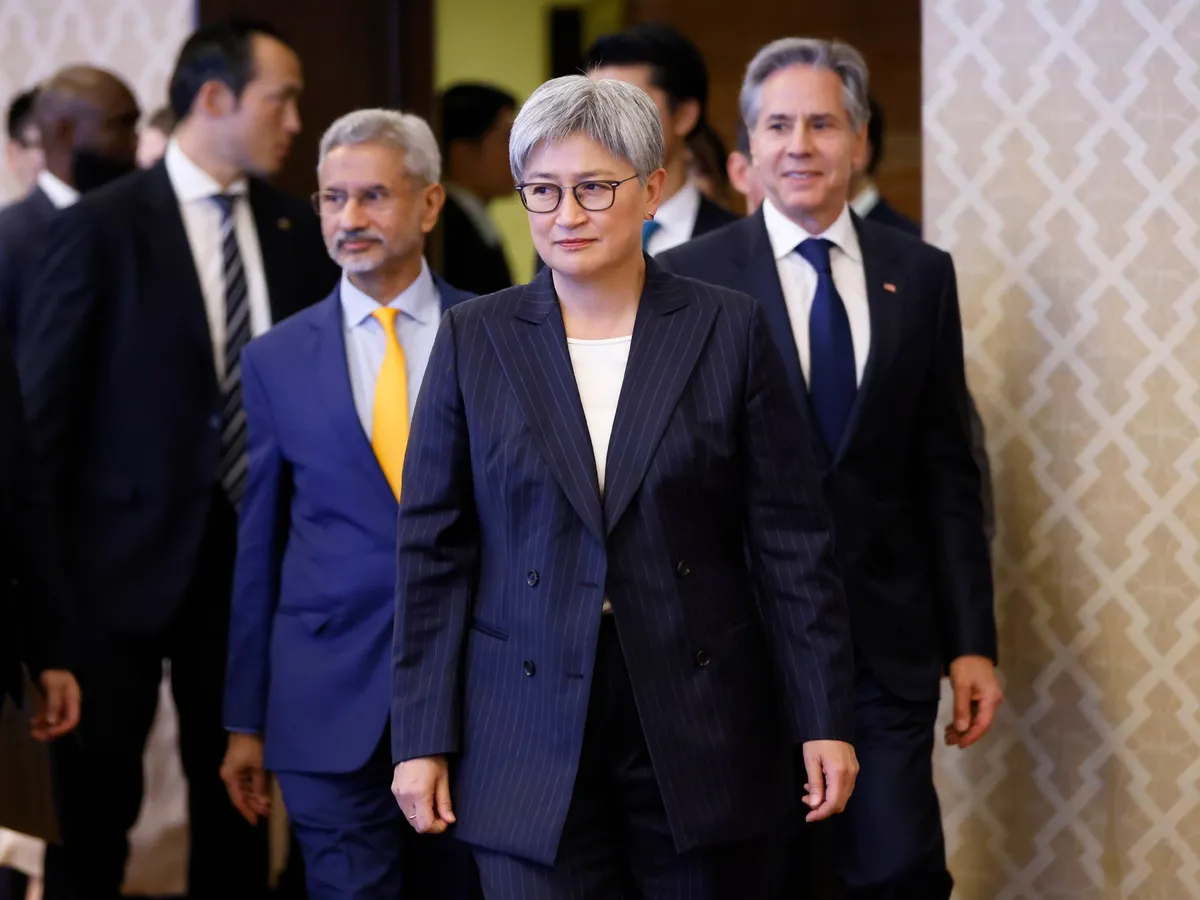
As Washington courts Beijing and shifts military focus away from Asia, analysts across the region say the Quad is increasingly struggling to define its purpose.Officials from Australia, India and the US arrive for a Quad meeting in Tokyo, Japan, on July 29, 2024 [Kiyoshi Ota/Pool via Getty Images]Published On 26 May 2026As the foreign ministers of India, Japan and Australia lined up with US Secretary of State Marco Rubio for a “family photograph” at the start of a meeting in New Delhi on Tuesday, their body language was stiff, with only the top Indian diplomat, S Jaishankar, trying to smile.Their grouping — the Quadrilateral Security Dialogue alliance, better known as the Quad — has not been very different in recent months. For nearly two decades, multiple iterations of the Quad have attempted to forge a collective plan to counterbalance China’s rise in the Asia Pacific.Recommended Stories list of 4 itemslist 1 of 4Pentagon downplays China threat: What it means for US allieslist 2 of 4Japan builds up its ‘southern shield’ as faith in US security cover falterslist 3 of 4Japan PM says oil crisis having ‘enormous impact’ in Asia Pacificlist 4 of 4US Secretary of State kicks off India visit, invites Modi to White Houseend of listBut under US President Donald Trump’s second term, starting January 2025, the coalition has sputtered, say analysts, with Washington pivoting away from the region as its top priority back to the Western Hemisphere and the Middle East.The United States began shifting its armada from the Asia Pacific to the Middle East at the outset of its war on Iran alongside Israel in February. Then, during Epic Fury — the US military operation launched on February 28 against Iran — US forces spent more than half of their pre-war stockpile of four critical munitions, alarming US allies in Asia that recognised they could no longer count on Washington to come to their military defence in the event of a war.Meanwhile, came the detente between Trump and his Chinese counterpart, Xi Jinping, marked by a growing rapprochement between the two powers through trade deals, and the first visit by a US president to China in nearly a decade.These developments have rattled Quad countries, say analysts, raising questions over its future, even as the top diplomats of the grouping try to revive its relevance in New Delhi.“It is essentially damage control,” Umi Ariga, an analyst at the Japan Institute for International Affairs, told Al Jazeera.‘Uneven alignment’First formed in 2007 and revived in 2017 with the aim of countering China’s rise, the Quad’s cohesion has since waxed and waned amid shifting US priorities.A planned leader-level Quad meeting in New Delhi last year failed to materialise amid diplomatic tensions and competing priorities. In June 2025, Indian Prime Minister Narendra Modi personally invited Trump to the summit.A year later, Trump is yet to visit, and there is no clarity on when the summit will be held.This week’s gathering, meanwhile, follows US Secretary of State Marco Rubio’s visit to India — a last-ditch attempt to reinvigorate the alliance, some analysts say.But as Washington courts Beijing and shifts military focus away from Asia, analysts across the region say the Quad is increasingly struggling to define its purpose.The Tuesday meeting of the Quad is “an attempt to agree on a summit date before the grouping slides into irrelevance”, Ariga said.Meanwhile, Beijing-based political analyst Einar Tangen said Rubio’s visit to India before the meeting was, in itself, telling.“From Beijing’s perspective, Rubio’s trip reveals Washington’s underlying anxiety. If the Quad was fully confident and strategically aligned, reassurance would not be necessary,” he told Al Jazeera.Tangen said Beijing interpreted the Trump-Xi summit as a diplomatic asymmetry — one that made Washington’s scramble to reassure its partners all the more transparent.“After Trump appeared eager to stabilise relations with Beijing, Washington suddenly needed to convince its partners that America had not abandoned the Indo-Pacific,” he said.Trump needed the appearance of engagement with Xi more than the Chinese leader needed him, Tangen said. In Beijing’s reading, China gave Trump “ceremony and symbolism”, but not the “strategic concessions” Washington was looking for, he said.“That perception matters because it helps explain why Rubio was dispatched afterward to reassure India, Japan, and Australia that the Quad still matters and that Washington remains committed to Indo-Pacific balancing,” he said.The Quad additionally suffers from a structural problem that goes beyond any single summit. The alliance is highly informal, with no formal treaty, no permanent secretariat and no binding mutual defence commitments.A lack of leadership and a more disengaged Washington have ultimately eroded the Quad’s strategic coherence, argued Ariga.“No leaders’ summit was held in 2025. Trump has never attended one, and neither has Japan’s Takaichi,” she noted, referring to Prime Minister Sanae Takaichi.“The grouping has been essentially leaderless at the top level for over a year.”The Quad has pursued low-risk initiatives such as vaccines, critical technologies, supply chains, and maritime domain awareness, which the Japanese analyst said are “useful at the margins, but they cannot conceal the absence of collective political will”.“These are worthwhile, but they are second-order achievements for a grouping conceived as a strategic bulwark,” said Ariga.The key question, one that Tuesday’s meeting will not resolve, is whether the Quad retains a coherent purpose if its leading member is simultaneously seeking accommodation with the power it was designed to counterbalance, said the Japanese analyst.The grouping received only a single passing mention in Trump’s National Security Strategy unveiled in late 2025, she said.“That marginalisation would have been unthinkable two years ago,” Ariga said.Tangen said Beijing has drawn its own conclusions from this drift. For years, China viewed it as an “Asian NATO” in the making.“Beijing’s assessment of the Quad has evolved from viewing it as a potentially unified anti-China coalition into seeing it as a structurally uneven alignment held together primarily by concern over China rather than by deep internal unity,” he said.“China increasingly doubts whether the four countries share the same long-term strategic vision or level of commitment.”As US forces leave Asia, fears grow within the QuadThe redeployment of US forces and warships from the Asia Pacific to the Middle East has further deepened unease within the bloc.When Washington moved troops from Japan to the Middle East, Tokyo saw it as a removal of a direct check on Chinese power at a time when Beijing is conducting large-scale military exercises around Taiwan, said Ariga.“The troop redeployment and the Beijing summit together create compounding perception risks,” she said.One of Japan’s responses has been to work the phones after the Trump-Xi summit. Prime Minister Takaichi got in touch with Trump within days, the Japan analyst explained.“The speed of that call reflects how anxiously Tokyo is monitoring every signal from Washington,” said Ariga.Tangen said Chinese strategists view Trump’s unpredictability as an unintended strategic gift.“He has made America’s alliance system appear conditional, negotiable, and transactional rather than permanent and values-based,” Tangen said.Anxiety over abandonment fuels deeper Asia Pacific hedgingFor Japan, the optics of the Trump-Xi summit were also alarming.“There were some concerns within the Japanese policy community ahead of the Xi-Trump summit last week that Trump would ‘sell out’ its Asian allies by laying claim to the Western Hemisphere while leaving China to expand its military, political and economic influence in Asia,” Ariga told Al Jazeera.“We managed to avoid that this time, but there is still a lot of anxiety in Japan about abandonment.”Ariga said Tokyo has responded by doubling down on ramping up its own security.“The defence budget is up 9.4 percent for fiscal 2026, hitting 2 percent of GDP two years ahead of schedule,” she said.Tokyo has also deepened security partnerships with Australia, the Philippines and the United Kingdom through the Global Combat Air Programme (GCAP) — a fighter jet development alliance — hedging against an unpredictable Washington, said Ariga.Beijing sees the same hedging dynamic playing out across other Quad members. Tangen said Chinese policymakers believe India, Australia and Japan are each recalculating their position.New Delhi saw the Trump-Xi summit as evidence that Washington could ultimately negotiate directly with Beijing while “expecting India to continue absorbing regional balancing costs”, he said.“That concern becomes sharper when combined with American engagement with Pakistan, suspicions in India regarding US political interference narratives surrounding Modi’s last election, and in the instability produced by colour revolutions in neighbouring Bangladesh and Nepal.”These developments are reinforcing India’s instinct for strategic autonomy rather than formal bloc alignment, said Tangen.In Australia, similar doubts are emerging for different reasons, the analyst said.“Canberra has faced tariffs, steel disputes, pharmaceutical penalties … pressure over defence spending, and public attacks on Ambassador Kevin Rudd,” said Tangen, pointing to this as evidence from China’s perspective that Washington increasingly treats even close allies through a transactional economic lens.“Washington simultaneously pressures allies economically while asking them to shoulder greater strategic risk against China,” he said. “Beijing believes these differences are widening under Trump rather than narrowing.”From China’s perspective, that is the Quad’s central vulnerability.“China still views it as a containment structure, but increasingly sees it as one where each member is quietly calculating whether they are participating in a durable strategic coalition or merely serving as bargaining chips in Washington’s larger negotiations with Beijing,” said Tangen.
SRCAl Jazeera
LANGEN
LEANCenter
WORDS1 525
ENT12
TUE · 2026-05-26 · 07:27 GMTBRIEF NSR-2026-0526-79214
NSR-2026-0526-79214Analysis·EN·Political Strategy
As Trump woos China, the Quad grouping drifts towards irrelevance
The Quadrilateral Security Dialogue (Quad), an alliance of Australia, India, Japan, and the United States, is reportedly struggling to define its purpose. Analysts suggest this is due to shifts in US priorities under President Trump's second term, including a pivot away from Asia towards the Western Hemisphere and Middle East.
Urooba JamalAl JazeeraFiled 2026-05-26 · 07:27 GMTLean · CenterRead · 7 min
Al JazeeraFIG 01
Reading time
7min
Word count
1 525words
Sources cited
1cited
Entities identified
12entities
Quality score
100%
§ 01
Briefing Summary
AI-generatedNEWSAR · AI
The Quadrilateral Security Dialogue (Quad), an alliance of Australia, India, Japan, and the United States, is reportedly struggling to define its purpose. Analysts suggest this is due to shifts in US priorities under President Trump's second term, including a pivot away from Asia towards the Western Hemisphere and Middle East. This shift is exemplified by the US military's redeployment to the Middle East and a perceived rapprochement between the US and China. A recent Quad foreign ministers' meeting in New Delhi aimed to agree on a summit date, seen by some as an attempt to prevent the grouping from becoming irrelevant. The informal nature of the Quad, lacking a formal treaty or mutual defense commitments, further contributes to its challenges in maintaining strategic coherence amidst a disengaged Washington.
Confidence 0.90Sources 1Claims 5Entities 12
§ 02
Article analysis
Model · rule-basedFraming
Political Strategy
Diplomatic
Tone
Mixed Tone
AI-assessed
CalmNeutralAlarmist
Factuality
0.40 / 1.00
Mixed
LowHigh
Sources cited
1
Limited
FewMany
§ 03
Key claims
5 extracted01
The United States began shifting its armada from the Asia Pacific to the Middle East at the outset of its war on Iran in February.
factual
Confidence
0.90
02
US forces spent more than half of their pre-war stockpile of four critical munitions during the US military operation against Iran.
factual
Confidence
0.80
03
The Quad grouping is increasingly struggling to define its purpose as Washington shifts military focus away from Asia.
factualanalysts
Confidence
0.80
04
There is a growing rapprochement between the US and China through trade deals and the first visit by a US president to China in nearly a decade.
factual
Confidence
0.70
05
Under US President Donald Trump’s second term, the coalition has sputtered, with Washington pivoting away from the Asia Pacific.
factualanalysts
Confidence
0.70
§ 04
Full report
7 min read · 1 525 words§ 05
Entities
12 identifiedKey playerOppositionContextPositiveNeutralNegative
People4
Organizations1
§ 06
Keywords & salience
9 termsquad grouping
1.00
china
0.90
us foreign policy
0.80
asia pacific
0.70
trump administration
0.70
geopolitical shift
0.60
us-china relations
0.50
military focus
0.50
alliance relevance
0.40
§ 07
Topic connections
Interactive graph No topic relationship data available yet. This graph will appear once topic relationships have been computed.