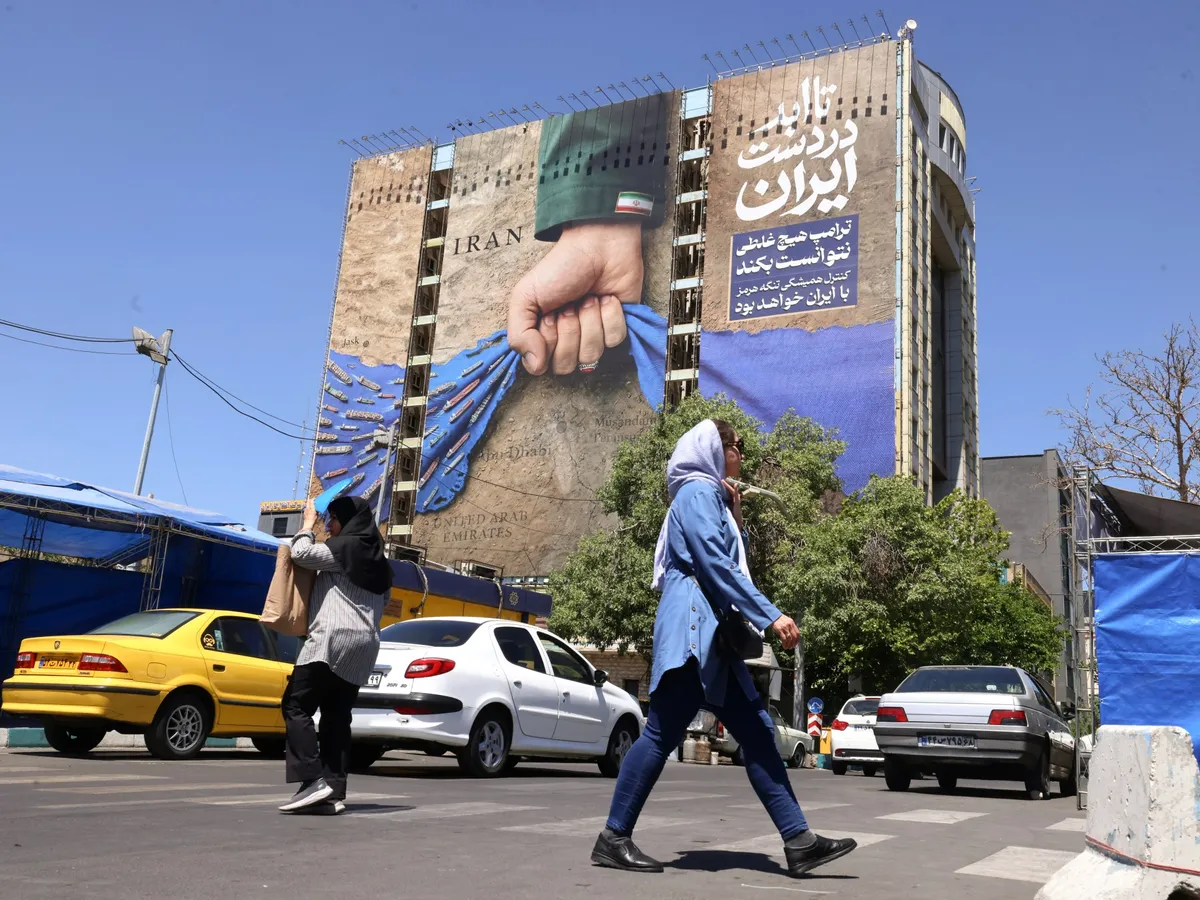
The markets in Iran predict a breakthrough, but sentiments on the street and among the leadership are divided.People cross a street near a billboard on the facade of a building depicting the Strait of Hormuz, with a caption in Persian reading 'Forever in Iran’s Hand', at Vanak Square in Tehran on May 25, 2026 [AFP]Published On 26 May 2026Tehran, Iran – Iran and the United States continue negotiations through intermediaries to reach an understanding, but no deal appears imminent after another exchange of fire amid an air of distrust.The US military said it hit missile launch sites and Iranian boats attempting to place mines in Iran’s southern waters, and Iranian state media reported that the country’s military fired back. Iranian state media also reported several casualties. But so far, there has been no breakdown of the fragile ceasefire that has been in place since April 8.The markets in Tehran appear to be expecting an understanding taking shape with Washington, with Iran’s national currency gaining more than 5 percent this week. The rial stood at about 1.73 million against the US dollar on Tuesday morning, which was still not far from an all-time low hit last month.The main index of the Tehran-stock-exchange" class="entity-link entity-organization" data-entity-id="129233" data-entity-type="organization">Tehran Stock Exchange also extended its gains this week, and shot back above 4 million points again on Tuesday morning after a controlled reopening a week earlier. The index had hit an all-time high of about 4.5 million points at the start of the year, but had plummeted after thousands were killed during nationwide protests in January, and war approached.The overall Iranian economy is under immense pressure as a result of local mismanagement and intensifying pressure from the US, including a naval blockade of Iran’s southern ports.The blockade and the elimination of the United Arab Emirates as a main source of imports to Iran – ties between the UAE and Tehran have worsened dramatically during the war, following multiple Iranian missile attacks against the UAE – have taken a huge toll.“Supply is in question at least for a few more months, so there’s no telling what will happen in the market,” said a vendor at a shop in downtown Tehran selling mobile phones and other digital products, mostly imported from the UAE before the war.“We see how the prices make customers change their minds, but it’s not just the prices; you might not find the laptop you saw available a week ago with the same specs today,” he told Al Jazeera.The government has mostly narrowed its focus to ensuring the procurement of essential goods like food and medicine in order to weather the storm. No serious nationwide shortages of essential goods have been reported so far, but prices are skyrocketing.Rampant inflation continues to make average citizens poorer, war-damaged industries will take much capital and time to rebuild, and a near-total internet shutdown imposed by the authorities has decimated more jobs.State-run media reported late Monday that President Masoud Pezeshkian ordered preparations to reinstate the global internet after the longest nationwide shutdown ever in any country. But there was no confirmation from the Supreme National Security Council, which ordered the ban, and the restrictions remained in place on Tuesday.Dariush, a retired construction engineer who lives in western Tehran, said he was worried about the compounding impacts of the status quo.“Anything to end this current state of no war, no peace, no trace of a clear future would be welcome at this point. If this continues, it will be devastating,” he told Al Jazeera.A 64-year-old art teacher and sculptor, speaking on condition of anonymity, said she believed Iran and the US would reach an agreement, which would put Iran in a relatively stronger position compared with before the war. She said the continued disruption in the Strait of Hormuz would pressure Trump to make a deal and possibly release a number of Iranian funds frozen abroad.But a 23-year-old student said he believed that even if a memorandum of understanding is signed between the two sides, it would not bring an end to pressure against the Iranian population by guaranteeing a more secure future.“A temporary deal could have positive points for both sides, but I think the war will continue after the World Cup,” he said about the US, Mexico and Canada-hosted football competition ending on July 19.In the meantime, politicians and affiliated media in Iran continue to debate the merits of any deal with Washington.Hardliners are pushing for minimum concessions, arguing that Tehran’s position has been significantly strengthened after surviving nearly 40 days of relentless attacks and the blockade that came afterwards, while maintaining the disruption of the Strait of Hormuz.Mahmoud Nabavian, a hardline scholar, lawmaker and member of the Iranian negotiating team during the first round of talks in Pakistan in April, on Tuesday released the text of a letter he wrote to parliament chief Mohammad Bagher Ghalibaf and security chief Mohammad Bagher Zolghadr.“Reopening the Strait of Hormuz in exchange for lifting the blockade runs counter to the interests of the Iranian nation,” he wrote, adding that all sanctions must be lifted, and Tehran must maintain sovereignty over the strategic waterway.Hardline media operated along the same lines, with Keyhan newspaper, whose editor-in-chief was appointed by slain Supreme Leader Ayatollah Ali Khamenei, saying the negotiations must be stopped since the US refused to give Foreign Minister Abbas Araghchi a visa to travel to New York for a United Nations Security Council meeting on the war.
SRCAl Jazeera
LANGEN
LEANCenter
WORDS902
ENT12
TUE · 2026-05-26 · 10:08 GMTBRIEF NSR-2026-0526-79275
NSR-2026-0526-79275News Report·EN·Diplomatic
Anticipation in Iran as talks with US continue amid attacks, war of words
Iran and the United States are continuing negotiations through intermediaries amid ongoing exchanges of fire, with the US reporting strikes on missile launch sites and Iranian boats. Despite these clashes, a fragile ceasefire remains in place.
Maziar MotamediAl JazeeraFiled 2026-05-26 · 10:08 GMTLean · CenterRead · 4 min
Al JazeeraFIG 01
Reading time
4min
Word count
902words
Sources cited
1cited
Entities identified
12entities
Quality score
100%
§ 01
Briefing Summary
AI-generatedNEWSAR · AI
Iran and the United States are continuing negotiations through intermediaries amid ongoing exchanges of fire, with the US reporting strikes on missile launch sites and Iranian boats. Despite these clashes, a fragile ceasefire remains in place. Tehran's markets show optimism, with the national currency and stock exchange index gaining, suggesting an expectation of a breakthrough. However, public sentiment and leadership views are divided on the prospects and potential outcomes of any agreement. The Iranian economy faces immense pressure from mismanagement and US sanctions, including a naval blockade, impacting supply chains and causing rampant inflation. While the government prioritizes essential goods, widespread internet restrictions, imposed after nationwide protests, have further damaged the economy.
Confidence 0.90Sources 1Claims 5Entities 12
§ 02
Article analysis
Model · rule-basedFraming
Diplomatic
Economic Impact
Tone
Measured
AI-assessed
CalmNeutralAlarmist
Factuality
0.70 / 1.00
Factual
LowHigh
Sources cited
1
Limited
FewMany
§ 03
Key claims
5 extracted01
Iran's national currency gained more than 5 percent this week.
statistic
Confidence
0.90
02
Iran and the United States continue negotiations through intermediaries to reach an understanding.
factual
Confidence
0.90
03
Rampant inflation continues to make average citizens poorer, war-damaged industries will take much capital and time to rebuild, and a near-total internet shutdown imposed by the authorities has decimated more jobs.
factual
Confidence
0.80
04
The overall Iranian economy is under immense pressure as a result of local mismanagement and intensifying pressure from the US, including a naval blockade of Iran’s southern ports.
factual
Confidence
0.80
05
The US military said it hit missile launch sites and Iranian boats attempting to place mines in Iran’s southern waters.
factualUS military
Confidence
0.80
§ 04
Full report
4 min read · 902 words§ 05
Entities
12 identifiedKey playerOppositionContextPositiveNeutralNegative
Locations5
Events4
§ 06
Keywords & salience
10 termsiran-us negotiations
1.00
fragile ceasefire
0.90
strait of hormuz
0.80
iranian economy
0.80
naval blockade
0.70
iran's national currency
0.60
tehran stock exchange
0.60
us military
0.50
nationwide protests
0.40
local mismanagement
0.40
§ 07
Topic connections
Interactive graph Network visualization showing 51 related topics
View Full Graph Person Organization Location Event|Click node to navigate|Edge numbers = shared articles