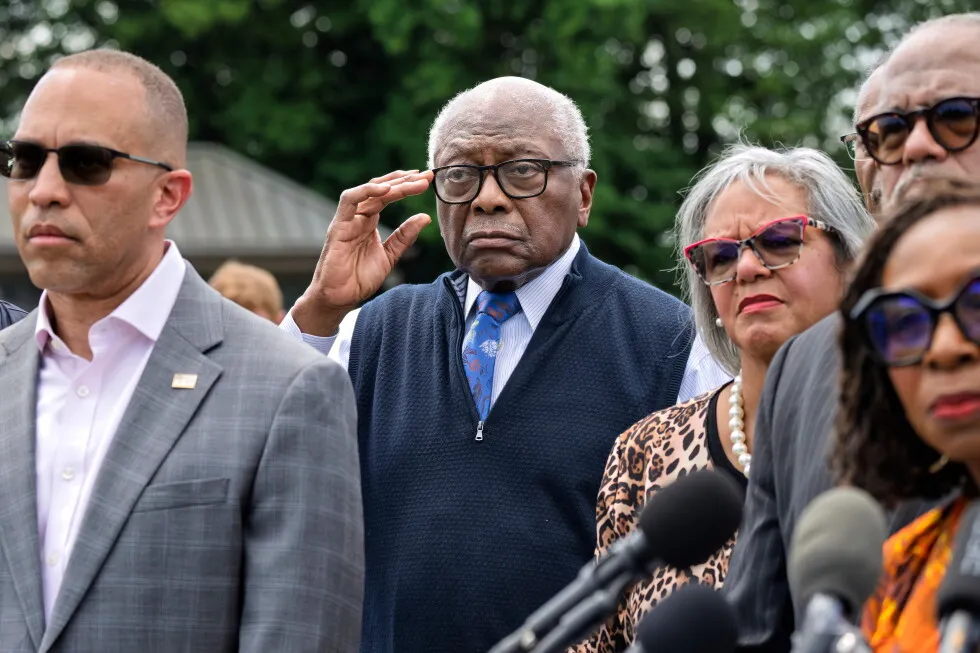
South Carolina Senate rejects President Trump’s call to redraw congressional maps 1 of 3 | Rep. Jim Clyburn, D-S.C., center, joined by House Minority Leader Hakeem Jeffries, D-N.Y., left, stands with members of the Congressional Black Caucus during an event outside the Capitol in Washington, Tuesday, May 19, 2026. (AP Photo/J. Scott Applewhite) 2 of 3 | Republican South Carolina Sen. Carlisle Kennedy, left, Democratic Sen. Ronnie Sabb, middle, and Republican Sen. Jeff Zell, right, watch a video during a session on redistricting on Tuesday, May 26, 2026, in Columbia, S.C. (AP Photo/Jeffrey Collins) 3 of 3 | Rep. Jim Clyburn, D-S.C., center, stands with members of the Congressional Black Caucus during an event outside the Capitol in Washington, Tuesday, May 19, 2026. (AP Photo/J. Scott Applewhite) 1 of 3 | Rep. Jim Clyburn, D-S.C., center, joined by House Minority Leader Hakeem Jeffries, D-N.Y., left, stands with members of the Congressional Black Caucus during an event outside the Capitol in Washington, Tuesday, May 19, 2026. (AP Photo/J. Scott Applewhite) 1 of 3 Rep. Jim Clyburn, D-S.C., center, joined by House Minority Leader Hakeem Jeffries, D-N.Y., left, stands with members of the Congressional Black Caucus during an event outside the Capitol in Washington, Tuesday, May 19, 2026. (AP Photo/J. Scott Applewhite) Add AP News on Google Add AP News as your preferred source to see more of our stories on Google. Share 2 of 3 | Republican South Carolina Sen. Carlisle Kennedy, left, Democratic Sen. Ronnie Sabb, middle, and Republican Sen. Jeff Zell, right, watch a video during a session on redistricting on Tuesday, May 26, 2026, in Columbia, S.C. (AP Photo/Jeffrey Collins) 2 of 3 Republican South Carolina Sen. Carlisle Kennedy, left, Democratic Sen. Ronnie Sabb, middle, and Republican Sen. Jeff Zell, right, watch a video during a session on redistricting on Tuesday, May 26, 2026, in Columbia, S.C. (AP Photo/Jeffrey Collins) Add AP News on Google Add AP News as your preferred source to see more of our stories on Google. Share 3 of 3 | Rep. Jim Clyburn, D-S.C., center, stands with members of the Congressional Black Caucus during an event outside the Capitol in Washington, Tuesday, May 19, 2026. (AP Photo/J. Scott Applewhite) 3 of 3 Rep. Jim Clyburn, D-S.C., center, stands with members of the Congressional Black Caucus during an event outside the Capitol in Washington, Tuesday, May 19, 2026. (AP Photo/J. Scott Applewhite) Add AP News on Google Add AP News as your preferred source to see more of our stories on Google. Share Updated [hour]:[minute] [AMPM] [timezone], [monthFull] [day], [year] Columbia, S.C. (AP) — President Donald Trump’s push to reshape congressional districts ahead of the November elections suffered a double setback Tuesday, as South Carolina senators declined to do so and a federal court blocked a Republican-backed map in Alabama.As early in-person voting began Tuesday in South Carolina’s primaries, the state Senate rejected a Republican plan to cancel those congressional votes and instead schedule a new primary under revised districts designed to help the GOP oust a longtime Democrat.Some senators said it was simply too late to make a change.“South Carolina citizens are going to the polls today. And neither my conscience or common sense is going to let me stop an election that is already underway,” Republican state Sen. Richard Cash said.The political drama in South Carolina is part of a Republican strategy — propelled by Trump — to redraw voting districts to the GOP’s advantage in an attempt to hold on to a slim House majority in the midterm elections. Republicans have been moving quickly to try to leverage a recent U.S. Supreme Court ruling that weakened minority protections under the federal Voting Rights Act. But the GOP also suffered a setback Tuesday in Alabama, where a three-judge federal panel issued a preliminary injunction blocking the state from using a Republican-drawn congressional map that could help the GOP win an additional seat. The court said the Republican plan “intentionally discriminated based on race” by including only one Black-majority district and ordered the continued use of a court-imposed map that includes two districts with a significant proportion of Black residents. 4 MIN READ 4 MIN READ 6 MIN READ Alabama Attorney General Steve Marshall, a Republican, vowed a quick appeal to the U.S. Supreme Court and predicted an eventual victory. Among the first to cast an early ballot in the small city of Orangeburg was U.S. Rep. Jim Clyburn, the Democrat whose district Republicans are trying to reshape in their quest for a clean sweep of South Carolina’s seven congressional seats. A defiant Clyburn insisted he would run for reelection, regardless of what the district looks like. “I’m OK if it’s Trump plus 20,” Clyburn said while describing the potential Republican advantage in a reshaped district. “I would be running where I live.”The political drama in South Carolina is part of a Republican strategy — propelled by Trump — to redraw voting districts to the GOP’s advantage in an attempt to hold on to a slim House majority in the midterm elections. Republicans have been moving quickly to try to leverage a recent U.S. Supreme Court ruling that weakened minority protections under the federal Voting Rights Act. But the GOP also suffered a setback Tuesday in Alabama, where a three-judge federal panel issued a preliminary injunction blocking the state from using a Republican-drawn congressional map that could help the GOP win an additional seat. The court said the Republican plan “intentionally discriminated based on race” by including only one Black-majority district and ordered the continued use of a court-imposed map that includes two districts with a significant proportion of Black residents. Alabama Attorney General Steve Marshall, a Republican, vowed a quick appeal to the U.S. Supreme Court and predicted an eventual victory.Democrats, who have suffered their own share of setbacks in the national redistricting battle, praised the turn of events in Alabama. The “fight for justice is far from over in states across the country where politicians are enacting gerrymanders on top of gerrymanders to erase equal representation for communities of color,” said Marina Jenkins, executive director of the National redistricting Foundation, a nonprofit affiliate of the National Democratic redistricting Committee. The national redistricting battle has spanned 10 monthsVoting districts typically are redrawn after a census at the start of a decade. But Trump has urged Republican-led states to redistrict ahead of the November elections to try to rebuff political headwinds, which typically result in lost congressional seats for the president’s party in midterms.Since Trump first urged Texas to redraw its voting districts last summer, Republicans also have enacted new House districts in Missouri, North Carolina, Ohio, Florida and Tennessee. Meanwhile, voters in California adopted new Democratic-drawn districts, and a court imposed a favorable map for Democrats in Utah. Democrats suffered a setback in Virginia, where the state Supreme Court invalidated a voter-approved redistricting plan that could have helped Democrats win additional seats. redistricting discussions are ongoing in Louisiana following an April high court ruling that struck down a majority-Black congressional district as an illegal partisan gerrymander. The Louisiana House could vote later this week on a new map that could eliminate a seat held by Democratic U.S. Rep. Cleo Fields and improve Republicans’ chances of winning six out of the state’s seven seats. The Congressional Black Caucus on Tuesday called on major corporations across the U.S., including those that previously expressed support for voting rights and racial justice, to oppose redistricting efforts by Republican-led states that seek to eliminate majority-Black U.S. House districts. That comes after the caucus last week called for Black athletes to boycott public universities in states that are gerrymandering congressional maps to eliminate districts held by Black lawmakers. Clyburn decries White House role in redistrictingMore than 26,000 votes were cast in South Carolina by noon Tuesday on the first day of early voting for the June 9 primary after Democrats called for people against a proposed new map to turn out in force. In 2022, about 125,000 early votes were cast the entire two weeks.The Republican-led House already has passed a plan that would reconfigure Clyburn’s district, void the results of current congressional primaries and instead hold new U.S. House primaries in August. Trump has lobbied for the plan, making at least two phone calls to Republican state Senate Majority Leader Shane Massey and also phoning in to a private meeting of Republican senators earlier this month. He also has maintained the pressure on social media.Debate has stalled in the Senate, where Democrats are staunchly opposed and some GOP lawmakers have concerns that an aggressive redistricting could backfire by making some Republican-held seats susceptible to losses because of the addition of Democratic voters. Clyburn noted that when state lawmakers last redrew congressional districts, after the 2020 census, they spent months holding meetings across the state to gather public suggestions. Although that map resulted in a 6-1 seat advantage for Republicans over Democrats, the process was orderly and fair, he said. “When the map was challenged, the U.S. Supreme Court said, yes, this is constitutional,” Clyburn said. But now, “this White House says, to hell with the process, to hell with the Constitution, just do what we want done.”___Chandler reported from Montgomery, Alabama, and Lieb from Jefferson City, Missouri. Kinnard covers national politics for The Associated Press. She lives in South Carolina. Collins covers South Carolina from Columbia for The Associated Press. He has been with the AP since 2000. Lieb covers issues and trends in state governments across the U.S. He’s reported about government and politics for The Associated Press for 30 years.
SRCAssociated Press (AP)
LANGEN
LEANCenter
WORDS1 595
ENT12
TUE · 2026-05-26 · 17:23 GMTBRIEF NSR-2026-0526-79368
NSR-2026-0526-79368News Report·EN·Political Strategy
Early voting begins in South Carolina as senators weigh scrapping primary for congressional races
South Carolina began early in-person voting for its primaries on Tuesday, as state senators debated canceling congressional votes to implement new districts aimed at unseating a Democratic representative. U.S.
By
MEG KINNARD, JEFFREY COLLINS, KIM CHANDLER and DAVID A. LIEBAssociated Press (AP)Filed 2026-05-26 · 17:23 GMTLean · CenterRead · 7 min
Associated Press (AP)FIG 01
Reading time
7min
Word count
1 595words
Sources cited
3cited
Entities identified
12entities
Quality score
100%
§ 01
Briefing Summary
AI-generatedNEWSAR · AI
South Carolina began early in-person voting for its primaries on Tuesday, as state senators debated canceling congressional votes to implement new districts aimed at unseating a Democratic representative. U.S. Rep. Jim Clyburn, a Democrat whose district Republicans are targeting, cast an early ballot and vowed to run for reelection regardless of redistricting. This move is part of a broader Republican strategy, supported by President Trump, to redraw districts to their advantage following a Supreme Court ruling weakening minority protections. However, Republicans faced a setback in Alabama, where a federal court blocked a new congressional map, ruling it intentionally discriminated based on race. South Carolina senators ultimately rejected the plan to redraw districts, with some citing the ongoing election as a reason to maintain the current process.
Confidence 0.90Sources 3Claims 4Entities 12
§ 02
Article analysis
Model · rule-basedFraming
Political Strategy
Legal & Judicial
Tone
Measured
AI-assessed
CalmNeutralAlarmist
Factuality
0.80 / 1.00
Factual
LowHigh
Sources cited
3
Well sourced
FewMany
§ 03
Key claims
4 extracted01
President Donald Trump’s push to reshape congressional districts suffered a double setback Tuesday.
factual
Confidence
1.00
02
Early in-person voting began Tuesday in South Carolina’s primaries.
factual
Confidence
1.00
03
A federal court blocked a Republican-backed map in Alabama.
factual
Confidence
1.00
04
South Carolina senators declined to redraw congressional districts.
factual
Confidence
1.00
§ 04
Full report
7 min read · 1 595 words§ 05
Entities
12 identifiedKey playerOppositionContextPositiveNeutralNegative
People6
Organizations1
§ 06
Keywords & salience
7 termsearly voting
0.90
congressional races
0.80
redistricting
0.70
congressional maps
0.60
south carolina senate
0.50
president trump
0.40
congressional black caucus
0.40
§ 07
Topic connections
Interactive graph Network visualization showing 27 related topics
View Full Graph Person Organization Location Event|Click node to navigate|Edge numbers = shared articles