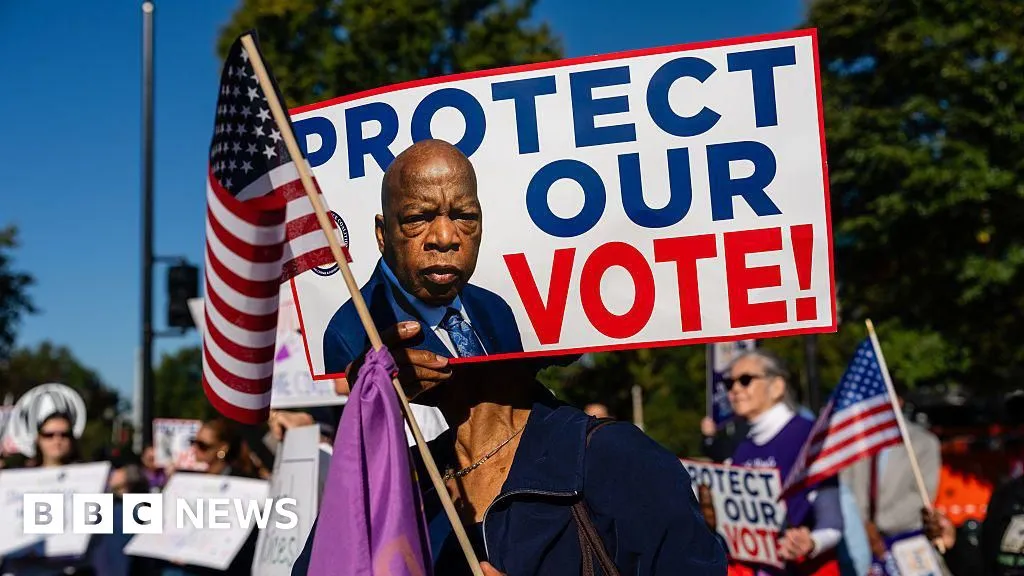
The US Supreme Court limited the ability of lawmakers to take the racial make-up of a state into account when drawing voting maps, in a ruling that could reshape politics across the American south.In a 6-3 decision, the conservative justices sided with a challenge to new districts in Louisiana that were created to comply with a landmark Civil Rights law meant to protect black Americans from racial discrimination.The way courts have previously interpreted Section 2 of the Voting Rights Act, Justice Samuel Alito wrote in the court's majority opinion, has sometimes forced states "to engage in the very race-based discrimination that the Constitution forbids".The group of mainly white voters challenging the law had argued that relying on race to create districts ran afoul of the US Constitution and suggested that the provision of the Voting Rights Act should be found unconstitutional in its entirety. The court majority did not take that position, but its decision will make it significantly more difficult to successfully challenge legislative maps for diluting the voting power of racial minorities.To prove a violation, Alito wrote, litigants will have to prove that legislators intentionally drew the maps to provide less opportunity to racial minority voters."The court's decision will set back the foundational right Congress granted of racial equality in electoral opportunity," Justice Elena Kagan wrote in her dissenting opinion.The fight over voting maps has grown fierce in the last year, as Democrats and Republicans seek to carve out districts that could help them win congressional majorities.
SRCBBC News - World
LANGEN
LEANCenter
WORDS249
WED · 2026-04-29 · 15:05 GMTBRIEF NSR-2026-0429-72385
NSR-2026-0429-72385News Report·EN·Legal & Judicial
US Supreme Court limits use of race in drawing electoral maps
The US Supreme Court, in a 6-3 decision, has limited the use of race in drawing electoral maps, impacting states like Louisiana. The ruling, authored by Justice Samuel Alito, stated that previous interpretations of Section 2 of the Voting Rights Act sometimes compelled states to engage in race-based discrimination, which the Constitution prohibits.
BBC News - WorldFiled 2026-04-29 · 15:05 GMTLean · CenterRead · 1 min
BBC News - WorldFIG 01
Reading time
1min
Word count
249words
Sources cited
3cited
Entities identified
0entities
Quality score
75%
§ 01
Briefing Summary
AI-generatedNEWSAR · AI
The US Supreme Court, in a 6-3 decision, has limited the use of race in drawing electoral maps, impacting states like Louisiana. The ruling, authored by Justice Samuel Alito, stated that previous interpretations of Section 2 of the Voting Rights Act sometimes compelled states to engage in race-based discrimination, which the Constitution prohibits. The majority opinion found that to prove a violation of the Voting Rights Act, litigants must now demonstrate intentional map-drawing to diminish minority voting opportunities. This decision makes it more challenging to challenge maps for diluting minority voting power. The ruling could significantly alter the political landscape, particularly in the American South, amidst ongoing partisan battles over redistricting.
Confidence 0.90Sources 3Claims 5
§ 02
Article analysis
Model · rule-basedFraming
Legal & Judicial
Political Strategy
Tone
Measured
AI-assessed
CalmNeutralAlarmist
Factuality
0.85 / 1.00
Factual
LowHigh
Sources cited
3
Well sourced
FewMany
§ 03
Key claims
5 extracted01
The Supreme Court majority did not find the provision of the Voting Rights Act unconstitutional in its entirety.
factual
Confidence
1.00
02
To prove a violation of the Voting Rights Act, litigants must now prove legislators intentionally drew maps to provide less opportunity to racial minority voters.
factualJustice Samuel Alito
Confidence
1.00
03
The US Supreme Court issued a 6-3 decision limiting the use of race in drawing electoral maps in Louisiana.
factual
Confidence
1.00
04
Previous interpretations of Section 2 of the Voting Rights Act have forced states to engage in race-based discrimination.
quoteJustice Samuel Alito
Confidence
0.90
05
The court's decision will set back the foundational right of racial equality in electoral opportunity.
quoteJustice Elena Kagan
Confidence
0.80
§ 04
Full report
1 min read · 249 words§ 06
Keywords & salience
9 termsvoting maps
1.00
race in politics
0.90
voting rights act
0.80
racial discrimination
0.70
supreme court
0.60
racial minorities
0.50
electoral opportunity
0.50
section 2
0.40
us constitution
0.40
§ 07
Topic connections
Interactive graph No topic relationship data available yet. This graph will appear once topic relationships have been computed.