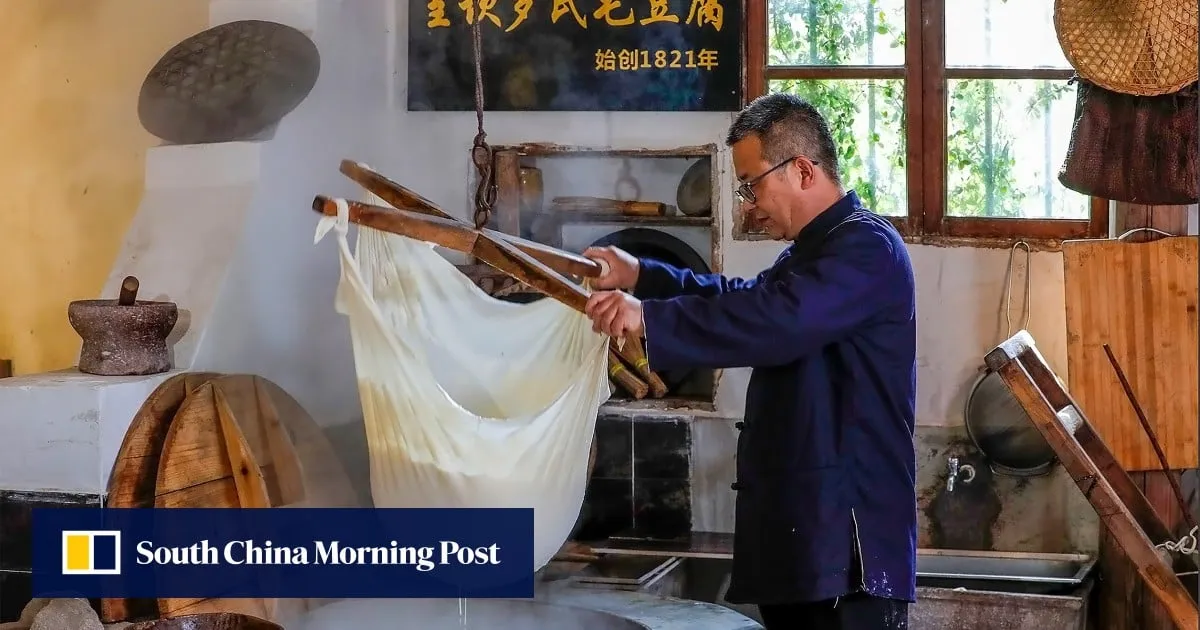
In China, few foods are as modest yet culturally resonant as tofu.Its origins are most often traced to Liu An, the King of Huainan during the Western Han dynasty (206 BC – AD 9), a nobleman fascinated by the search for immortality.According to legend, Liu gathered alchemists on a mountain in Anhui province, central China, where they experimented with spring water, soybeans and gypsum in an attempt to create an elixir of life. What they produced instead was tofu.An ancient tofu dish, above, being eaten using a pair of chopsticks. Photo: BilibiliThe story survived because later texts gave it authority.Zhu Xi, the Song dynasty scholar, alluded to tofu’s Huainan origins in his poetry, while the Ming dynasty medical classic Bencao Gangmu also credited Liu with its invention.Archaeological findings have added further intrigue.In an ancient tomb in Henan province, central China, researchers discovered a stone carving believed to depict tofu-making.Many scholars regard it as an important clue linking tofu’s origins to the Han dynasty (206 BC-AD 220).By the Five Dynasties period (907 to 979), tofu had already entered everyday life.The above image depicts a cook making tofu the way people did in ancient times. Photo: BilibiliHistorical records show an official too poor to afford meat bought several pieces of tofu each day.Modern researchers often cite the account as evidence that tofu was valued as an affordable meat substitute and a source of nourishment.Its journey did not stop at China’s borders.During the Tang Dynasty (618–907), tofu is believed to have reached Japan through Buddhist exchange, where it became deeply absorbed into local food culture and evolved into varieties such as silken tofu.Further ReadingIt arrived in Europe much later, around the 17th century, through missionaries and maritime trade.A tofu factory worker in Indonesia prepares traditional soybean curd. Photo: ShutterstockAt home, tofu was firmly established by the Song dynasty (960–1279), when it moved beyond workshops and into the rhythms of urban life.Mengliang Lu, a detailed account of Song-era society, recorded vendors selling fried tofu and tofu soup in cities.It also entered literature: Lu You, one of the great Song poets, wrote of a snack pairing tofu with honey.Ancient diners also enjoyed bolder tofu dishes.Water Margin mentions “spicy braised tofu”, a popular drinking snack flavoured with native seasonings such as Sichuan peppercorns and ginger.A young Japanese woman, above, tucks into a modern-day tofu dish. Photo: ShutterstockCooks also experimented with appearance, ancient scholar Fang Yizhi recorded “coloured tofu,” including a green version tinted with plant juice.As food culture evolved, tofu acquired a reputation for health.Bencao Gangmu described it as a Chinese medicine food that could clear heat, moisten dryness, nourish the stomach and aid digestion.Over time, tofu came to mean more than nourishment.Legend has it that Zhu Yuanzhang, the founding emperor of the Ming dynasty (1368–1644), survived hardship after being given a bowl of tofu soup.After taking the throne, he was said to have eaten tofu daily as a reminder of simplicity and restraint.Its whiteness made it a symbol of purity and moral refinement, while its plainness appealed to ancient nobles who saw in it the virtues of the cultivated person.Tang Bin, a Qing dynasty official remembered for his austere lifestyle, reportedly wore old cotton robes and ate tofu at every meal, treating the humble food as a metaphor for integrity and incorruptibility.Trays of tofu stacked up in a food-making factory in Indonesia. Photo: ShutterstockToday, China’s tofu dishes reflect the country’s vast geography and culinary diversity.Sichuan’s mapo tofu turns bean curd into a fiery vehicle for chilli and spice; Guangdong’s stuffed tofu is filled with meat and gently braised; in Shaanxi, tofu is folded into steamed buns.Modern chefs have pushed it further still, transforming tofu into ice cream, doughnuts and intricate carved artworks.In 2023, China’s tofu market was reportedly valued at over 34 billion yuan (US$5 billion), underscoring the enduring commercial power of this ancient food.
SRCSouth China Morning Post
LANGEN
LEANCenter-Right
WORDS640
ENT12
THU · 2026-05-28 · 10:00 GMTBRIEF NSR-2026-0528-79880
NSR-2026-0528-79880News Report·EN·Human Interest
How tofu evolved from an accidental discovery to one of China’s most prized culinary symbols
Tofu's origins are traced to Liu An, the King of Huainan during the Western Han dynasty, who accidentally discovered it while attempting to create an elixir of life with soybeans, spring water, and gypsum. By the Five Dynasties period, tofu was an affordable meat substitute in everyday Chinese life.
Zoey ZhangSouth China Morning PostFiled 2026-05-28 · 10:00 GMTLean · Center-RightRead · 3 min
South China Morning PostFIG 01
Reading time
3min
Word count
640words
Sources cited
4cited
Entities identified
12entities
Quality score
100%
§ 01
Briefing Summary
AI-generatedNEWSAR · AI
Tofu's origins are traced to Liu An, the King of Huainan during the Western Han dynasty, who accidentally discovered it while attempting to create an elixir of life with soybeans, spring water, and gypsum. By the Five Dynasties period, tofu was an affordable meat substitute in everyday Chinese life. It spread to Japan during the Tang dynasty and Europe by the 17th century. During the Song dynasty, tofu became a staple in urban Chinese society, appearing in dishes like fried tofu and tofu soup. Beyond nourishment, tofu became a symbol of purity and integrity, with historical figures eating it as a reminder of simplicity. Today, tofu remains a prized culinary symbol in China, with diverse regional variations and modern culinary innovations, and its market is valued at over 34 billion yuan.
Confidence 0.90Sources 4Claims 5Entities 12
§ 02
Article analysis
Model · rule-basedFraming
Human Interest
Social Justice
Tone
Measured
AI-assessed
CalmNeutralAlarmist
Factuality
0.70 / 1.00
Factual
LowHigh
Sources cited
4
Well sourced
FewMany
§ 03
Key claims
5 extracted01
Later texts like Zhu Xi's poetry and the Bencao Gangmu credited Liu An with tofu's invention.
factualhistorical texts
Confidence
0.90
02
By the Five Dynasties period, tofu was in everyday life, valued as an affordable meat substitute.
factualhistorical records
Confidence
0.80
03
Tofu's origins are often traced to Liu An, King of Huainan during the Western Han dynasty, who experimented with soybeans and gypsum.
factuallegend/historical accounts
Confidence
0.80
04
Tofu reached Japan during the Tang dynasty and Europe around the 17th century.
factualhistorical accounts
Confidence
0.70
05
Archaeological findings in a Henan tomb suggest tofu-making practices linked to the Han dynasty.
factualarchaeological findings
Confidence
0.70
§ 04
Full report
3 min read · 640 words§ 05
Entities
12 identifiedKey playerOppositionContextPositiveNeutralNegative
Locations4
Events3
§ 06
Keywords & salience
9 termstofu
1.00
china
0.90
culinary history
0.80
liu an
0.70
cultural significance
0.60
soybeans
0.60
meat substitute
0.50
ancient china
0.50
dynasties
0.40
§ 07
Topic connections
Interactive graph Network visualization showing 51 related topics
View Full Graph Person Organization Location Event|Click node to navigate|Edge numbers = shared articles