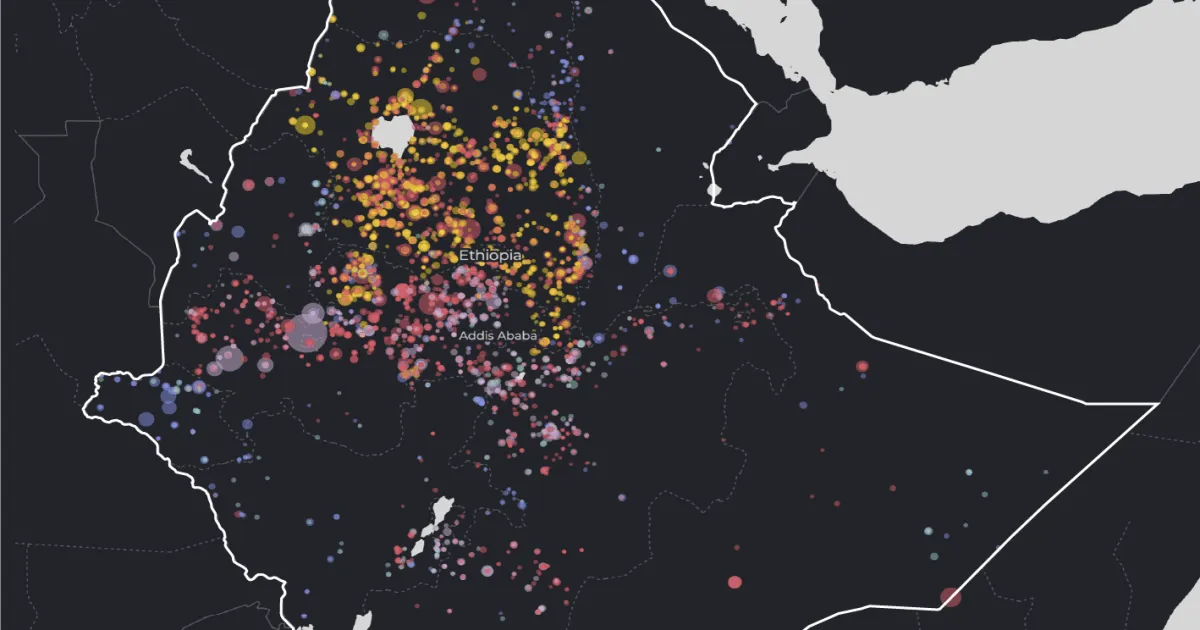
EXPLAINEREthiopia has faced near-continuous conflict since 2020, with fighting in Tigray, Oromia and Amhara.Published On 29 May 2026Ethiopia will head to the polls on June 1 for its first nationwide elections since the formal end of the Tigray-war" class="entity-link entity-event" data-entity-id="17218" data-entity-type="event">Tigray War, a devastating two-year conflict from 2020 to 2022 that concluded with a peace agreement between the Ethiopian federal government and the Tigray People’s Liberation Front (TPLF).With a population of about 135 million, Ethiopia is Africa’s second-most populous country and the 10th most populous in the world.More than 50.5 million voters have registered to participate in the vote, which is held every five years, with all 547 parliamentary seats up for grabs. Since 2018, the country has been run by Prime Minister Abiy Ahmed, whose Prosperity Party holds 457 out of the country’s 547 seats.The Ethiopia" class="entity-link entity-organization" data-entity-id="136464" data-entity-type="organization">National Election Board of Ethiopia (NEBE) is likely to announce the official results on June 11.Ethiopia at a glanceEthiopia is a landlocked country in the Horn of Africa, covering an area of 1,104,300sq km (426,400sq miles) and bordered by Eritrea, Sudan, South Sudan, Kenya, Somalia and Djibouti.The country has sustained notable economic growth over the past two decades, with the IMF projecting a 9.2 percent expansion in 2026, the highest on the continent. Yet persistent challenges remain, including high inflation (11.7 percent as of April 2026), foreign exchange shortages, and the costly burden of post-war reconstruction.The country has five official languages – Afar, Amharic, Oromo, Somali and Tigrinya. Roughly two-thirds of the population are Christian and one-third Muslim, with small communities of Ethiopian Jews and adherents of traditional faiths.Ethiopia’s ethnic groupsThe East African country is one of the most ethnically diverse countries in the world, with more than 80 distinct groups.
SRCAl Jazeera
LANGEN
LEANCenter
WORDS284
ENT12
FRI · 2026-05-29 · 09:18 GMTBRIEF NSR-2026-0529-80141
NSR-2026-0529-80141News Report·EN·Conflict
A visual guide to Ethiopia’s ethnic groups and conflict areas
Ethiopia is preparing for its first nationwide elections since the formal end of the Tigray war in 2022, with voting scheduled for June 1. The country, Africa's second-most populous, has experienced near-continuous conflict since 2020, including fighting in Tigray, Oromia, and Amhara.
Amr Alkazaz,Mohamed HusseinAl JazeeraFiled 2026-05-29 · 09:18 GMTLean · CenterRead · 2 min
Al JazeeraFIG 01
Reading time
2min
Word count
284words
Sources cited
0cited
Entities identified
12entities
Quality score
100%
§ 01
Briefing Summary
AI-generatedNEWSAR · AI
Ethiopia is preparing for its first nationwide elections since the formal end of the Tigray war in 2022, with voting scheduled for June 1. The country, Africa's second-most populous, has experienced near-continuous conflict since 2020, including fighting in Tigray, Oromia, and Amhara. Prime Minister Abiy Ahmed's Prosperity Party currently holds a significant majority of parliamentary seats. Despite notable economic growth, Ethiopia faces challenges such as high inflation and the costs of post-war reconstruction. The nation is highly ethnically diverse, with over 80 distinct groups, and has five official languages. The election results are expected around June 11.
Confidence 0.90Claims 5Entities 12
§ 02
Article analysis
Model · rule-basedFraming
Conflict
Political Strategy
Tone
Measured
AI-assessed
CalmNeutralAlarmist
Factuality
0.90 / 1.00
Factual
LowHigh
Sources cited
0
No named sources
FewMany
§ 03
Key claims
5 extracted01
Ethiopia is one of the most ethnically diverse countries, with over 80 distinct groups.
factual
Confidence
1.00
02
The IMF projects a 9.2 percent economic expansion for Ethiopia in 2026.
statisticIMF
Confidence
1.00
03
Ethiopia is Africa’s second-most populous country with about 135 million people.
factual
Confidence
1.00
04
Ethiopia will hold nationwide elections on June 1 for the first time since the formal end of the Tigray war.
factual
Confidence
1.00
05
Ethiopia has faced near-continuous conflict since 2020, with fighting in Tigray, Oromia and Amhara.
factual
Confidence
1.00
§ 04
Full report
2 min read · 284 words§ 05
Entities
12 identifiedKey playerOppositionContextPositiveNeutralNegative
Organizations4
Locations6
§ 06
Keywords & salience
8 termsethiopia
1.00
ethnic groups
0.90
conflict
0.80
tigray war
0.70
elections
0.60
post-war reconstruction
0.50
horn of africa
0.40
economic growth
0.40
§ 07
Topic connections
Interactive graph Network visualization showing 32 related topics
View Full Graph Person Organization Location Event|Click node to navigate|Edge numbers = shared articles