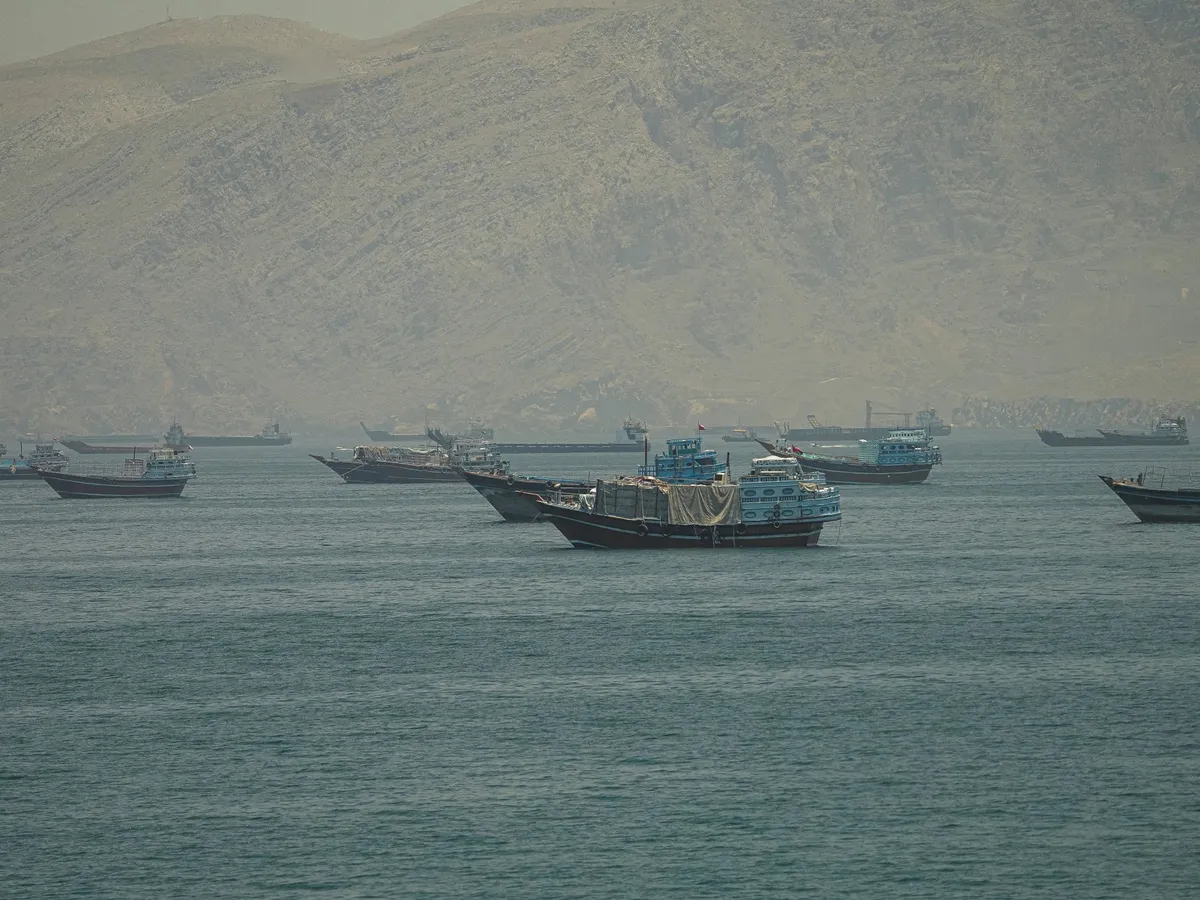
A debate is under way in Tehran over whether control of the world’s busiest oil chokepoint can replace uranium enrichment as the country’s deterrent.Iranian-Canadian author, researcher, and public speaker.Published On 29 May 2026Vessels anchored at the Strait of Hormuz, as seen from Musandam, Oman, May 25, 2026 [Stringer/Reuters]Iran’s decision to act on its long-promised threat to close the Strait of Hormuz has brought United States countermeasures in the form of a US naval blockade. Despite doubts over the legality, feasibility and efficacy of Iran’s initial move and flip-flops about the continuation of the closure, the immediate global impact, surging oil prices and cascading market shocks appear to have surprised even Iran itself, judging by reactions from regime loyalists on state and social media.A radical idea once dismissed as rhetorical bluster or, at worst, a doomsday scenario, has emerged as a weapon of mass disruption, potentially more potent than the weapon of mass destruction Iran has long been suspected of pursuing.Considerable attention has been paid to what closure means for energy, food and trade security in Europe, Africa and Asia. Less notice has been given to its domestic political consequences inside Iran, and to the deeper shift it may signal: from a defensive doctrine built on nuclear capability to one built on control of the strait.Until the June 2025 US attack on Iran’s main nuclear fuel production facilities, the Islamic republic had spent billions on R&D, manufacturing and the protection of its nuclear programme, and lost billions more in income and opportunity to the isolation and sanctions the programme entailed.The nuclear file was also a driver of political repression at home. Since 2005, some of the sharpest divisions between moderates and hardliners have been over the programme and its accumulating costs. Nearly every presidential election after 2005 became, to some degree, a referendum on the nuclear file and how to manage its fallout. Much of the opposition to Supreme Leader Ayatollah Ali Khamenei’s authoritarianism stemmed from his insistence on preserving this costly project and tolerating the distortions it imposed on the economy.Every figure or faction that criticised the programme and favoured a diplomatic resolution was gradually purged. By 2021, after most reformists and moderates had been barred from the presidential race, even Khamenei’s longtime confidant Ali Larijani (later assassinated by Israel in March 2026, shortly after Khamenei himself was killed) was disqualified, largely because of his role as parliament speaker in advancing the 2015 Joint Comprehensive Plan of Action (JCPOA).Evidence after the latest US-Israeli assault does not yet point to a settled doctrinal revolution, but a real internal debate is now under way over whether control of the strait can replace nuclear latency as Iran’s main deterrent. Iran’s reported offer in the Pakistan talks to suspend enrichment for several years is significant. Even if tactical and temporary, it suggests that parts of the Iranian state no longer treat enrichment as an untouchable strategic core, and are willing to elevate leverage rooted in Hormuz and maritime disruption in its place.Other signs point the same way. Since succeeding his father, the new Supreme Leader Mojtaba Khamenei did not mention the nuclear programme once in his public statements. He has, however, repeatedly emphasised Iran’s right to govern the Strait of Hormuz.The extreme right-wing populist faction in the conservative camp, symbolised by former nuclear negotiator and national security adviser Saeed Jalili and the Paydari (Steadfastness) Front, has shown less fixation on the nuclear question. Foad Izadi, one of its key analysts, did not raise it once during a recent 50-minute appearance on state television, instead praising the Strait of Hormuz as a source of revenue greater than oil exports. “How long do we need to chase Americans and beg them to lift the sanctions?” he asked. “It’s now India, as a buyer of Iranian oil, that has to lobby the American Congress to lift sanctions so it can pay for it.”More pragmatist conservatives close to parliament speaker — and now nuclear negotiator — Mohammad Bagher Ghalibaf had already begun justifying a suspension of enrichment after the June 2025 strikes on Iran’s underground facilities, floating the idea of a “nuclear sunset” in exchange for greater investment in the oil industry. They now question more openly the deterrent value of threshold status and argue for a pivot to maritime control. “Enrichment, which was never strong leverage in the first place,” wrote Jalil Mohebbi, a senior adviser to Ghalibaf, “is now replaced by the Strait of Hormuz, which, unlike nuclear facilities, can neither be bombed, nor oxidised, nor filled with cement.”Whatever the outcome of US-Iran talks, the two consecutive assaults on Iran’s top political and military leadership, and on its military, security, and civilian infrastructure, have made one thing clear: nuclear-threshold status has not only failed to provide deterrence, but may even have undermined Iran’s conventional defensive assets, as the pragmatist conservative analyst Mostafa Najafi has argued.If the Hormuz camp consolidates its position, the consequences for Iran’s internal politics and for the wider region could be substantial.The nuclear file made it easier for hardliners to define patriotism, stigmatise dissent and concentrate power in the security state. It helped drive a de facto Baathification, in which the Islamic Revolutionary Guard Corps captured much of the state and hollowed out representative institutions. A shift from nukes to Hormuz could weaken the hardliners’ justification for purging reformers on national security grounds, and open more space for elected offices and civil society. It would also vindicate those who long argued that Iran’s leverage lies in geography, trade and diplomacy rather than military-technological might, empowering diplomats and technocrats over military-minded ideologues. If maritime geography can impose effective global costs faster and more cheaply than atomic latency, Iran may no longer need the same level of enrichment and ambiguity to command attention or deter pressure.A maritime doctrine would also shift Iran’s strategic centre of gravity towards the Gulf and the southern coast. Ports, shipping, customs, logistics and energy transit would matter more than the inland symbolic projects tied to the nuclear-security complex. Southern Iran would gain economic and political weight.Culturally, such a shift could begin to loosen the hold of the Cold War paradigms and Shia revolutionary narratives that have long defined the Islamic republic’s worldview. The name Hormuz itself carries echoes, in Persian tradition, of Ohrmazd or Ahura Mazda, the Zoroastrian god of wisdom and order. A pivot towards Hormuz would not erase the revolutionary worldview, but it could begin to displace it with a different language: one of territory, exchange, geography and state interest. Over time, this could foster a more unified and stable Iran, as younger generations continue to drift from the regime’s religious and at times apocalyptic outlook towards a more territorial, historical and nationalist understanding of the country.Regionally, a Hormuz-centred order could push the Gulf monarchies towards accommodation rather than confrontation. Maritime security arrangements, deconfliction channels and transit frameworks would become more attractive, and Iran’s relations with its Arab neighbours could become less ideological.Finally, the shift could gradually ease the existential anxiety Israel feels towards Iran. A nuclear posture compresses distance and raises fears of annihilation; the Strait of Hormuz, by contrast, is too far from Israel and too passive a deterrent to generate the same kind of panic. Israel may still see Iran as hostile, but less as an immediate threat, making the conflict more indirect, regional and containable. That, in turn, could reshape Israel’s own political environment, where existential fear of Iran has long strengthened radical parties and marginalised more moderate ones.
SRCAl Jazeera
LANGEN
LEANCenter
WORDS1 245
ENT12
FRI · 2026-05-29 · 10:05 GMTBRIEF NSR-2026-0529-80179
NSR-2026-0529-80179Analysis·EN·Political Strategy
How the end of the nuclear file could reshape Iran, and the region
Iran's decision to threaten closure of the Strait of Hormuz, leading to a US naval blockade, has prompted a significant internal debate about the country's deterrent strategy. This shift potentially moves Iran's focus from nuclear ambition, which incurred substantial economic and political costs, to controlling the vital oil chokepoint.
Hossein DerakhshanAl JazeeraFiled 2026-05-29 · 10:05 GMTLean · CenterRead · 5 min
Al JazeeraFIG 01
Reading time
5min
Word count
1 245words
Sources cited
0cited
Entities identified
12entities
Quality score
100%
§ 01
Briefing Summary
AI-generatedNEWSAR · AI
Iran's decision to threaten closure of the Strait of Hormuz, leading to a US naval blockade, has prompted a significant internal debate about the country's deterrent strategy. This shift potentially moves Iran's focus from nuclear ambition, which incurred substantial economic and political costs, to controlling the vital oil chokepoint. The nuclear program, a source of division and repression, has been significantly impacted by recent US attacks on its facilities. Now, factions within Iran are considering whether control of the Strait of Hormuz can replace nuclear latency as the primary deterrent, with some arguing it offers greater leverage and is less vulnerable than nuclear facilities. This potential doctrinal shift is reflected in public statements and policy discussions, suggesting a reevaluation of Iran's strategic priorities.
Confidence 0.90Claims 5Entities 12
§ 02
Article analysis
Model · rule-basedFraming
Political Strategy
Economic Impact
Tone
Mixed Tone
AI-assessed
CalmNeutralAlarmist
Factuality
0.40 / 1.00
Mixed
LowHigh
Sources cited
0
No named sources
FewMany
§ 03
Key claims
5 extracted01
The nuclear program was a driver of political repression and divisions between moderates and hardliners in Iran.
factual
Confidence
0.90
02
Iran's decision to close the Strait of Hormuz has led to US naval countermeasures and global market shocks.
factual
Confidence
0.90
03
Ali Larijani was disqualified from the presidential race largely due to his role in advancing the 2015 JCPOA.
factual
Confidence
0.80
04
The closure of the Strait of Hormuz may signal a shift in Iran's defensive doctrine from nuclear capability to control of the strait.
factual
Confidence
0.80
05
Iran's reported offer in Pakistan talks to suspend enrichment for several years is significant.
factual
Confidence
0.70
§ 04
Full report
5 min read · 1 245 words§ 05
Entities
12 identifiedKey playerOppositionContextPositiveNeutralNegative
Locations5
§ 06
Keywords & salience
10 termsstrait of hormuz
1.00
nuclear program
1.00
uranium enrichment
0.90
deterrent
0.80
oil prices
0.70
us naval blockade
0.70
domestic political consequences
0.60
sanctions
0.50
energy security
0.40
economic distortions
0.40
§ 07
Topic connections
Interactive graph Network visualization showing 51 related topics
View Full Graph Person Organization Location Event|Click node to navigate|Edge numbers = shared articles