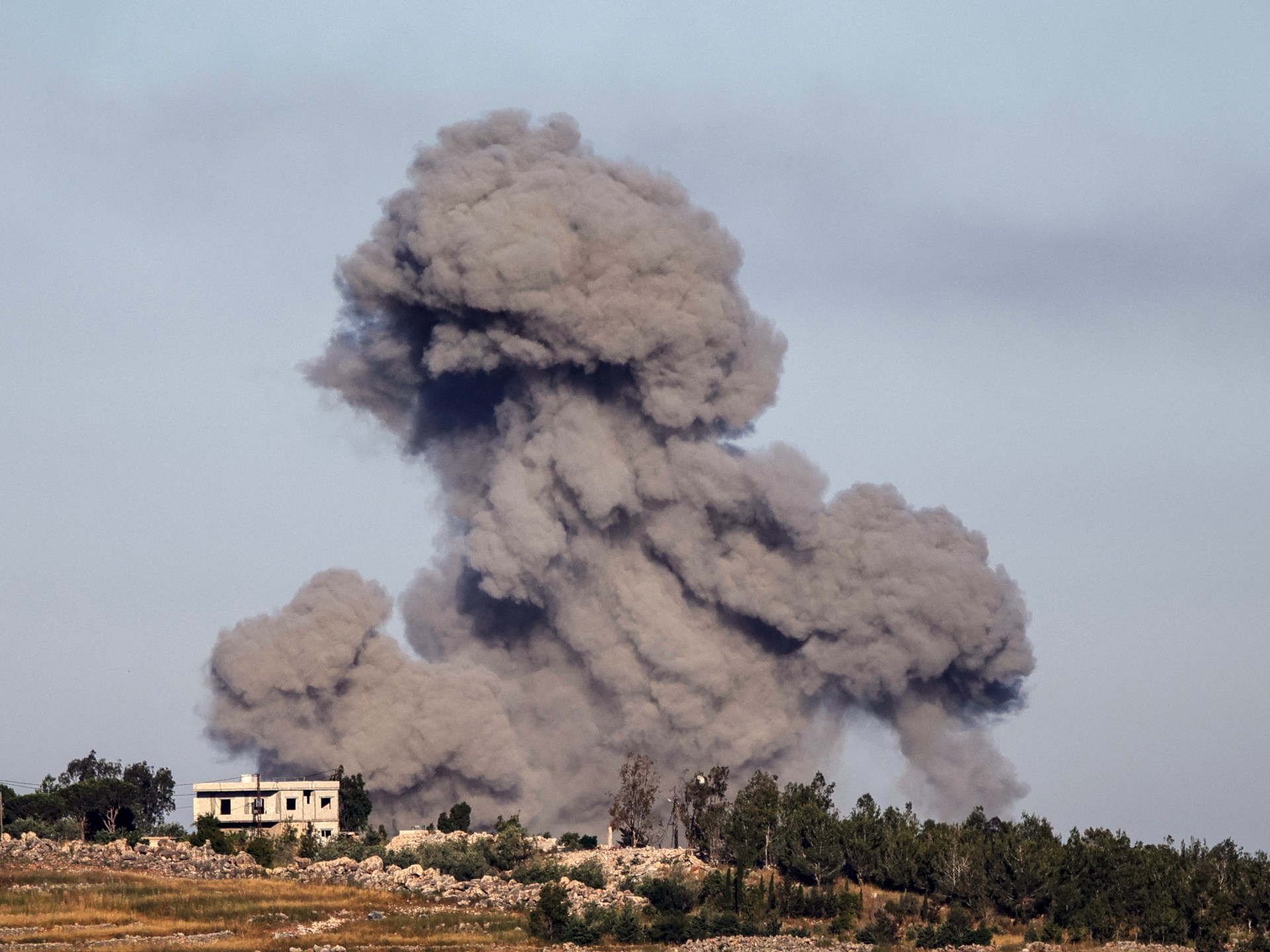
Israeli Defence Minister Israel-katz" class="entity-link entity-person" data-entity-id="4249" data-entity-type="person">Israel Katz describes the capture of Beaufort Castle as a significant tactical victory.Smoke rises from an Israeli air strike on the village of Arnoun, as seen from the Marjayoun area in southern Lebanon [AFP]Published On 31 May 2026Israel has ordered the forced displacement of all residents living south of the Zahrani River in southern Lebanon as it expands its invasion of the country before a possible assault on the city of Nabatieh.In a post on the social media platform X on Sunday, Israeli military Arabic spokesperson Avichay Adraee instructed residents to move immediately north of the Zahrani River, warning that anyone who remained in the area risked being killed.Recommended Stories list of 3 itemslist 1 of 3Harvard Medical School graduate dedicates speech to Lebanon and Palestinelist 2 of 3Netanyahu says Israeli forces have crossed Lebanon’s Litani Riverlist 3 of 3Israeli soldiers reach Nabatieh, one of southern Lebanon’s biggest citiesend of listIsrael had issued more than 10 displacement orders in the previous 24 hours as it expanded its offensive against Hezbollah, after its forces crossed the Litani River on Friday for the first time since 2006.Israel seized Beaufort Castle, which sits atop a strategic hill near Nabatieh, Lebanon’s fifth largest city. The Israeli military previously captured the 12th-century fortress in 1982 and maintained control of it until withdrawing from Lebanon 18 years later.Israeli Defence Minister Israel-katz" class="entity-link entity-person" data-entity-id="4249" data-entity-type="person">Israel Katz described the capture as a significant tactical victory.“Under Prime Minister Benjamin Netanyahu and my direction, the [Israeli military] expanded the operations in Lebanon, crossed the Litani River, and captured the Beaufort Ridge – one of the most important strategic points for defending the communities of the Galilee and safeguarding the security of our forces.”Israel has been encircling Nabatieh, a city that is key to southern Lebanon’s economy and a cultural hub for the region.Nabatieh is viewed by many Lebanese as a symbol of resistance due to its historic role on the front line of Israeli assaults.Despite Israel’s advances in southern Lebanon, Hezbollah, which is backed by Iran, has continued to target Israeli forces. On Sunday, Israel confirmed that one of its soldiers was killed in a Hezbollah drone attack a day earlier, bringing the total number of Israeli soldiers killed since the current round of fighting escalated on March 2 to 25.Al Jazeera correspondent Nida Ibrahim, reporting from the occupied West Bank, said the Israeli government believes Hezbollah has strengthened in recent months and is now showing greater defiance, particularly through the use of drones that have caused casualties in Israel.Hezbollah has been deploying fibre-optic drones that are resistant to electronic jamming and near-impossible to detect by radar. The low-cost aircraft have been able to penetrate Israel’s multi-layered air defence systems, which are valued at billions of dollars.‘Scorched-earth policy’Lebanese Prime Minister Nawaf Salam has denounced Israel’s invasion of the country, accusing its southern neighbour of pursuing a “scorched-earth policy” and imposing “collective punishment” on residents of southern Lebanon. Israel also has repeatedly been accused of collective punishment against Palestinians in Gaza over its genocidal war and blockade of the enclave, including severe restrictions on the flow of humanitarian aid.Reporting from the southern city of Tyre, Al Jazeera’s Obaida Hitto said Israel’s invasion had caused a humanitarian crisis.“The Israeli military has created a zone that is essentially one-fifth of Lebanon’s territory where Lebanese citizens can’t go. Many families can’t return to their homes. There’s ongoing demolitions. Today, Israeli troops continued [to] demolish homes and businesses.”Israel and Lebanon are currently engaged in peace talks facilitated by the United States. Officials from both countries met at the Pentagon in Washington, DC, on Friday to discuss the implementation of the nominal “ceasefire” that came into effect in mid-April, which Israel has repeatedly violated. The negotiations are expected to resume next week.Filippo Dionigi, Senior Lecturer in International Relations at the University of Bristol, told Al Jazeera that the Lebanese government is in an extremely difficult position because Israel is not currently interested in peace, which strengthens Hezbollah’s narrative that it is the country’s only means of defence. Dionigi added that Hezbollah’s opposition to the peace talks further adds to the pressure.“On one hand they have to negotiate with Israel and Israel fundamentally is indicating that it has no significant political plan for Lebanon, it is basically pursuing only a military strategy at this point. On the other hand, they’re [also] pressured from the domestic political scene.”Both Lebanon and Israel want to see Hezbollah disarmed, but Beirut has struggled with the task. Hezbollah, which is stronger than the official state army, argues that it is the country’s only means of defence against Israel.
SRCAl Jazeera
LANGEN
LEANCenter
WORDS766
ENT12
SUN · 2026-05-31 · 08:49 GMTBRIEF NSR-2026-0531-80572
NSR-2026-0531-80572News Report·EN·Conflict
Israel issues more displacement orders in Lebanon, seizes strategic castle
Israel has ordered the forced displacement of residents south of the Zahrani River in southern Lebanon as its invasion expands, potentially targeting the city of Nabatieh. The Israeli military has also seized Beaufort Castle, a strategic location near Nabatieh, which Defense Minister Israel Katz described as a significant tactical victory.
Daniel Khalili-TariAl JazeeraFiled 2026-05-31 · 08:49 GMTLean · CenterRead · 4 min
Al JazeeraFIG 01
Reading time
4min
Word count
766words
Sources cited
3cited
Entities identified
12entities
Quality score
100%
§ 01
Briefing Summary
AI-generatedNEWSAR · AI
Israel has ordered the forced displacement of residents south of the Zahrani River in southern Lebanon as its invasion expands, potentially targeting the city of Nabatieh. The Israeli military has also seized Beaufort Castle, a strategic location near Nabatieh, which Defense Minister Israel Katz described as a significant tactical victory. These actions follow Israeli forces crossing the Litani River for the first time since 2006, as part of an offensive against Hezbollah. Despite Israeli advances, Hezbollah has continued attacks, including a drone strike that killed an Israeli soldier. Lebanese Prime Minister Nawaf Salam has denounced Israel's actions as a "scorched-earth policy" and "collective punishment." Peace talks between Israel and Lebanon are ongoing, but Israel's military strategy is reportedly overshadowing political solutions.
Confidence 0.90Sources 3Claims 5Entities 12
§ 02
Article analysis
Model · rule-basedFraming
Conflict
National Security
Tone
Mixed Tone
AI-assessed
CalmNeutralAlarmist
Factuality
0.70 / 1.00
Factual
LowHigh
Sources cited
3
Well sourced
FewMany
§ 03
Key claims
5 extracted01
Israeli Defence Minister Israel Katz described the capture of Beaufort Castle as a significant tactical victory.
quoteIsrael Katz
Confidence
0.95
02
Israel seized Beaufort Castle, a strategic hill near Nabatieh.
factualArticle
Confidence
0.95
03
Israeli military spokesperson Avichay Adraee instructed residents to move immediately north of the Zahrani River, warning that anyone who remained risked being killed.
quoteAvichay Adraee
Confidence
0.95
04
One Israeli soldier was killed in a Hezbollah drone attack on Saturday, bringing the total killed since March 2 to 25.
statisticIsrael
Confidence
0.90
05
Israel has ordered the forced displacement of all residents living south of the Zahrani River in southern Lebanon.
factualIsrael
Confidence
0.90
§ 04
Full report
4 min read · 766 words§ 05
Entities
12 identifiedKey playerOppositionContextPositiveNeutralNegative
People3
Organizations1
§ 06
Keywords & salience
10 termssouthern lebanon
1.00
displacement orders
1.00
beaufort castle
0.90
nabatieh
0.80
litani river
0.80
israeli military
0.70
hezbollah
0.70
tactical victory
0.60
resistance
0.50
drone attack
0.40
§ 07
Topic connections
Interactive graph Network visualization showing 51 related topics
View Full Graph Person Organization Location Event|Click node to navigate|Edge numbers = shared articles