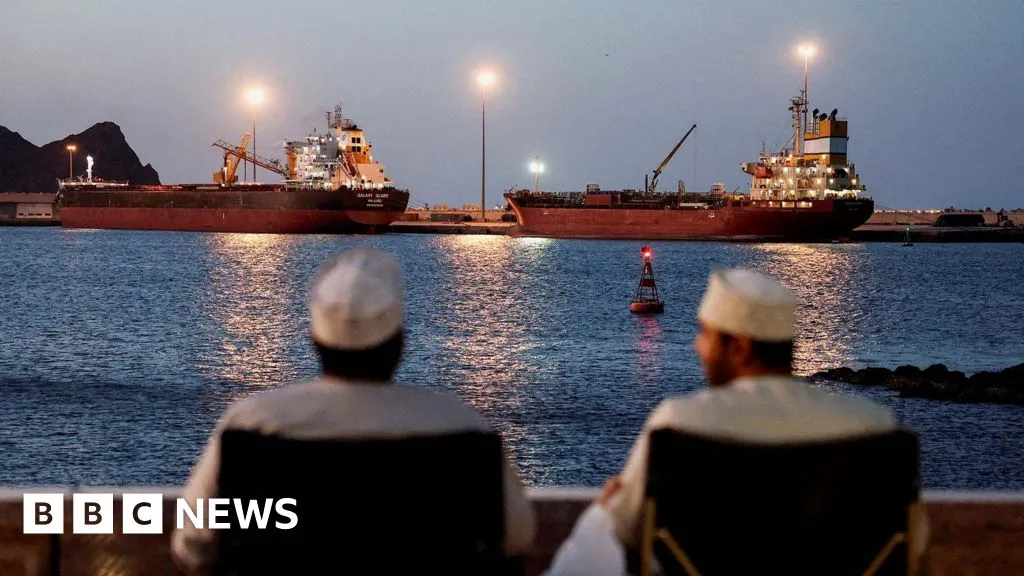
Site search3 hours agoMukimul Himel,BBC News Bangla,Mohammed Zubair Khan,BBC World ServiceandGrace Tsoi,BBC World ServiceReutersThe sea is sometimes so tranquil that Captain Hassan Khan forgets his ship has been stuck in the middle of a war zone for three months."It is really strange that everything looks normal outside, but people inside are not calm," says the Pakistani sailor, who doesn't want to use his real name.Things may look normal in this part of the Gulf, but they are certainly not. Khan and 20,000 other sailors have been trapped in or near the Strait of Hormuz by the Iran" class="entity-link entity-event" data-entity-id="39146" data-entity-type="event">US-Israeli war with Iran since late February. What was once one of the world's busiest waterways, used to transport a fifth of the globe's oil and gas, has ground to a halt as missiles fly overhead and mines are laid beneath the waves.Despite this, the crew on Capt Khan's ship has been trying to follow the usual work routine - although no one wants to leave the ship for rarely-allowed shore breaks, while cheerful banter has given way to anxious silence punctuated by the buzzing of phones. People jump at the smallest sound, even in their sleep."The stress stays in our mind all the time," Khan says. "Everyone is just exhausted – both physically and mentally."Crossings and suppliesEven without the danger posed by the missiles and mines, the 1,600 ships that the International Maritime Organisation (IMO) estimates to be stuck on the wrong side of the Strait of Hormuz are unable to leave. Days after the war began, Iran shut the narrow waterway - the only way out of the Gulf - and refused to let anyone through without its express permission."It is as if we are trapped in a pond. There's only one way out, and that's Hormuz," explains the captain of another vessel, Shafiqul Islam.Islam, whose Bangladesh-owned ship the Banglar Joyjatra is carrying about 37,000 tonnes of fertiliser bound for South Africa, has twice tried to leave in the months since.Both attempts have ended in failure.After the announcement of a ceasefire on 8 April, Islam caught wind that another ship had been given permission by the Islamic Revolutionary Guard Corps (IRGC) to cross. He then steered his ship towards the critical waterway along with four other vessels. Shortly after, they were warned not to proceed.Nine days later, Islam tried again as Iran said the strait would be "completely open" for all commercial vessels in line with the ceasefire. But Iran quickly reversed the decision after the US kept the blockade of its ports in place.By then, Islam's ship had already come within 30 nautical miles of the strait. He had no choice but to turn it away as warnings of attacks continued to crackle over the radio.Rashedul HasanBanglar Joyjatra's Captain Islam (second from the right in the front row) and chief engineer Rashedul Hasan (sitting to the left of the captain) record a video for the crew to boost their moraleShips have moved to different ports or anchored offshore within the Gulf for safety. But now, getting supplies of food and water has become increasingly pressing.Doing so is still possible without necessarily entering ports, as the Gulf region - especially around Dubai, Abu Dhabi and Kuwait - has well-established supply services. But deliveries are now unpredictable.Among all essential items, the price of water has increased the most, says Banglar Joyyatra's chief engineer Rashedul Hasan. "We purchased about 180 tonnes of water for the ship two days ago. Earlier, it would cost between $1,500 and $2,000. Now, it costs us $11,000.""It also feels like some food and water suppliers are trying to take advantage of the situation and make excessive profits," says a Korean sailor who doesn't want to be named. He is on a different ship.The stranded ships will need even more water as summer is coming. The air temperature has already exceeded 30C in May – and it can go as high as 45C.On Khan's ship, they "still have food and water, but things are simpler now". While he can still get beef and chicken, vegetables and lentils are hard to come by.Death and diplomacyRashedul HasanBanglar Joyjatra set sail from Bangladesh in late January and is now docked at Port of Sharjah, UAEBut then, Islam still considers himself lucky. On the second day of the conflict, his ship was only 200m (656ft) – barely the length of a medium-sized tanker – from Dubai's Jebel Ali port, which was targeted by an Iranian strike.Since then, Islam and his 30 crew members have lost count of the attacks they have witnessed. "Sometimes missiles fly over one ship, and sometimes debris falls on the next," the captain says."Whenever attacks continued throughout the night, none of us could sleep," says Hasan, the engineer. "We have witnessed horror and devastation with our eyes."They are scared for good reason. At least 11 sailors have been killed and another is unaccounted for in 39 verified incidents, the IMO says.Tension eased somewhat after the ceasefire, but the ongoing military activities in the strait are reminders of its fragility.Some sailors continue to see drones and fighter jets, while others spot naval ships and submarines regularly."These ships use bright lights. We also hear announcements over the loudspeakers. The captain says the Iranians are doing this to stop anyone from passing through," says Sajid Masood, a Pakistani who works as a cook on an oil tanker. His name has been changed to protect his identity.ReutersIran retaliated by launching attacks across Gulf countries, including the UAE's Jebel Ali Port, after the US-Israeli strikesSo is there any way out for the trapped sailors?Shipping companies, which are facing huge losses, are hoping they may be able to cut staffing costs.Many sailors' contracts are expiring and large-scale crew rotations are overdue. Given the circumstances, it will be difficult to find enough hands to man these ships – even after the war is over."This crisis has shown how dangerous the job can become," says Pakistani sailor Kamil, who spoke to the BBC using an alias. "Many sailors may think differently about this profession." He is worried that access to international waterways will become weaponised in future conflicts.Masood, the cook, is also having second thoughts about his seafaring career – he has only one month left on his contract.But before making the big decision, he is just looking forward to returning to Pakistan and bringing gifts from Dubai for his family: Barbie dolls for his daughters and a toy airplane for his son."I thought I would be home soon, but we are still stuck," he says. "Every day my family asks when I will come back, but I have no answers for them."Rashedul HasanRashedul Hasan says he has faith in overcoming this "critical moment" with courageThere are some ships - an estimated 750 since 28 February, according to maritime data firm Kpler - which have managed to get through the Strait of Hormuz.Their owners appear to have relied on international direct diplomacy with Iran, with most coming from China, India and Pakistan, says Dr Jonathan Schroden of CNA, a Washington DC-based non-profit research organisation.It appears they have also "paid a fee of some millions of dollars per ship", he adds.Diplomacy is now the Banglar Joyjatra's best hope – and the Bangladeshi government has been working with its owner Bangladesh Shipping Corporation (BSC) to secure its exit.But that has proved difficult as well.BSC managing director Commodore Mahmudul Malek said initially Bangladesh agreed to pay the toll Iran demanded. But the plan was dropped after the US threatened sanctions against any country for doing so."We are in a double crisis now," he says.
SRCBBC News - World
LANGEN
LEANCenter
WORDS1 263
ENT12
TUE · 2026-06-02 · 23:40 GMTBRIEF NSR-2026-0603-81300
NSR-2026-0603-81300News Report·EN·Human Interest
Sailors stressed and exhausted after months trapped by Strait of Hormuz blockade
Approximately 20,000 seafarers are trapped and experiencing significant stress and exhaustion due to the ongoing conflict in the Strait of Hormuz, which began in late February. Iran has blocked the waterway, preventing ships from passing, leading to an estimated 1,600 vessels being stuck.
BBC News - WorldFiled 2026-06-02 · 23:40 GMTLean · CenterRead · 6 min
BBC News - WorldFIG 01
Reading time
6min
Word count
1 263words
Sources cited
3cited
Entities identified
12entities
Quality score
100%
§ 01
Briefing Summary
AI-generatedNEWSAR · AI
Approximately 20,000 seafarers are trapped and experiencing significant stress and exhaustion due to the ongoing conflict in the Strait of Hormuz, which began in late February. Iran has blocked the waterway, preventing ships from passing, leading to an estimated 1,600 vessels being stuck. Sailors report constant anxiety, disrupted routines, and fear due to missile attacks and mines. The blockade has also caused disruptions in essential supplies, with the price of water significantly increasing. Despite a ceasefire announcement, attempts to navigate the strait have been unsuccessful, leaving crews in a precarious situation with dwindling resources and heightened safety concerns.
Confidence 0.90Sources 3Claims 5Entities 12
§ 02
Article analysis
Model · rule-basedFraming
Human Interest
Conflict
Tone
Mixed Tone
AI-assessed
CalmNeutralAlarmist
Factuality
0.70 / 1.00
Factual
LowHigh
Sources cited
3
Well sourced
FewMany
§ 03
Key claims
5 extracted01
Captain Shafiqul Islam explains, 'It is as if we are trapped in a pond. There's only one way out, and that's Hormuz.'
quoteCaptain Shafiqul Islam
Confidence
1.00
02
Captain Hassan Khan states, 'It is really strange that everything looks normal outside, but people inside are not calm.'
quoteCaptain Hassan Khan
Confidence
1.00
03
The Strait of Hormuz, which transports a fifth of the globe's oil and gas, has halted operations due to missiles and mines.
factualBBC News
Confidence
0.90
04
Sailors are stressed and exhausted after being trapped for months by the Strait of Hormuz blockade.
factualBBC News
Confidence
0.90
05
Approximately 20,000 sailors have been trapped in or near the Strait of Hormuz due to the US-Israeli war with Iran since late February.
statisticBBC News
Confidence
0.80
§ 04
Full report
6 min read · 1 263 words§ 05
Entities
12 identifiedKey playerOppositionContextPositiveNeutralNegative
Organizations4
Locations5
§ 06
Keywords & salience
10 termssailors stressed and exhausted
1.00
strait of hormuz blockade
1.00
us-israeli war with iran
0.90
trapped ships
0.80
maritime blockade
0.70
global trade disruption
0.70
oil and gas transport
0.60
islamic revolutionary guard corps
0.50
ceasefire announcement
0.40
mental health impact
0.40
§ 07
Topic connections
Interactive graph Network visualization showing 51 related topics
View Full Graph Person Organization Location Event|Click node to navigate|Edge numbers = shared articles