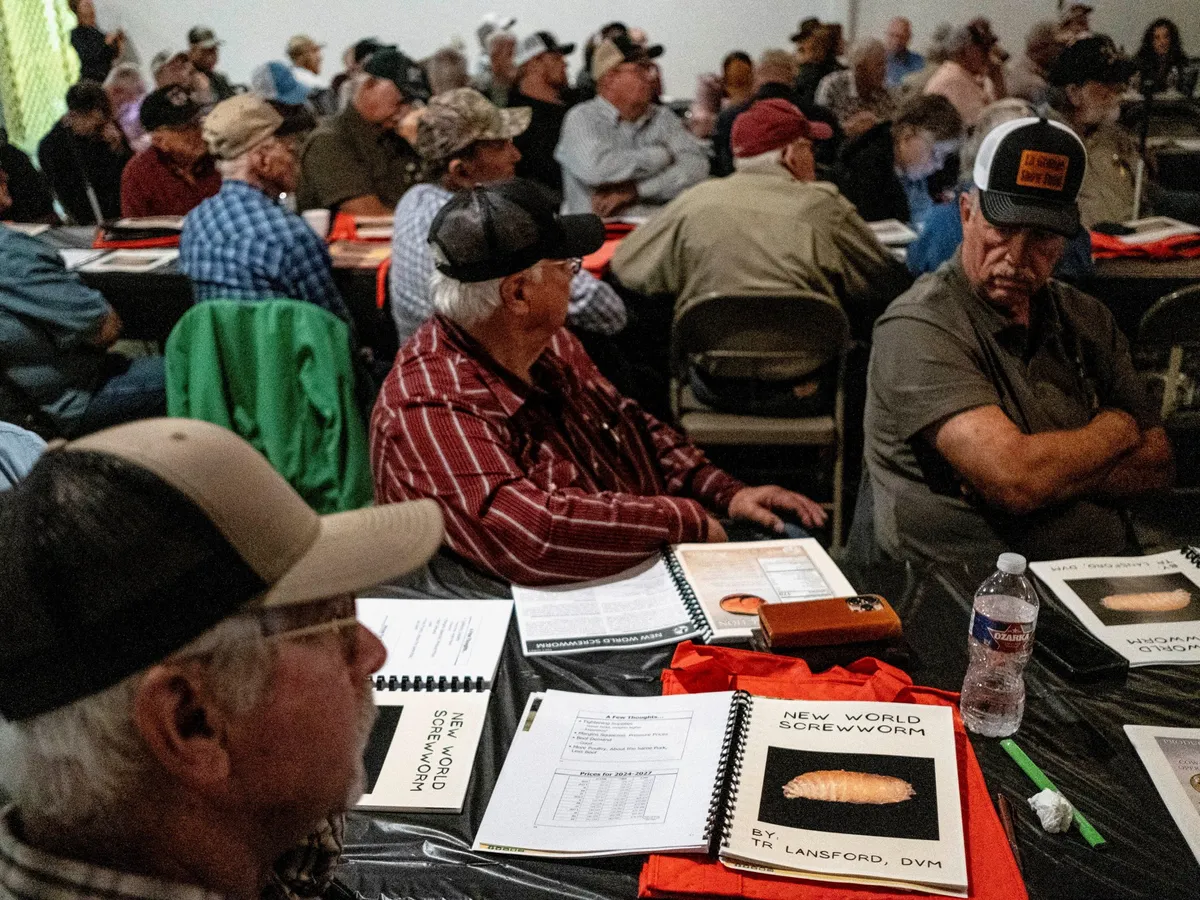
EXPLAINERThe US Department of Agriculture says New World Screwworm has been detected in a Texas calf.Cattle ranchers at a presentation on the threat of the New World Screwworm in La Grange, Texas, May 1 [Joel Angel Juarez/Reuters]Published On 4 Jun 2026The New World Screwworm, a flesh‑eating parasite which infects cattle and other warm‑blooded animals, has been found in a calf in Texas, the US Department of Agriculture announced on Wednesday.The screwworm is believed to have travelled from Central America to Mexico before being found in the calf in Texas, evading biological barriers that have kept the pest contained for decades, experts said. Screwworm was previously declared eradicated in the US in 1966.Between mid-July and mid-August 2025, Mexico reported a 53 percent rise in the number of cases in animals. Humans can also be infected.An outbreak in the US could heavily impact the livestock industry and cause increased beef prices. The USDA predicts that could cost the Texas economy $1.8bn in losses.Here is why the first confirmed case in six decades is so concerning.What is screwworm and can humans be infected?A screwworm comes from the larvae of a screwworm fly, also called Cochliomyia hominivorax and, yes, humans can be infected.Female screwworm flies lay their eggs in scratches and wounds of warm-blooded animals, normally livestock or wild animals. The eggs hatch into hundreds of screwworm larvae which eat the living tissue of the infected animals.The flies are attracted to the smell of open wounds on the bodies of these animals, or sometimes even of humans. Newborn calves are at high risk because the post-partum navel has yet to scar.The larvae use their sharp mouths to burrow through the living flesh of their hosts for about a week.Then they drop to the ground, form a pupa and develop in the ground for another week to two months before emerging as an adult fly.Screwworm can be devastating in cattle and wildlife which can die from infection if untreated.As adult screwworm flies are capable of travelling many kilometres in search of hosts, infestations can spread quickly across wildlife populations, livestock herds and between humans.Dr Timothy Goldsmith, a veterinary medicine professor at the University of Minnesota, told Reuters that homeless people can be especially vulnerable to infestation because they sleep outside and have less access to hygiene products and medical care.It is rare for people to catch screwworm, however, and they cannot be infected by New World Screwworm from eating normal, inspected, cooked beef.Last year, Mexico confirmed 41 human cases, primarily in the state of Chiapas, according to Mexican media.The New World Screwworm is a species of parasitic fly that is known for the way its larvae eat living tissue [Shutterstock]What are the symptoms?Screwworm infestations in wildlife and humans cause painful, progressive wounds as larvae burrow into living tissue. Symptoms include open, foul-smelling sores that enlarge rapidly, with visible maggots inside.Affected animals may show weakness, reduced mobility, weight loss and abnormal behaviour from distress. In humans, symptoms include severe pain, swelling, fever and secondary infections.Screwworm is diagnosed primarily by visual identification of larvae in wounds. The maggots have distinctive features, such as dark tracheal tubes visible through their bodies with bands of spines around each segment.If untreated, infestations can lead to tissue destruction and even death.How is screwworm treated?Painfully.The hundreds of larvae which hatch in a wound have to be manually removed, and the wounds must be disinfected.Antibiotics are often prescribed to control secondary bacterial infections, and pain management may be necessary in severe cases.In animals, insecticides are used to kill remaining larvae and prevent re-infestation.With thorough care, recovery is possible, but untreated cases can lead to extensive tissue damage and death.How are authorities responding to this latest case in Texas?The current case concerns a three-week old calf infested with screw worm in LaPryor Texas, around around 50km (30 miles) from the Mexican border.“This is regarded as a locally acquired infestation with the larvae infesting the umbilical cord of the calf,” Cheryl Whitehorn, medical entomologist and principal scientific officer at the London School of Hygiene and Tropical Medicine (LSHTM), told Al Jazeera.A quarantine zone spanning 20km (12.4 miles) has been established around the affected farm with no movement of any animals including pets, the animal is being treated and the larvae will be killed, Whitehorn said.“The primary measure is vigilance, identification and isolation of cases, treatment and elimination of larvae and controlling movement of animals. A programme of sterile male release is the best long-term method of controlling this fly,” she said.Why is this significant?Last August, the US Department of Health and Human Services (HHS) reported America’s first ever human case of New World Screwworm.The case, investigated by the US Centers for Disease Control and Prevention (CDC) involved a patient who had returned from El Salvador to the US state of Maryland. Local news reports suggested the patient made a full recovery.The recent case in a Texas calf is significant because it is the first time New World Screwworm has been detected in animals in the United States since it was declared eradicated in 1966. That followed the massive release of sterile flies which killed off existing populations.The parasite reappeared in Panama, Costa Rica, Nicaragua, Honduras, Guatemala, Belize and El Salvador before moving on to Mexico in 2023.While the precise reasons are unclear, experts point to a combination of factors, including possible disruptions to sterile‑fly programmes during the COVID‑19 pandemic, increased movement of livestock and people, and favourable weather conditions that have helped the fly to thrive.How does this impact beef prices?Washington has halted cattle imports from Mexico for the past year, citing the insect’s spread further into Mexico.The US typically imports more than one million Mexican cattle annually. The import suspension contributed to rising beef prices by tightening the supply of beef cattle, which dwindled after a drought forced ranchers on both sides of the border to reduce herds.A US outbreak would cause further shortages to the cattle supply and put other livestock and household pets at risk.Mexican cattle are usually fed and fattened on US farms for five to six months before slaughter, and a diminished slaughter rate can also raise beef prices.With US cattle herds already at a multi‑decade low after severe drought, high feed costs have forced ranchers to shrink their herds. The suspension of US imports of live cattle from Mexico has pushed record‑high beef prices even higher, as more calves have been kept out of the US supply chain.The first confirmed case in the US during the latest outbreak represents a serious challenge for ranchers and could cause beef prices to rise further.After decades of eradication, most cattle ranchers no longer have the experience or tools to diagnose and treat screwworm, experts say.Infestations can be cured, but treatment is a time-consuming, pricey and labour-intensive process.
SRCAl Jazeera
LANGEN
LEANCenter
WORDS1 125
ENT10
THU · 2026-06-04 · 13:05 GMTBRIEF NSR-2026-0604-81732
NSR-2026-0604-81732News Report·EN·Public Health
First US screwworm case in 60 years: Should America be worried?
The US Department of Agriculture has confirmed the first New World screwworm case in a Texas calf in 60 years. This flesh-eating parasite, believed to have traveled from Central America, lays eggs in wounds of warm-blooded animals, with larvae consuming living tissue.
Sarah ShamimAl JazeeraFiled 2026-06-04 · 13:05 GMTLean · CenterRead · 5 min
Al JazeeraFIG 01
Reading time
5min
Word count
1 125words
Sources cited
2cited
Entities identified
10entities
Quality score
100%
§ 01
Briefing Summary
AI-generatedNEWSAR · AI
The US Department of Agriculture has confirmed the first New World screwworm case in a Texas calf in 60 years. This flesh-eating parasite, believed to have traveled from Central America, lays eggs in wounds of warm-blooded animals, with larvae consuming living tissue. While rare, humans can also be infected, and an outbreak could significantly impact the livestock industry, potentially costing the Texas economy $1.8 billion. The affected calf in LaPryor, Texas, is being treated, and a quarantine zone has been established. Authorities are implementing measures including vigilance, identification, isolation, treatment, and controlling animal movement, with sterile male release considered a long-term control method.
Confidence 0.90Sources 2Claims 5Entities 10
§ 02
Article analysis
Model · rule-basedFraming
Public Health
Economic Impact
Tone
Mixed Tone
AI-assessed
CalmNeutralAlarmist
Factuality
0.80 / 1.00
Factual
LowHigh
Sources cited
2
Limited
FewMany
§ 03
Key claims
5 extracted01
New World screwworm has been detected in a calf in Texas, the first case in the US in 60 years.
factualUS Department of Agriculture
Confidence
1.00
02
Humans can also be infected by screwworm, though it is rare.
factual
Confidence
0.95
03
The USDA predicts that an outbreak could cost the Texas economy $1.8bn in losses.
statisticUSDA
Confidence
0.90
04
The screwworm is believed to have travelled from Central America to Mexico before being found in Texas.
factualexperts
Confidence
0.90
05
An outbreak in the US could heavily impact the livestock industry and cause increased beef prices.
prediction
Confidence
0.80
§ 04
Full report
5 min read · 1 125 words§ 05
Entities
10 identifiedKey playerOppositionContextPositiveNeutralNegative
Organizations3
Locations4
§ 06
Keywords & salience
9 termsnew world screwworm
1.00
flesh-eating parasite
0.90
livestock industry
0.80
texas
0.70
animal infection
0.60
usda
0.50
economic impact
0.50
eradicated
0.40
human infection
0.40
§ 07
Topic connections
Interactive graph Network visualization showing 7 related topics
View Full Graph Person Organization Location Event|Click node to navigate|Edge numbers = shared articles