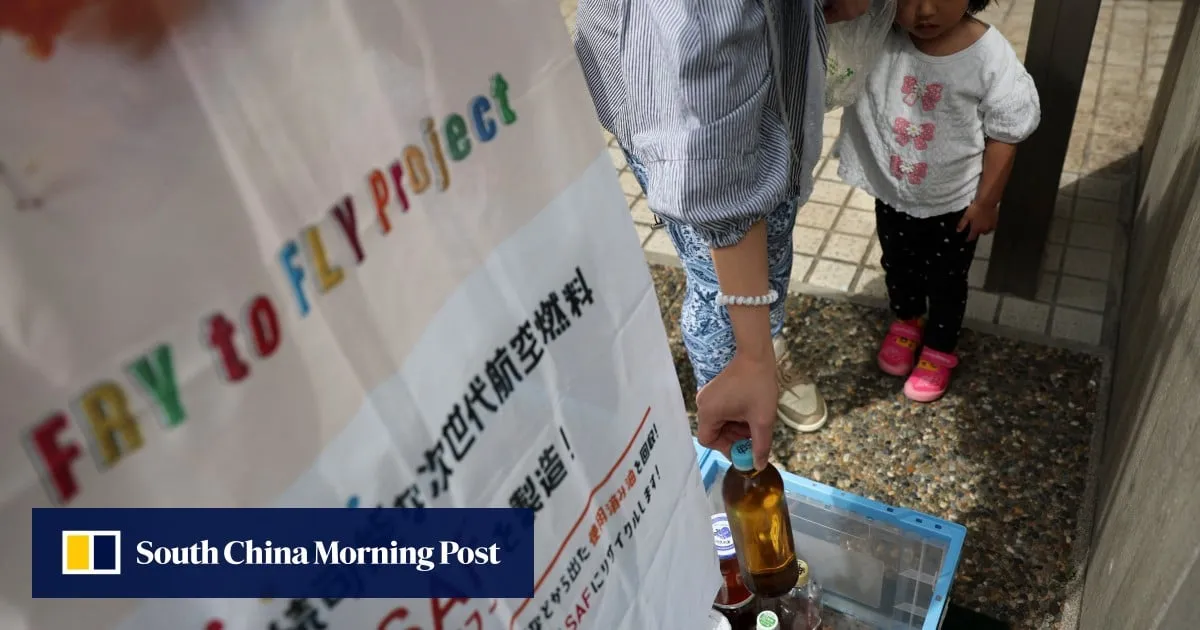
Japanese homemaker Maki Watanabe carefully pours into a plastic bottle the oil she used to cook her deep-fried aubergines, doing her part in her Tokyo kitchen for a national effort to ramp up production of eco-friendly jet fuel.“It would take a tremendous amount to make an aircraft fly, so I hope we can collect more,” said Watanabe, whose penchant for cooking allows her to donate about 40 litres (10 gallons) a year.Her contribution is pooled at a nearby supermarket that is among roughly 300 participants in a public-private project dubbed “Fry to Fly”, as the Iran war squeezes energy supply and raises costs for the resource-poor country.Japan is looking to consumers like Watanabe with more urgency than ever as it scrambles to reach a goal of procuring a tenth of airline fuel from sustainable sources by 2030.The world’s fourth-biggest economy estimates it needs about 1.7 million kilolitres in 2030, and hopes to gain as much as it can domestically through used cooking oil, a relatively cheap feedstock for Sustainable Aviation Fuel (SAF).But scarce feedstock and lack of infrastructure have limited domestic output of SAF to just 30,000 kilolitres now, or 0.3 per cent of total jet fuel use.
SRCSouth China Morning Post
LANGEN
LEANCenter-Right
WORDS198
ENT6
SAT · 2026-06-06 · 01:07 GMTBRIEF NSR-2026-0606-82137
NSR-2026-0606-82137News Report·EN·Environmental
How everyday cooking oil is helping Japan fight an aviation fuel crisis
Japan is facing an aviation fuel crisis exacerbated by the Iran war, prompting a national effort to increase the production of sustainable aviation fuel (SAF). The country aims to source ten percent of its airline fuel from sustainable sources by 2030, requiring approximately 1.7 million kilolitres annually.
ReutersSouth China Morning PostFiled 2026-06-06 · 01:07 GMTLean · Center-RightRead · 1 min
South China Morning PostFIG 01
Reading time
1min
Word count
198words
Sources cited
1cited
Entities identified
6entities
Quality score
100%
§ 01
Briefing Summary
AI-generatedNEWSAR · AI
Japan is facing an aviation fuel crisis exacerbated by the Iran war, prompting a national effort to increase the production of sustainable aviation fuel (SAF). The country aims to source ten percent of its airline fuel from sustainable sources by 2030, requiring approximately 1.7 million kilolitres annually. To achieve this, Japan is encouraging citizens, like homemaker Maki Watanabe in Tokyo, to donate used cooking oil. This oil is collected through a public-private project called "Fry to Fly," involving around 300 participants, including supermarkets. While used cooking oil is a cost-effective feedstock for SAF, current domestic output is limited to 30,000 kilolitres due to scarce feedstock and insufficient infrastructure.
Confidence 0.90Sources 1Claims 5Entities 6
§ 02
Article analysis
Model · rule-basedFraming
Environmental
Economic Impact
Tone
Measured
AI-assessed
CalmNeutralAlarmist
Factuality
0.80 / 1.00
Factual
LowHigh
Sources cited
1
Limited
FewMany
§ 03
Key claims
5 extracted01
Maki Watanabe, a Japanese homemaker, donates about 40 litres of used cooking oil per year.
quoteMaki Watanabe
Confidence
1.00
02
The 'Fry to Fly' project involves roughly 300 participants in Japan collecting used cooking oil.
factual
Confidence
0.90
03
Domestic output of SAF in Japan is currently 30,000 kilolitres, or 0.3 per cent of total jet fuel use.
statistic
Confidence
0.90
04
Japan needs about 1.7 million kilolitres of sustainable aviation fuel in 2030.
statistic
Confidence
0.90
05
Japan is aiming to procure a tenth of its airline fuel from sustainable sources by 2030.
prediction
Confidence
0.90
§ 04
Full report
1 min read · 198 words§ 05
Entities
6 identifiedKey playerOppositionContextPositiveNeutralNegative
§ 06
Keywords & salience
7 termssustainable aviation fuel
1.00
used cooking oil
0.90
energy crisis
0.80
japan
0.70
fry to fly
0.60
feedstock
0.50
domestic output
0.40
§ 07
Topic connections
Interactive graph Network visualization showing 51 related topics
View Full Graph Person Organization Location Event|Click node to navigate|Edge numbers = shared articles