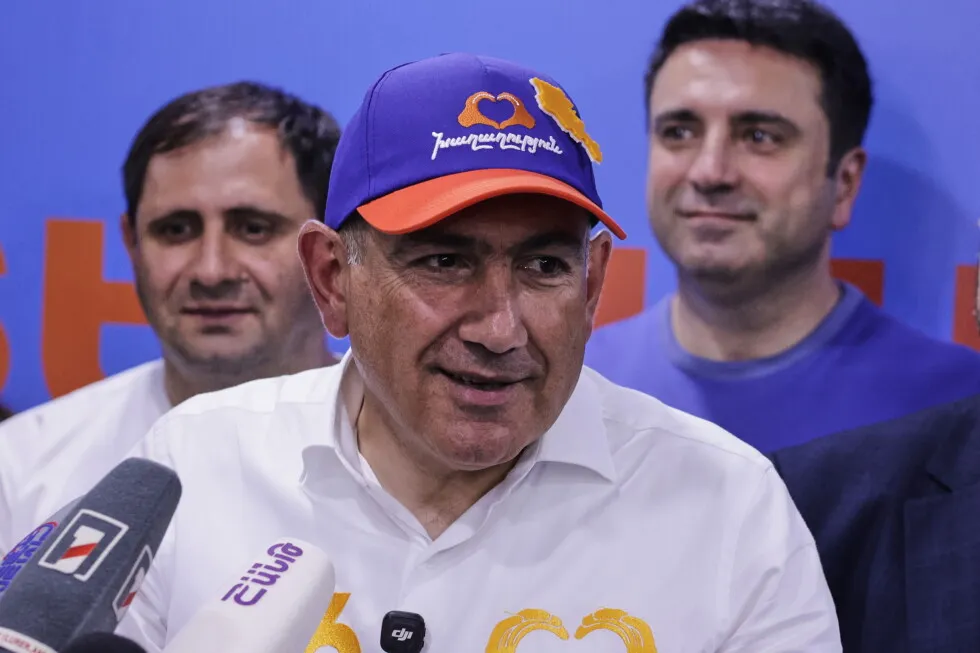
Armenian Prime Minister Pashinyan claims victory in election seen as test of Russia’s influence 1 of 4 | Armenian Prime Minister Nikol Pashinyan speaks at his Armenia Ruling Civil Contract party headquarters after parliamentary elections in Yerevan, Armenia, Monday, June 8, 2026. (AP Photo/Anthony Pizzoferrato) 2 of 4 | Armenian Prime Minister Nikol Pashinyan speaks to journalists after voting at a polling station during the parliamentary election in Yerevan, Armenia, Sunday, June 7, 2026. (AP Photo/Anthony Pizzoferrato) 3 of 4 | A member of an election commission prepares the ballots while waiting for voters at a polling station, during a parliamentary election in Yerevan, Armenia, Sunday, June 7, 2026. (AP Photo/Anthony Pizzoferrato) 4 of 4 | Russian-Armenian tycoon Samvel Karapetyan speaks to the media after voting at a polling station during a parliamentary election in Yerevan, Armenia, Sunday, June 7, 2026. (AP Photo/Anthony Pizzoferrato) By AVET DEMOURIAN Updated 4:27 PM MESZ, June 8, 2026 Leer en español Add AP News on Google Add AP News as your preferred source to see more of our stories on Google. Share Share Facebook Copy Link copied Print Email X LinkedIn Bluesky Flipboard Pinterest Reddit Yerevan, Armenia (AP) — Armenian Prime Minister Nikol Pashinyan claimed victory Monday in a general election seen as a test of Russia’s influence in the South Caucasus country, as preliminary results showed his governing party in first with more than double the votes of the next contender. Pashinyan was looking for a strong mandate for a new geopolitical course that includes distancing Armenia from Moscow and deepening cooperation with the West. “The European Union is our main partner in democratic reform implementation, and we will continue that path,” Pashinyan said as he cast his vote on Sunday. Pashinyan’s Civil Contract party came in first with 49.82% of the vote, according to the latest preliminary results on Monday. His main opponent, Samvel Karapetyan, is a billionaire who made his fortune in Russia and is under house arrest, accused of advocating for the government’s overthrow. Karapetyan, whose Armenia" class="entity-link entity-organization" data-entity-id="141693" data-entity-type="organization">Strong Armenia bloc was the runner-up with 23.28% of the vote, rejects that charge as politically motivated. Armenian investigators said they also issued six arrest warrants for members of Armenia" class="entity-link entity-organization" data-entity-id="141693" data-entity-type="organization">Strong Armenia the day before the election, accusing them of buying votes. The party seeks to develop close business ties with Moscow and has accused Pashinyan of attempting to start a war with the Kremlin. While the Central Election Commission says it has counted ballots from all electoral precincts, full results are not expected until Sunday. This is to give parties time to lodge complaints about any perceived irregularities. Armenians vote in general election under Russian pressure aimed at preventing a drift toward West Armenia prepares for an election that could reshape ties with Moscow and the West Armenia hosts a historic European Union summit as the country charts a course away from Russia ‘Referendum on the future of the country’ Richard Giragosian, who heads the Regional Studies Center think tank in Armenia’s capital, Yerevan, said that despite concerns that Russia was trying to sway the election, the vote had been “genuinely free and fair” and “stands as a referendum on the future of the country.” “Much of the Russian efforts at interference fell flat and were ineffective,” Giragosian told the AP on Monday. Russia has warned Armenia it would suffer economic consequences if it continues moves toward the EU. Moscow controls a significant portion of Armenia’s energy and infrastructure, a point that has been driven home by Russian President Vladimir Putin in his meetings with Pashinyan. Russia recently banned the import of a number of Armenian products, including, flowers, wine and fish. Moscow has cited violations of import rules, but the European Commission has called the measures “economic coercion.” Putin and other Russian officials also have made thinly veiled threats comparing Armenia’s path to that already taken by Ukraine, which was invaded by Russia. Armenia’s National Assembly must consist of at least 101 members elected for five-year terms. Parties must win at least 4% of the vote to enter, while blocs made up of three or more parties must hit 8%. The Hayastan (Armenia) bloc led by former President Robert Kocharyan is also set to take seats, receiving 9.93% of the vote. The Prosperous or Blossoming Armenia party, led by pro-Russia businessman Gagik Tsarukyan, has hovered around the 4% threshold. Turnout stood at 58.94%, according to the latest announcement by the election commission. Preliminary results from the election commission suggested the governing party has won 61 seats in the National Assembly. According to Giragosian, the analyst, this will allow Pashinyan’s party to rule on its own and pass most laws independently, but not to secure constitutional amendments without a referendum. PM vows to continue peace process with neighboring Azerbaijan Opposition parties have strongly criticized the government for attempting to normalize relations with neighboring Azerbaijan. Pashinyan and Azerbaijani President Ilham Aliyev initialed a document on moving toward a peace deal at the White House alongside U.S. President Donald Trump in August. Armenia and Azerbaijan were locked in a decades-long conflict over Karabakh, a breakaway region that had been controlled for decades by ethnic Armenian forces backed by Yerevan. Azerbaijan took control of the entire Karabakh region during a rapid offensive in 2023. Pashinyan announced on Monday that Armenia intends to move toward “institutionalizing” a peace deal, and ratifying an agreement with the White House that would create a major transit corridor through Armenian territory to be named after Trump. “This is a truly transformative project, as Armenia is becoming a crossroads of the world,” Pashinyan said at a meeting of a parliamentary committee, referring to the country’s position bridging Europe’s hungry energy markets and Central Asia’s gas fields. Giragosian said a priority of the next government will be border demarcation with Azerbaijan, as well as cracking down on corruption. “It’s not going to be easy,” he said, adding that the government’s re-election was, for many voters, because of a lack of any credible alternative, saying the opposition was “largely discredited and mistrusted.” Top officials of the EU, which is preparing an economic support package for Armenia, congratulated Pashinyan following the tightly contested race. “We deeply value our partnership with a democratic Armenia that is drawing ever closer to Europe. Armenia can count on us,” European Commission President Ursula von der Leyen said on social media on Monday. Kaja Kallas, the EU’s foreign policy chief, said Armenians have withstood “heavy Russian pressure and economic coercion.” Russia’s Foreign Ministry said in a statement that same day that Armenia’s elections were held “amid unprecedented pressure on the opposition and interference from the West, primarily the EU.” The ministry’s spokesperson, Maria Zakharova, did not give examples of such interference, but said “the elections clearly demonstrated that Armenian society is extremely polarized.” She added that Moscow’s approach to future relations will “take into account actual steps taken by the Armenian leadership.” According to Giragosian, Russia “is not necessarily that surprised or that upset” at the result. “It seems the lack of direct Russian support for the opposition reflects a Russian desire to continue working with the Pashinyan government but to increase pressure” on it, he said. AP writers Sam McNeil in Brussels and Menelaos Hadjicostis in Nicosia, Cyprus contributed. An earlier version of this story wrongly stated that according to an earlier announcement by Armenia’s election commission, turnout in the general election on Sunday stood at 97%. The correct figure at that time was 59.97%.
SRCAssociated Press (AP)
LANGEN
LEANCenter
WORDS1 245
ENT10
MON · 2026-06-08 · 14:23 GMTBRIEF NSR-2026-0608-82737
NSR-2026-0608-82737News Report·EN·Political Strategy
Armenian PM Nikol Pashinyan claims victory in election seen as test of Russia’s influence
Armenian Prime Minister Nikol Pashinyan claimed victory in a general election held on Sunday, June 8, 2026, which was seen as a test of Russia's influence. Preliminary results show his Civil Contract party leading with 49.82% of the vote, securing enough seats to form a government independently.
Associated Press (AP)Filed 2026-06-08 · 14:23 GMTLean · CenterRead · 5 min
Associated Press (AP)FIG 01
Reading time
5min
Word count
1 245words
Sources cited
1cited
Entities identified
10entities
Quality score
100%
§ 01
Briefing Summary
AI-generatedNEWSAR · AI
Armenian Prime Minister Nikol Pashinyan claimed victory in a general election held on Sunday, June 8, 2026, which was seen as a test of Russia's influence. Preliminary results show his Civil Contract party leading with 49.82% of the vote, securing enough seats to form a government independently. Pashinyan's party seeks a mandate for a new geopolitical course, including closer ties with the West and distancing from Moscow. His main opponent, Samvel Karapetyan, whose party received 23.28% of the vote, is a Russian-based billionaire accused of advocating for the government's overthrow, charges he denies. The election occurred amidst Russian economic pressure and thinly veiled threats, while the EU congratulated Pashinyan and pledged support.
Confidence 0.90Sources 1Claims 5Entities 10
§ 02
Article analysis
Model · rule-basedFraming
Political Strategy
Diplomatic
Tone
Measured
AI-assessed
CalmNeutralAlarmist
Factuality
0.80 / 1.00
Factual
LowHigh
Sources cited
1
Limited
FewMany
§ 03
Key claims
5 extracted01
The EU is Armenia's main partner in democratic reform implementation.
quoteNikol Pashinyan
Confidence
1.00
02
Armenian Prime Minister Nikol Pashinyan claimed victory in a general election.
factualNikol Pashinyan
Confidence
1.00
03
Pashinyan's Civil Contract party received 49.82% of the vote according to preliminary results.
statisticCentral Election Commission
Confidence
0.95
04
Samvel Karapetyan, Pashinyan's main opponent, is under house arrest accused of advocating for the government's overthrow.
factualArmenian investigators
Confidence
0.90
05
The election was seen as a test of Russia’s influence in Armenia.
factual
Confidence
0.90
§ 04
Full report
5 min read · 1 245 words§ 05
Entities
10 identifiedKey playerOppositionContextPositiveNeutralNegative
Organizations3
Locations4
§ 06
Keywords & salience
9 termsarmenian election
1.00
russia influence
0.90
nikol pashinyan
0.90
geopolitical course
0.80
west cooperation
0.70
democratic reform
0.60
european union
0.50
samvel karapetyan
0.50
vote buying accusations
0.40
§ 07
Topic connections
Interactive graph Network visualization showing 14 related topics
View Full Graph Person Organization Location Event|Click node to navigate|Edge numbers = shared articles