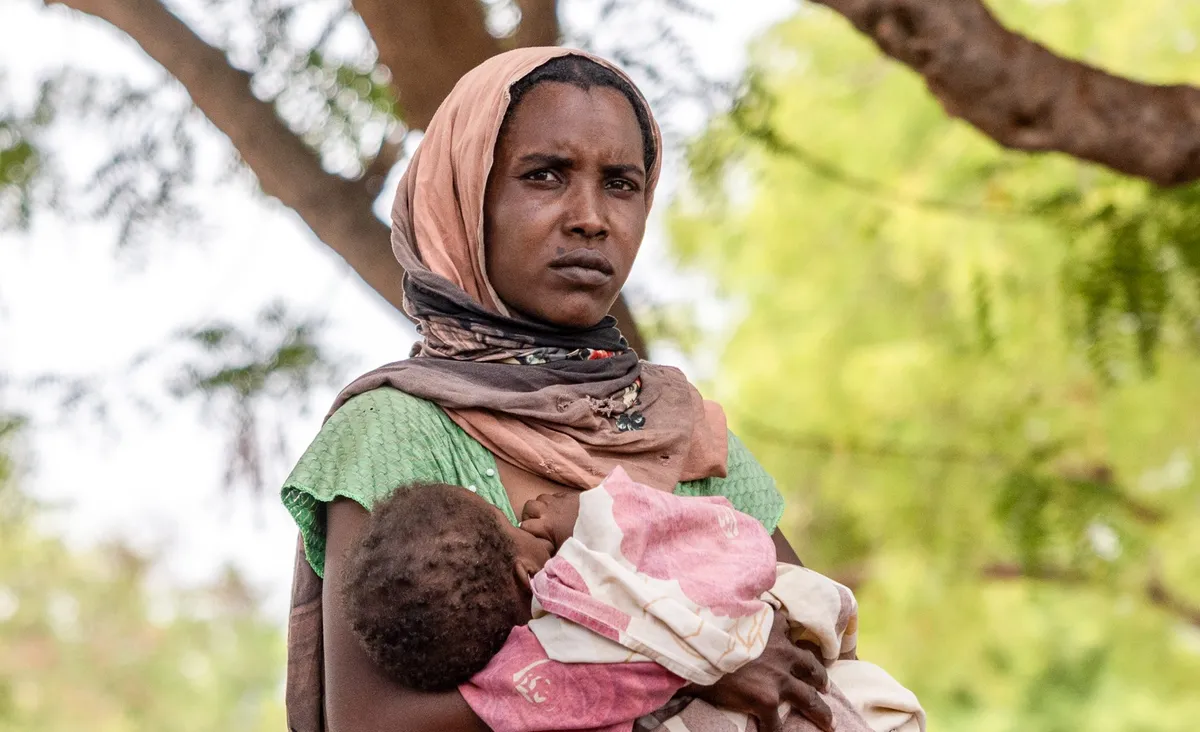
At least 117.8 million people worldwide remain forcibly displaced due to conflict, violence, human rights abuses and persecution.A woman holds her baby outside the registration centre for new refugees on the outskirts of the Korsi refugee camp in Birao, Central African Republic. [Caitlin Kelly/AP Photo]Published On 11 Jun 2026At least 117.8 million people, or one in 70 individuals worldwide, remain forcibly displaced, according to a report released by the United Nations High Commissioner for Refugees (UNHCR) today.For the first time in 10 years, forced displacement has declined – a shift driven by large-scale returns of refugees and internally displaced people (IDPs) from the world’s biggest displacement crises.Despite a roughly 4 percent decrease in the number of displaced people in 2025, this progress has been overshadowed by Lebanon’s fast-growing displacement crisis. Since the Iran" class="entity-link entity-event" data-entity-id="38678" data-entity-type="event">US-Israel war on Iran began in late March 2026, Israeli attacks have forcibly displaced more than one million, with a further 3.2 million internally displaced in Iran.Of the 117.3 million forcibly displaced: 68.6 million are internally displaced within their own countries due to conflict or other crises. Roughly 28.5 million refugees are under the UNHCR mandate 9 million are asylum seekers – people waiting for a decision while seeking protection in another country due to persecution or fear of harm in their home country 7.2 million people are in need of international protection 6 million are Palestinian refugees under UNRWA’s mandate Where are refugees coming from?Almost three-quarters (72 percent) of all refugees came from just seven countries: Venezuela (6.4 million), Palestine (6 million), Ukraine (5.2 million), Syria (4.9 million), Afghanistan (3.7 million), Sudan (2.8 million), South Sudan (2.4 million). Under international law, refugees are people who are forced to flee their home countries to escape persecution or a serious threat to their life, physical integrity or freedom.Who hosts the most refugees?More than one-third of the world’s refugees live in just seven countries.Globally, the largest refugee populations are hosted by: Colombia (2.8 million), Germany (2.7 million), Turkiye (2.4 million), Uganda (1.9 million), Iran (1.7 million), Chad (1.5 million), Pakistan (1.3 million). Some 65 percent of refugees and other people in need of international protection lived in countries neighbouring their countries of origin.Nearly all refugees in Iran and Pakistan are Afghans, while most refugees in Turkiye are Syrians.The vast majority of refugees in Colombia are from Venezuela, while Germany hosts a large Ukrainian, Syrian and Afghan refugee population. A majority of the refugees in Uganda are from South Sudan; similarly, Sudanese refugees make up the largest displaced group in Chad.The history of global displacementIn 1951, the UN established the Refugee Convention to protect the rights of refugees in Europe in the aftermath of World War II. In 1967, the convention was expanded to address displacement across the rest of the world.When the Refugee Convention was born, there were 2.1 million refugees. By 1980, the number of refugees recorded by the UN surpassed 10 million for the first time. Wars in Afghanistan and Ethiopia during the 1980s caused the number of refugees to double to 20 million by 1990.The number of refugees remained fairly consistent over the next two decades.However, the US invasion of Afghanistan in 2001 and Iraq in 2003, together with the civil wars in South Sudan and Syria, resulted in refugee numbers exceeding 30 million by the end of 2021.The war in Ukraine, which started in 2022, led to one of the fastest-growing refugee crises since World War II, with 5.7 million people forced to flee Ukraine in less than a year.In 2023, conflict in Sudan between the Sudanese army and the Rapid Support Forces increased the number of refugees to 1.5 million.In the same year, Israel’s bombardment of the Gaza Strip had a devastating toll on the Palestinian population. Nearly all of Gaza’s population of 2.3 million people has been displaced, with many having been forced to flee multiple times.More recently, the Iran" class="entity-link entity-event" data-entity-id="38678" data-entity-type="event">US-Israel war on Iran has caused a new displacement crisis in Lebanon following the resumption of hostilities between Israel and Hezbollah, with Israel issuing sweeping forced displacement orders for southern Lebanon and launching a ground invasion alongside its aerial bombardment.Largest wave of refugee returnsIn 2025, the number of refugees and IDPs returning home rose by 50 percent compared with 2024, with just more than 14.7 million returning. This marks the largest wave of returns recorded by the UNHCR.The UNHCR warns that the conditions for refugee returns are far from ideal, with many people returning to violence and instability, raising questions about the dangers facing those who go back to their country of origin.
SRCAl Jazeera
LANGEN
LEANCenter
WORDS758
ENT12
THU · 2026-06-11 · 04:25 GMTBRIEF NSR-2026-0611-83468
NSR-2026-0611-83468News Report·EN·Human Interest
One in 70 people worldwide is forcibly displaced: UNHCR
As of June 2026, 117.8 million people worldwide are forcibly displaced due to conflict, violence, human rights abuses, and persecution, representing one in 70 individuals. While 2025 saw a 4% decrease in displacement due to large-scale returns, this progress is overshadowed by a significant new crisis in Lebanon following the US-Israel war on Iran, which has displaced over a million people and internally displaced 3.2 million in Iran.
Hanna Duggal,Mohamed HusseinAl JazeeraFiled 2026-06-11 · 04:25 GMTLean · CenterRead · 4 min
Al JazeeraFIG 01
Reading time
4min
Word count
758words
Sources cited
2cited
Entities identified
12entities
Quality score
100%
§ 01
Briefing Summary
AI-generatedNEWSAR · AI
As of June 2026, 117.8 million people worldwide are forcibly displaced due to conflict, violence, human rights abuses, and persecution, representing one in 70 individuals. While 2025 saw a 4% decrease in displacement due to large-scale returns, this progress is overshadowed by a significant new crisis in Lebanon following the US-Israel war on Iran, which has displaced over a million people and internally displaced 3.2 million in Iran. The majority of refugees originate from seven countries, including Venezuela, Palestine, and Ukraine. Colombia, Germany, and Turkiye host the largest refugee populations, with most refugees living in countries bordering their homelands. Despite an increase in returns in 2025, the UNHCR notes that many returnees face continued violence and instability.
Confidence 0.90Sources 2Claims 5Entities 12
§ 02
Article analysis
Model · rule-basedFraming
Human Interest
Social Justice
Tone
Measured
AI-assessed
CalmNeutralAlarmist
Factuality
0.90 / 1.00
Factual
LowHigh
Sources cited
2
Limited
FewMany
§ 03
Key claims
5 extracted01
Almost three-quarters (72 percent) of all refugees came from just seven countries: Venezuela, Palestine, Ukraine, Syria, Afghanistan, Sudan, South Sudan.
statisticUNHCR
Confidence
1.00
02
Globally, the largest refugee populations are hosted by Colombia (2.8 million), Germany (2.7 million), Turkiye (2.4 million), Uganda (1.9 million), Iran (1.7 million), Chad (1.5 million), Pakistan (1.3 million).
statisticUNHCR
Confidence
1.00
03
Since the US-Israel war on Iran began in late March 2026, Israeli attacks have forcibly displaced more than one million, with a further 3.2 million internally displaced in Iran.
statisticUNHCR
Confidence
1.00
04
For the first time in 10 years, forced displacement has declined, driven by large-scale returns of refugees and internally displaced people.
statisticUNHCR
Confidence
1.00
05
At least 117.8 million people worldwide remain forcibly displaced due to conflict, violence, human rights abuses and persecution.
statisticUNHCR
Confidence
1.00
§ 04
Full report
4 min read · 758 words§ 05
Entities
12 identifiedKey playerOppositionContextPositiveNeutralNegative
Organizations2
Locations9
§ 06
Keywords & salience
10 termsforcibly displaced
1.00
refugees
0.90
unhcr
0.90
internally displaced people
0.80
displacement crisis
0.70
persecution
0.60
human rights abuses
0.60
asylum seekers
0.50
us-israel war on iran
0.40
international protection
0.40
§ 07
Topic connections
Interactive graph No topic relationship data available yet. This graph will appear once topic relationships have been computed.