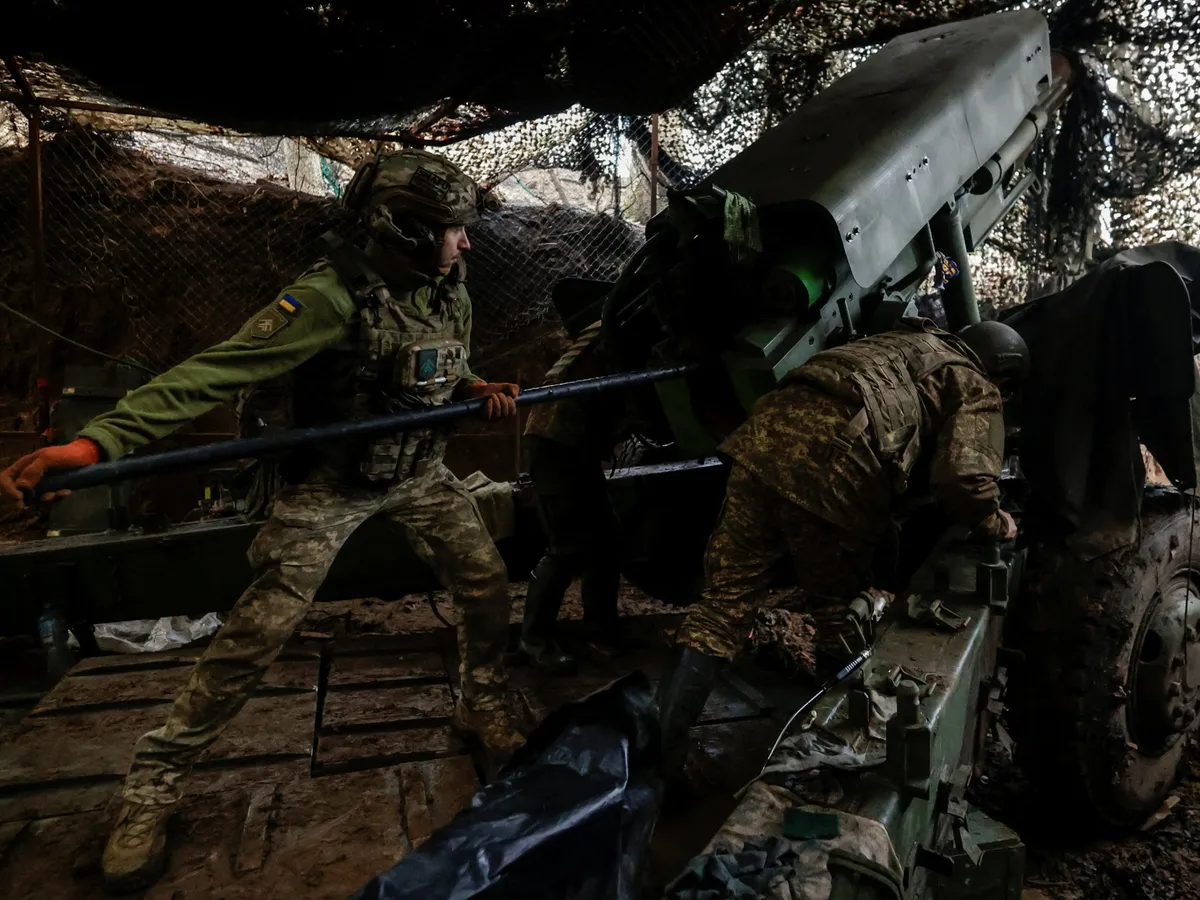
These are the key developments from day 1,379 of Russia’s war on Ukraine.Service members of the 13th Operative Purpose Brigade 'Khartiia' of the National Guard of Ukraine load ammunition to fire a Bohdana self-propelled howitzer towards Russian troops from a front-line position in Ukraine's Kharkiv region, December 3, 2025 [Sofiia Gatilova/Reuters]Published On 4 Dec 2025Here’s where things stand on Thursday, December 4:Fighting Russian forces have taken control of the village of Chervone in Ukraine’s southeastern Zaporizhia region, according to the Russian Ministry of Defence. Ukraine’s military said it struck a Russian oil depot in the Tambov region and another one in the Oryol region on Tuesday. It added that the attacks sparked fires at the sites. A source in Ukraine’s GUR military intelligence also confirmed to the Reuters news agency that it had hit the Druzhba oil pipeline, also in Russia’s central Tambov region, which supplies Russian oil to Hungary and Slovakia. Peace talks United States President Donald Trump has said the path ahead for peace in Ukraine is unclear after what he called “reasonably good” talks with Russian President Vladimir Putin on Tuesday. Special envoy Steve Witkoff and Trump adviser Jared Kushner spent hours at the Kremlin but departed with no breakthrough on ending the war. Trump said Witkoff and Kushner briefed him about the talks and told him their impression of Putin was “he would like to make a deal”. But Trump added that he “can’t tell” what will come out of the meeting “because it does take two to tango”. He added that Washington already has “something pretty well worked out [with Ukraine]”. Asked if it would be correct to say that Putin had rejected Washington’s proposals, Kremlin spokesman Dmitry Peskov disagreed. “A direct exchange of views took place yesterday for the first time,” Peskov said. “Some things were accepted, some things were marked as unacceptable. This is a normal working process of finding a compromise.” Ukrainian President Volodymyr Zelenskyy has confirmed his team is preparing for meetings in the US and that dialogue with Trump’s envoys will continue. “Only by taking Ukraine’s interests into account is a dignified peace possible,” he said. An unnamed White House official confirmed to Reuters that Witkoff and Kushner would meet with Ukrainian officials in Miami on Thursday. United Nations Ninety-one countries at the United Nations General Assembly, including the US, have backed a resolution demanding Russia “ensure the immediate, safe and unconditional return of all Ukrainian children who have been forcibly transferred or deported” from Ukraine since Moscow launched its war in 2022. Russia and 11 other countries voted against the resolution – which was drafted by Ukraine, Canada and the European Union – while 57 countries abstained. Ahead of the vote, Russia had urged countries to oppose the resolution. “Each vote for the resolution is support for lies, war and confrontation. Every vote against is a vote for peace,” Russia’s deputy UN ambassador, Maria Zabolotskaya, said. Ukrainian affairs Ukraine’s parliament has approved the 2026 budget allocating nearly a third of the country’s gross domestic product (GDP) to defence. The vote, which comes as Ukraine is dogged by a political crisis following a recent corruption scandal, was seen as a litmus test for parliament to pass key decisions during a critical stage of the war. “This is an important signal of Ukraine’s resilience and securing a stable financial provision for the next year’s needs,” President Zelenskyy said. “The priorities are clear: ensuring our defence, social programmes and the ability to rebuild our lives after Russia’s attacks.” Sanctions and military aid The European Commission, the EU’s executive body, has proposed an unprecedented use of frozen Russian assets or international borrowing to raise 90 billion euros ($105bn) for Ukraine. Commission President Ursula von der Leyen said the body is “proposing to cover two-thirds of Ukraine’s financing needs for the next two years. That’s 90 billion euros”. She added that the “remainder would be for international partners to cover”. But Belgium, whose Brussels-based financial institution Euroclear is the main holder of the Russian assets, has voiced a range of legal concerns. While von der Leyen said the proposal had taken into account Belgium’s concerns, Brussels does not “share that assessment”, a senior official told Reuters, adding that it “cannot accept being asked to bear the risks of such an operation alone”. The EU also agreed to phase out Russian gas imports by late 2027 as part of an effort to end the bloc’s decades-long dependency on Russian energy. Under the agreement, the EU will permanently halt the import of Russian gas and move towards a phase-out of Russian oil. Liquefied natural gas imports will be phased out by the end of 2026 and pipeline gas by the end of September 2027. Hungary and Slovakia are both weighing up legal options to challenge the order, as both EU members are still highly reliant on gas and oil supplies from Moscow and fearful that more costly alternatives will damage their economies. More than two-thirds of NATO member states have so far committed $4bn worth of weapons for Ukraine through the Prioritised Ukraine Requirements List (PURL) – an initiative to supply Kyiv with weapons bought from the US – according to the alliance’s secretary-general, Mark Rutte. Outside NATO, Australia and New Zealand have also agreed to contribute to the PURL initiative, Rutte said. European defence
SRCAl Jazeera
LANGEN
LEANCenter
WORDS889
ENT9
THU · 2025-12-04 · 02:29 GMTBRIEF NSR-2025-1204-847
NSR-2025-1204-847News Report·EN·Conflict
Russia-Ukraine war: List of key events, day 1,379
On December 4, 2025, marking day 1,379 of the Russia-Ukraine war, Russia claimed control of Chervone in the Zaporizhia region. Ukraine reported striking Russian oil depots in the Tambov and Oryol regions, including the Druzhba pipeline.
By News AgenciesAl JazeeraFiled 2025-12-04 · 02:29 GMTLean · CenterRead · 4 min
Al JazeeraFIG 01
Reading time
4min
Word count
889words
Sources cited
6cited
Entities identified
9entities
Quality score
100%
§ 01
Briefing Summary
AI-generatedNEWSAR · AI
On December 4, 2025, marking day 1,379 of the Russia-Ukraine war, Russia claimed control of Chervone in the Zaporizhia region. Ukraine reported striking Russian oil depots in the Tambov and Oryol regions, including the Druzhba pipeline. Following talks with Vladimir Putin, Donald Trump stated the path to peace remains unclear, though his envoys, Steve Witkoff and Jared Kushner, felt Putin was open to a deal. While Trump indicated progress with Ukraine, the Kremlin noted disagreements remained. Volodymyr Zelenskyy confirmed preparations for further talks with US envoys, who are scheduled to meet with Ukrainian officials in Miami. At the United Nations, 91 countries, including the US, supported a resolution demanding [article incomplete].
Confidence 0.90Sources 6Claims 5Entities 9
§ 02
Article analysis
Model · rule-basedFraming
Conflict
Diplomatic
Tone
Measured
AI-assessed
CalmNeutralAlarmist
Factuality
0.80 / 1.00
Factual
LowHigh
Sources cited
6
Well sourced
FewMany
§ 03
Key claims
5 extracted01
Trump said Witkoff and Kushner briefed him about the talks and told him their impression of Putin was “he would like to make a deal”.
quoteDonald Trump
Confidence
1.00
02
Ninety-one countries at the United Nations General Assembly have backed a resolution demanding Russia return Ukrainian children.
factualUnited Nations General Assembly
Confidence
1.00
03
Ukraine’s military said it struck a Russian oil depot in the Tambov region and another one in the Oryol region on Tuesday.
factualUkraine’s military
Confidence
0.90
04
Russian forces have taken control of the village of Chervone in Ukraine’s southeastern Zaporizhia region.
factualRussian Ministry of Defence
Confidence
0.90
05
A source in Ukraine’s GUR military intelligence confirmed it had hit the Druzhba oil pipeline in Russia’s Tambov region.
factualUkraine’s GUR military intelligence
Confidence
0.80
§ 04
Full report
4 min read · 889 words§ 05
Entities
9 identifiedKey playerOppositionContextPositiveNeutralNegative
People4
§ 06
Keywords & salience
9 termsrussia-ukraine war
1.00
peace talks
0.80
russian forces
0.70
oil depot
0.60
trump
0.50
military intelligence
0.50
united nations
0.50
compromise
0.40
zelenskyy
0.40
§ 07
Topic connections
Interactive graph Network visualization showing 51 related topics
View Full Graph Person Organization Location Event|Click node to navigate|Edge numbers = shared articles