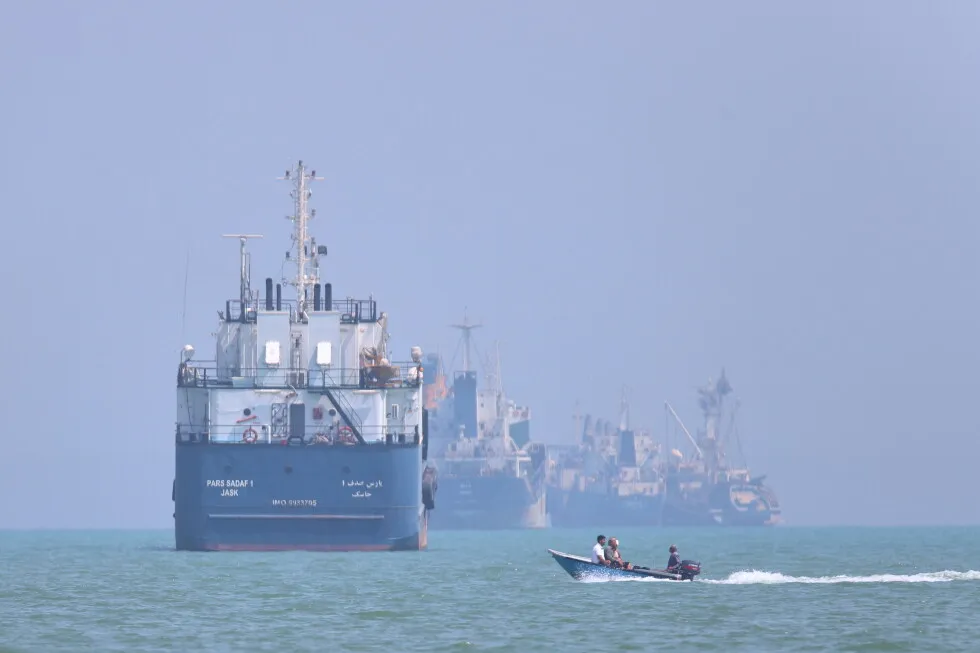
What to know about the demining and escort mission that US allies want for the Strait of Hormuz 0 seconds of 1 minute, 17 secondsVolume 0% Press shift question mark to access a list of keyboard shortcuts Keyboard ShortcutsEnabledDisabled Shortcuts Open/Close/ or ? Play/PauseSPACE Increase Volume↑ Decrease Volume↓ Seek Forward→ Seek Backward← Captions On/Offc Fullscreen/Exit Fullscreenf Mute/Unmutem Decrease Caption Size- Increase Caption Size+ or = Seek %0-9 Next Up Trump says US has reached a 'great settlement' to end war with Iran 01:34 Subtitle Settings OffEnglish(US)_v Font Color White Font Opacity 100% Font Size 100% Font Family Arial Character Edge None Edge Color Black Background Color Black Background Opacity 50% Window Color Black Window Opacity 0% Reset WhiteBlackRedGreenBlueYellowMagentaCyan 100%75%50%25% 200%175%150%125%100%75%50% ArialCourierGeorgiaImpactLucida ConsoleTahomaTimes New RomanTrebuchet MSVerdana NoneRaisedDepressedUniformDrop Shadow WhiteBlackRedGreenBlueYellowMagentaCyan WhiteBlackRedGreenBlueYellowMagentaCyan 100%75%50%25%0% WhiteBlackRedGreenBlueYellowMagentaCyan 100%75%50%25%0% 00:00 01:17 01:17 More Videos 01:34 Trump says US has reached a 'great settlement' to end war with Iran 01:41 Tensions between Trump and European leaders ahead of G7 summit in France 00:55 Tentative deal on ending the Iran war sends stocks soaring while oil prices fall 00:36 Stocks open sharply higher on tentative deal for end to Iran war 01:50 Trump meeting with France's Macron, says ‘great things are going to happen’ discussing Iran deal 01:12 Trump arrives at G7 summit after announcing US-Iran deal 01:56 Macron welcomes world leaders for the G7 summit in France 01:37 Trump believes Iran's Supreme Leader has signed off on emerging deal Close 1 of 4 | World leaders began gathering in a French spa town Monday for a summit of the Group of Seven club of powerful democracies with a new impetus following President Donald Trump’s announcement of an agreement that he says will bring an end to the U.S. war against Iran. 2 of 4 | A small motorboat passes anchored vessels in the Strait of Hormuz off Bandar Abbas, Iran, Thursday, June 11, 2026.(Amirhosein Khorgooi/ISNA via AP) 3 of 4 | U.S. President Donald Trump arrives for the G7 summit in Evian-les-Bains, France, Monday, June 15, 2026. (AP Photo/Vadim Ghirda) 4 of 4 | French President Emmanuel Macron visit security force ahead of the G7 summit in Evian-les-Bains, France, Monday, June 15, 2026. (AP Photo/Christophe Ena) CORRECTION: Corrects all details due to copy/paste error By JOHN LEICESTER Updated 6:08 AM MESZ, June 16, 2026 Add AP News on Google Add AP News as your preferred source to see more of our stories on Google. Share Share Facebook Copy Link copied Print Email X LinkedIn Bluesky Flipboard Pinterest Reddit Evian-les-Bains, France (AP) — The naval mission for the Strait of Hormuz that U.S. allies are proposing as a follow-up to a deal to end the Iran war would aim to reassure crews and shipping insurers that vessels can safely navigate the narrow waterway again, by removing any explosive mines and potentially providing military escorts. France and Britain have been working on the plans for months. French President Emmanuel Macron floated the idea back in March when the war was raging, saying warships could escort tankers and container ships through the maritime chokepoint when the conflict dies down. U.S. President Donald Trump told Macron on Monday at the Group of Seven summit that he doesn’t see a need for “much help” because the strait is “going to be open” thanks to the tentative deal with Iran. “But I don’t think it’s a bad idea to have a ship or two up here from a few countries. You’d be a great country to do it,” Trump told the French leader. Here’s a closer look at the envisioned mission that U.S. allies are pitching to speed the return of oil and gas supplies: US allies float it as a next step to the Iran deal In a statement welcoming the framework deal that would extend the U.S.-Iran tentative ceasefire and lead to the reopening of the Strait of Hormuz, U.S. allies said they “are committed to playing our part” to urgently reopen the waterway “with unconditional and unrestricted freedom of navigation.” The statement was issued by France, the United Kingdom, Germany, Japan and Italy, later joined by Canada — all members, with the United States, of the G7 club of nations. They proposed “a strictly defensive and independent mission to reassure commercial shipping and conduct mine clearance operations.” G7 leaders open summit talks on Ukraine and the Middle East as Zelenskyy joins in France 4 MIN READ Trump arrives at G7 summit looking for momentum after announcing a deal to end the Iran war 6 MIN READ 183 What to know about the G7 summit Trump is attending in France 4 MIN READ How they say it could work France’s nuclear-powered aircraft carrier, the Charles de Gaulle, is already in the region. Macron dispatched it first to the eastern Mediterranean in early March and then onward through the Suez Canal to the Arabian Sea. Other nations deployed in the region that could quickly help include the Netherlands, Italy and the U.K., Macron said. The French leader told Trump that French fighter aircraft could take part in observation missions over the vital waterway as soon as Tuesday, followed “within 48 hours” by frigates “and within two to three days, the aircraft carrier.” “Of course, all this supposes that it is desired and requested,” Macron said. “Perhaps it will not be wanted and perhaps it will not be necessary. But in any case, it reflects our willingness to help.” Mine-clearing vessels would aim to rid the waterway of those underwater dangers for shipping that can be rocket-propelled, cabled or sit on the seabed and be triggered by sound, movement or light. Trump said mines have been found and that efforts to locate others continue but that the strait “is already partially opened.” The U.K.'s Royal Navy has made a point of showing off the specialist expertise it could offer, welcoming reporters aboard a vessel, the RFA Lyme Bay, as it waited off the coast of Gibraltar last month to be deployed. French, American, British and other naval crews already have experience of escorting civilian ships through hostile fire in the region. They previously defended cargo vessels through attacks in the Red Sea carried out by Iran-backed Houthi rebels in Yemen. French frigates used machine guns, cannons and sophisticated air-defense missiles to fend off Houthi strikes. The French frigate Alsace downed three ballistic missiles in the Red Sea in 2024 as it was escorting a container ship. The ship’s commander at the time, Capt. Jérôme Henry, told the AP that being on the receiving end of the potentially deadly strikes was unnerving and exhausting. The sea battles also took a toll on U.S. Navy ships and personnel. If deployed in the Strait of Hormuz, naval crews would be hoping for fewer dangers if the ceasefire holds. But with Iran still believed to be armed with stocks of missiles, drones and other weaponry, warships’ defensive systems could be used to fend off any attacks if the ceasefire breaks down. “Once there is a ceasefire, the need for a naval mission is significantly reduced,” said Max Bergmann, an analyst at the Center for Strategic and International Studies, a Washington, D.C., think tank. “A U.K.-French naval presence will no doubt have some security benefits. It might raise the stakes for Iran to rekindle the war; it demonstrates European commitment to Gulf states; and it might reassure shipping and insurance companies,” he said. “But we should not overstate its utility.” Joint French-British planning for the mission has involved nations as far afield as Australia, South Korea and Japan, Bahrain and Qatar in the Gulf, Canada, and more than a dozen in Europe. A meeting of defense ministers and other representatives that France and Britain convened last month about the plans brought together 38 countries. Associated Press writer Sylvie Corbet in Evian-les-Bains contributed.
SRCAssociated Press (AP)
LANGEN
LEANCenter
WORDS1 303
ENT10
TUE · 2026-06-16 · 06:23 GMTBRIEF NSR-2026-0616-84816
NSR-2026-0616-84816News Report·EN·Conflict
What to know about the demining and escort mission that US allies want for the Strait of Hormuz
Following a tentative deal to end the Iran war, U.S. allies including France and Britain are proposing a naval mission for the Strait of Hormuz.
Associated Press (AP)Filed 2026-06-16 · 06:23 GMTLean · CenterRead · 6 min
Associated Press (AP)FIG 01
Reading time
6min
Word count
1 303words
Sources cited
2cited
Entities identified
10entities
Quality score
100%
§ 01
Briefing Summary
AI-generatedNEWSAR · AI
Following a tentative deal to end the Iran war, U.S. allies including France and Britain are proposing a naval mission for the Strait of Hormuz. This mission would focus on demining the waterway and potentially providing military escorts to reassure commercial shipping and insurers. The initiative aims to ensure safe navigation and the swift return of oil and gas supplies. While U.S. President Trump believes the strait will reopen due to the deal, he acknowledged the allies' proposal is not a bad idea. France and the UK have been planning this defensive mission, which could involve assets like France's aircraft carrier, the Charles de Gaulle. Several G7 nations have expressed commitment to reopening the strait with freedom of navigation.
Confidence 0.90Sources 2Claims 4Entities 10
§ 02
Article analysis
Model · rule-basedFraming
Conflict
Diplomatic
Tone
Measured
AI-assessed
CalmNeutralAlarmist
Factuality
0.70 / 1.00
Factual
LowHigh
Sources cited
2
Limited
FewMany
§ 03
Key claims
4 extracted01
World leaders gathered in France for a G7 summit.
factual
Confidence
1.00
02
President Donald Trump announced an agreement that he says will end the U.S. war against Iran.
quoteDonald Trump
Confidence
0.90
03
US allies are proposing a demining and escort mission for the Strait of Hormuz.
factual
Confidence
0.90
04
The naval mission aims to reassure crews and ships.
factual
Confidence
0.80
§ 04
Full report
6 min read · 1 303 words§ 05
Entities
10 identifiedKey playerOppositionContextPositiveNeutralNegative
Organizations1
Locations6
§ 06
Keywords & salience
8 termsstrait of hormuz
1.00
demining mission
0.90
escort mission
0.90
us allies
0.80
g7 summit
0.70
iran war
0.60
donald trump
0.50
emmanuel macron
0.40
§ 07
Topic connections
Interactive graph Network visualization showing 51 related topics
View Full Graph Person Organization Location Event|Click node to navigate|Edge numbers = shared articles