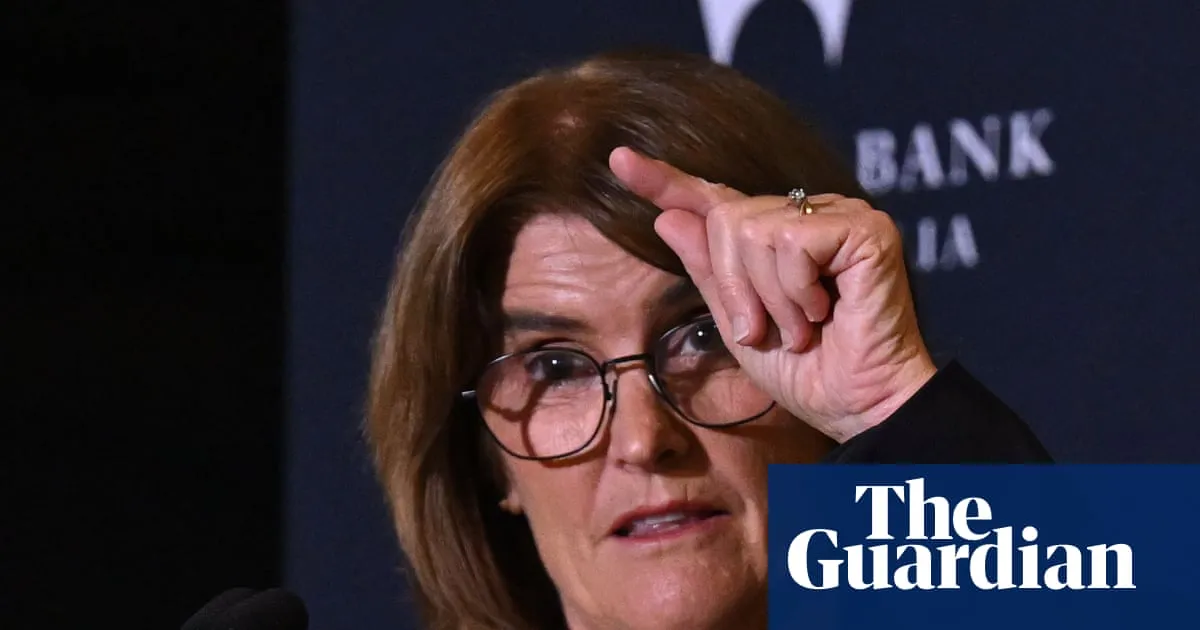
‘I want to be very clear that inflation remains too high’ … Michele Bullock speaks to the media after Tuesday’s RBA rate decision. Photograph: Dean Lewins/AAP View image in fullscreen ‘I want to be very clear that inflation remains too high’ … Michele Bullock speaks to the media after Tuesday’s RBA rate decision. Photograph: Dean Lewins/AAP Analysis Finally, an interest rate reprieve – but a ceasefire in the Middle East doesn’t have the RBA popping champagne yet Patrick Commins Economics editor Governor Michele Bullock delivers a strong message after the Reserve Bank holds the cash rate at 4.35%, ending a run of three rises RBA interest rates: Reserve Bank holds official cash rate at 4.35% Get our breaking news email, free app or daily news podcast It will take more than a ceasefire in the Middle East to prevent the Reserve Bank from hiking interest rates again. That was the strong message from the RBA governor, Michele Bullock, after the central bank held its cash rate at 4.35%, putting an end to a run of three increases. Higher borrowing costs have been “tough” on households, Bullock conceded during her regular post-meeting press conference, but there could be no let-up in the battle to (eventually) get consumer price growth into the 2-3% target range. So yes, things are tough – but they would get much tougher if inflation was left to run rampant, she reminded us for the umpteenth time. Prices were rising too quickly even before the US and Israel attacked Iran at the end of February and triggered the closure of the world’s most important oil shipping route, the Strait of Hormuz. “I want to be very clear that inflation remains too high,” Bullock said. “Today’s decision does not rule out further tightening in monetary policy if that is what is required to bring inflation down.” Still, for all the tough talk, financial markets are not convinced the RBA will need to go again, putting the probability of a hike by year’s end at a little over 50%. Economists are roughly split on whether interest rates will need to rise again, and the governor’s comments did nothing to change anybody’s mind. The economy slowed markedly at the start of the year, and interest rates are contributing to that slowdown. 2:40 RBA interest rates: governor Michele Bullock explains decision to hold cash rate at 4.35% – video Unemployment has jumped to 4.5% – its highest since late 2021 – and is set to push a bit higher. Consumer confidence is at around its lowest levels on record; we are as pessimistic as we were during the height of the pandemic. Rising unemployment and slowing growth suggests lower interest rates, or at least no more hikes. inflation at 4.2%, however, argues the opposite – and hence the difficult terrain the RBA is trying to navigate. Global oil prices have retreated to three-month lows of about $US83 a barrel as news emerged late last week that a peace deal between the US and Iran would be signed. Any progress towards peace is welcome, but the cork remains firmly in the champagne bottle. It will take time for shipping companies to regain the confidence to start travelling through the Strait of Hormuz. Insurance costs will be sky-high, and months of work will be needed to repair energy infrastructure damaged in the conflict. Bullock “welcomed” reports “that an agreement has been reached to end the conflict in the Middle East”. “If the conflict does end and the Strait of Hormuz is reopened, this should support the flow of commodities and lower prices,” she said. “But this could take some time, and an orderly resolution is still not assured, meaning there are still upside risks to inflation and downside risks to growth.” Jim Chalmers, the treasurer, was similarly realistic. “We’re very pleased with developments, but realistic about how long it will take for the world economy to normalise,” he said – even if the ceasefire holds. Still, there’s rising optimism that we can at least start ruling out the worst-case scenarios that the strait could remain shut into 2027. Explore more on these topics Australian economy Reserve Bank of Australia interest rates Cost-of-living crisis Business Jim Chalmers Australian politics analysis Share Reuse this content
SRCThe Guardian - World News
LANGEN
LEANCenter-Left
WORDS709
ENT12
TUE · 2026-06-16 · 15:00 GMTBRIEF NSR-2026-0616-84950
NSR-2026-0616-84950Analysis·EN·Economic Impact
Finally, an interest rate reprieve – but a ceasefire in the Middle East doesn’t have the RBA popping champagne yet
The Reserve Bank of Australia (RBA) has held its official cash rate at 4.35%, ending a series of three previous increases. Governor Michele Bullock stated that inflation remains too high and did not rule out further interest rate hikes if necessary to bring inflation within the 2-3% target range.
Patrick Commins Economics editorThe Guardian - World NewsFiled 2026-06-16 · 15:00 GMTLean · Center-LeftRead · 3 min
The Guardian - World NewsFIG 01
Reading time
3min
Word count
709words
Sources cited
2cited
Entities identified
12entities
Quality score
100%
§ 01
Briefing Summary
AI-generatedNEWSAR · AI
The Reserve Bank of Australia (RBA) has held its official cash rate at 4.35%, ending a series of three previous increases. Governor Michele Bullock stated that inflation remains too high and did not rule out further interest rate hikes if necessary to bring inflation within the 2-3% target range. While acknowledging the difficulty higher borrowing costs have imposed on households, Bullock emphasized the need to combat inflation. Despite the RBA's hawkish stance, financial markets are divided on the likelihood of future rate increases, with the economy showing signs of slowing and unemployment rising. The RBA welcomed news of a potential ceasefire in the Middle East, which could eventually lower commodity prices, but cautioned that an orderly resolution is not assured and risks to inflation and growth remain.
Confidence 0.90Sources 2Claims 5Entities 12
§ 02
Article analysis
Model · rule-basedFraming
Economic Impact
Conflict
Tone
Measured
AI-assessed
CalmNeutralAlarmist
Factuality
0.60 / 1.00
Mixed
LowHigh
Sources cited
2
Limited
FewMany
§ 03
Key claims
5 extracted01
Unemployment has risen to 4.5%, its highest level since late 2021.
statisticarticle
Confidence
1.00
02
The RBA may hike interest rates again if required to control inflation.
quoteMichele Bullock (RBA Governor)
Confidence
1.00
03
Inflation remains too high and is not expected to be resolved by a Middle East ceasefire alone.
quoteMichele Bullock (RBA Governor)
Confidence
1.00
04
The Reserve Bank of Australia (RBA) held its cash rate at 4.35%, ending a run of three increases.
factualRBA
Confidence
1.00
05
Financial markets are not convinced the RBA will raise rates again by year's end.
factualarticle
Confidence
0.80
§ 04
Full report
3 min read · 709 words§ 05
Entities
12 identifiedKey playerOppositionContextPositiveNeutralNegative
Organizations1
Locations5
§ 06
Keywords & salience
9 termsinterest rates
1.00
inflation
1.00
rba
0.90
monetary policy
0.80
cash rate
0.70
economic slowdown
0.60
consumer price growth
0.50
unemployment
0.40
middle east
0.40
§ 07
Topic connections
Interactive graph Network visualization showing 19 related topics
View Full Graph Person Organization Location Event|Click node to navigate|Edge numbers = shared articles