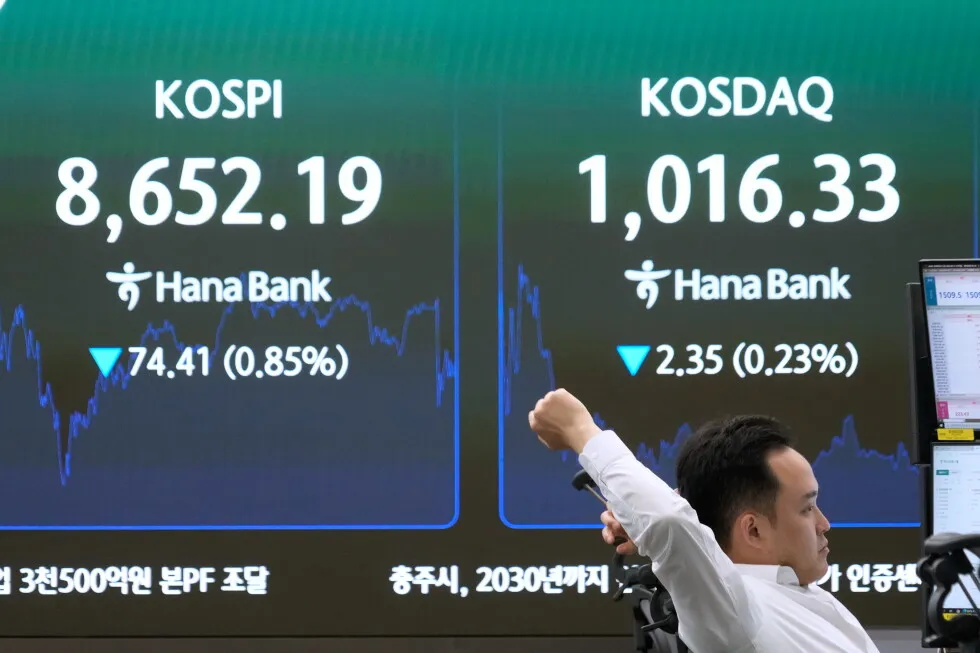
Shares mostly advance and oil trades below $80 on optimism over interim Iran-war-deal" class="entity-link entity-topic" data-entity-id="147830" data-entity-type="topic">US-Iran war deal 1 of 5 | A currency trader stretches near a screen showing the Korea Composite Stock Price Index (KOSPI) at the foreign exchange dealing room of the Hana Bank headquarters in Seoul, South Korea, Wednesday, June 17, 2026. (AP Photo/Ahn Young-joon) 2 of 5 | Currency traders work near a screen showing the Korea Composite Stock Price Index (KOSPI) and the foreign exchange rate between U.S. dollar and South Korean won at the foreign exchange dealing room of the Hana Bank headquarters in Seoul, South Korea, Wednesday, June 17, 2026. (AP Photo/Ahn Young-joon) 3 of 5 | An electronic board, left, shows Nikkei index at a securities company in Tokyo Tuesday, June 16, 2026. (Shinji Kouchi/Kyodo News via AP) 4 of 5 | Employees of a securities company celebrate as Japan’s benchmark Nikkei 225 topped 70,000 for the first time during trading hours in Tokyo Tuesday, June 16, 2026. A sign, left, reads “Congratulations. Nikkei index reached 70,000 yen.” (Shinji Kouchi/Kyodo News via AP) 5 of 5 | Employees of a securities company celebrate as Japan’s benchmark Nikkei 225 topped 70,000 for the first time during trading hours in Tokyo Tuesday, June 16, 2026. A sign, left, reads " Congratulations. Nikkei index reached 70,000 yen.” (Shinji Kouchi/Kyodo News via AP) By CHAN HO-HIM Updated 9:55 AM MESZ, June 17, 2026 Add AP News on Google Add AP News as your preferred source to see more of our stories on Google. Share Share Facebook Copy Link copied Print Email X LinkedIn Bluesky Flipboard Pinterest Reddit Hong Kong (AP) — Asian shares were mostly higher and oil was trading below $80 a barrel on Wednesday as markets watched for details on the interim agreement between the U.S. and Iran to end the war. U.S. futures edged higher ahead of the Federal Reserve’s policy decision announcement and after Wall Street closed mixed near their record highs. Tokyo’s Nikkei 225 was 0.7% higher at 69,902.25 after briefly crossing the 70,000 mark for a second straight day following news that Japan’s exports jumped 17% in May from a year earlier, helped in part by strong demand for high-tech products. South Korea’s Kospi gained 1.6% to 8,864.24, closing at another all-time high, with big technology stocks climbing despite a sell-off of artificial intelligence-related shares on Wall Street. Samsung Electronics, the country’s most valuable company, was up 1%. Chipmaker SK Hynix jumped 5.8%. Hong Kong’s Hang Seng lost 0.9% to 24,280.06, while the Shanghai Composite index rose 0.4% to 4,108.08. Taiwan’s Taiex traded 0.2% higher. India’s Sensex rose 0.3%. Oil prices stabilized after falling sharply earlier on optimism over a possible end to the war and reopening of the Strait of Hormuz, crucial for oil and gas transport worldwide. But challenges remain, including whether the deal includes Israel’s withdrawal from Lebanon. Oil drops below $80 per barrel, while tech stocks weigh on a mixed Wall Street 3 MIN READ Stocks leap worldwide, and oil prices drop after the US and Iran reach a tentative deal on their war 4 MIN READ 236 You can ignore AI giants like SpaceX, but your 401(k) won’t 4 MIN READ 64 Brent crude, the international standard, traded 1% lower at $78.19 per barrel early Wednesday after falling more than 5% on Tuesday. It was still above its roughly $70 a barrel level in late February, before the war started. Benchmark U.S. crude was down 1.1% to $75.21 a barrel. “Normalizing (oil) flows will take time,” economists at HSBC wrote in a note this week. “Hurdles include mine clearance, insurance reinstatement, emptying excess Gulf oil storage, repositioning ships, and restarting idled production fields.” Later in the day the Federal Reserve will wrap up a two-day policy meeting, the first under its new chair Kevin Warsh. It is widely expected to keep its benchmark interest rate unchanged despite pressure from U.S. President Donald Trump to cut rates. Countering that push are fresh worries over higher prices due to the Iran war. Lower rates could fuel higher inflation. “With weak wage growth and rent growth, underlying forces are pointing to inflation falling sharply once the energy price shock recedes. We don’t expect the Fed to hike rates in 2026,” Preston Caldwell, chief U.S. economist at Morningstar wrote in a commentary. “We expect the Fed to resume cutting in 2027.” On Tuesday, Wall Street’s benchmark S&P 500 fell 0.6% and the Dow Jones Industrial Average added 0.6%, hitting another all-time high. The technology-heavy Nasdaq composite dropped 1.2% to 26,376.34 following losses of some big tech stocks over renewed worries about an AI bubble. Shares of Nvidia fell 2.4%. Chipmaker Broadcom dropped 4.4% and Micron Technology lost 6.2%. SpaceX, Elon Musk’s rocket company, was up 4.8%, gaining for the third straight day since its Wall Street debut. Yum Brands gained 1.9% after it announced it is selling Pizza Hut for $2.7 billion, with most restaurants purchased by U.S.-based private equity firm LongRange Capital. In other dealings early Wednesday, the U.S. dollar fell to 160.26 Japanese yen from 160.42 yen. The euro was trading at $1.1607, down from $1.1608. AP Business Writers Elaine Kurtenbach, Stan Choe and Matt Ott contributed to this report. CHAN HO-HIM Chan writes about business and economy in China for The Associated Press, reporting on key sectors of the world’s second-largest economy from trade and technology to autos. He is based in Hong Kong. mailto
SRCAssociated Press (AP)
LANGEN
LEANCenter
WORDS907
ENT12
WED · 2026-06-17 · 06:23 GMTBRIEF NSR-2026-0617-85113
NSR-2026-0617-85113News Report·EN·Economic Impact
Shares are mixed and oil trades below $80 on optimism over interim US-Iran war deal
Asian shares showed mixed performance on Wednesday, with oil prices trading below $80 a barrel, influenced by optimism surrounding an interim agreement between the U.S. and Iran to end their war.
Associated Press (AP)Filed 2026-06-17 · 06:23 GMTLean · CenterRead · 4 min
Associated Press (AP)FIG 01
Reading time
4min
Word count
907words
Sources cited
0cited
Entities identified
12entities
Quality score
100%
§ 01
Briefing Summary
AI-generatedNEWSAR · AI
Asian shares showed mixed performance on Wednesday, with oil prices trading below $80 a barrel, influenced by optimism surrounding an interim agreement between the U.S. and Iran to end their war. Tokyo's Nikkei 225 rose due to a surge in Japanese exports, while South Korea's Kospi saw losses in technology stocks. Hong Kong and Shanghai also experienced declines. Oil prices stabilized after a sharp drop, driven by hopes of a potential end to the conflict and the reopening of the Strait of Hormuz, though challenges remain regarding the deal's specifics. U.S. futures edged higher ahead of the Federal Reserve's policy decision, with expectations that interest rates will remain unchanged despite pressure for cuts. Wall Street closed mixed, with the Nasdaq composite pulled down by declines in AI-related tech stocks.
Confidence 0.90Claims 5Entities 12
§ 02
Article analysis
Model · rule-basedFraming
Economic Impact
Diplomatic
Tone
Measured
AI-assessed
CalmNeutralAlarmist
Factuality
0.80 / 1.00
Factual
LowHigh
Sources cited
0
No named sources
FewMany
§ 03
Key claims
5 extracted01
South Korea’s Kospi gained 1.6% to 8,864.24, closing at another all-time high.
factual
Confidence
0.95
02
Japan’s exports jumped 17% in May from a year earlier.
statistic
Confidence
0.95
03
Tokyo’s Nikkei 225 was 0.7% higher at 69,902.25 after briefly crossing the 70,000 mark for a second straight day.
factual
Confidence
0.95
04
Asian shares were mostly higher and oil was trading below $80 a barrel on Wednesday.
factual
Confidence
0.90
05
Oil prices stabilized after falling sharply earlier on optimism over a possible end to the war and reopening of the Strait of Hormuz.
factual
Confidence
0.85
§ 04
Full report
4 min read · 907 words§ 05
Entities
12 identifiedKey playerOppositionContextPositiveNeutralNegative
Organizations4
Locations7
§ 06
Keywords & salience
9 termsus-iran war deal
1.00
asian shares
0.90
oil prices
0.80
nikkei 225
0.70
kospi
0.70
federal reserve
0.60
artificial intelligence
0.50
high-tech products
0.50
stock market
0.40
§ 07
Topic connections
Interactive graph Network visualization showing 51 related topics
View Full Graph Person Organization Location Event|Click node to navigate|Edge numbers = shared articles