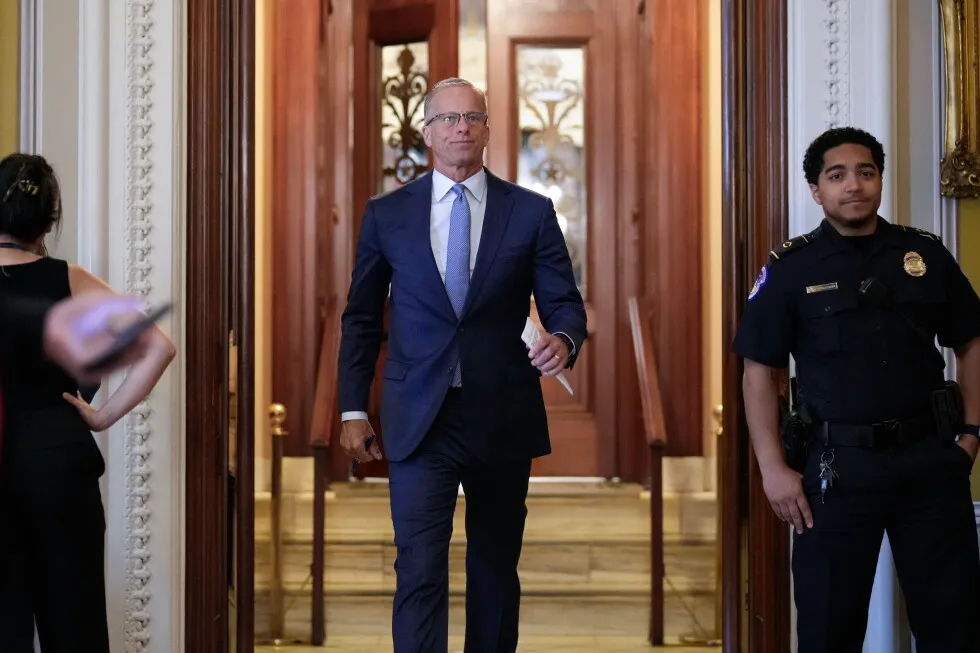
Some GOP senators and Trump allies have harsh reviews of his agreement to end Iran-war" class="entity-link entity-event" data-entity-id="38748" data-entity-type="event">Iran war 1 of 4 | President Donald Trump signed an agreement with Iran on Wednesday that calls for Tehran to dilute its stockpile of highly enriched uranium and waives U.S.-backed sanctions on the country, immediately allowing Iran to sell its oil freely in a major concession from Washington, according to details released by both countries. 2 of 4 | Senate Majority Leader John Thune, R-S.D., leaves the chamber, at the Capitol in Washington, Thursday, June 18, 2026. (AP Photo/J. Scott Applewhite) 3 of 4 | Sen. Ted Cruz, R-Texas, chairman of the Senate Commerce Committee, speaks to reporters after a closed-door meeting with fellow Republicans, at the Capitol in Washington, Tuesday, June 2, 2026. (AP Photo/J. Scott Applewhite) 4 of 4 | Sen. Roger Wicker, R-Miss., chairman of the Senate Armed Services Committee, walks to a closed door briefing on the Iran-war" class="entity-link entity-event" data-entity-id="38748" data-entity-type="event">Iran war at the Capitol, March 10, 2026, in Washington. (AP Photo/Jose Luis Magana, File) 1 of 4 President Donald Trump signed an agreement with Iran on Wednesday that calls for Tehran to dilute its stockpile of highly enriched uranium and waives U.S.-backed sanctions on the country, immediately allowing Iran to sell its oil freely in a major concession from Washington, according to details released by both countries. Add AP News on Google Add AP News as your preferred source to see more of our stories on Google. Share 2 of 4 | Senate Majority Leader John Thune, R-S.D., leaves the chamber, at the Capitol in Washington, Thursday, June 18, 2026. (AP Photo/J. Scott Applewhite) 2 of 4 Senate Majority Leader John Thune, R-S.D., leaves the chamber, at the Capitol in Washington, Thursday, June 18, 2026. (AP Photo/J. Scott Applewhite) Add AP News on Google Add AP News as your preferred source to see more of our stories on Google. Share 3 of 4 | Sen. Ted Cruz, R-Texas, chairman of the Senate Commerce Committee, speaks to reporters after a closed-door meeting with fellow Republicans, at the Capitol in Washington, Tuesday, June 2, 2026. (AP Photo/J. Scott Applewhite) 3 of 4 Sen. Ted Cruz, R-Texas, chairman of the Senate Commerce Committee, speaks to reporters after a closed-door meeting with fellow Republicans, at the Capitol in Washington, Tuesday, June 2, 2026. (AP Photo/J. Scott Applewhite) Add AP News on Google Add AP News as your preferred source to see more of our stories on Google. Share 4 of 4 | Sen. Roger Wicker, R-Miss., chairman of the Senate Armed Services Committee, walks to a closed door briefing on the Iran-war" class="entity-link entity-event" data-entity-id="38748" data-entity-type="event">Iran war at the Capitol, March 10, 2026, in Washington. (AP Photo/Jose Luis Magana, File) 4 of 4 Sen. Roger Wicker, R-Miss., chairman of the Senate Armed Services Committee, walks to a closed door briefing on the Iran-war" class="entity-link entity-event" data-entity-id="38748" data-entity-type="event">Iran war at the Capitol, March 10, 2026, in Washington. (AP Photo/Jose Luis Magana, File) Add AP News on Google Add AP News as your preferred source to see more of our stories on Google. Share Updated [hour]:[minute] [AMPM] [timezone], [monthFull] [day], [year] WASHINGTON (AP) — Republican leaders on Capitol Hill, including top national security figures, were voicing strong reservations Thursday —- and some outright condemnation — of the Trump administration’s agreement to end the fighting in Iran. The memorandum of understanding signed by President Donald Trump started a 60-day negotiating clock to reach a final deal on the future of Iran’s nuclear program. While Trump allies noted the agreement is not final, the lifting of economic sanctions on Iran’s sale of oil and the plan for a $300 billion fund to rebuild Iran and its economy were met with criticism from Republican leaders and conservative influencers, including some close Trump supporters. “President Trump has pursued peace through strength. I hope the intermediaries working on this deal are not undermining that objective,” said Mississippi Sen. Roger Wicker, the chairman of the Senate Armed Services Committee, who has urged Trump to keep up the pressure on Iran and last month warned against striking a bad deal. “The $300 billion fund for the reconstruction and economic development of Iran — though not funded by U.S. taxpayers — would make Iran’s payoff under President Obama’s 2015 deal look like a pittance by comparison,” Wicker said, referring to the Democratic administration’s Iran agreement that Trump withdrew from during his first term. The criticism from within Trump’s own party — though hardly unanimous — comes as he is trying to bring an end to the unpopular war fewer than five months from midterm elections, where Republicans are facing headwinds in their effort to hold their narrow majorities. 4 MIN READ 2 MIN READ 4 MIN READ Trump calls his critics ‘fools’Wicker’s points were backed by a number of his colleagues, many of whom supported the war when it began.“History demonstrates giving billions of dollars to the theocratic lunatics who want to kill you is an exceptionally bad idea,” said Texas Sen. Ted Cruz, a staunch supporter of the war. “And so I hope we don’t do that.”Trump on Truth Social called his critics “fools” and said the $300 billion payment to Iran by the United States is “fake news.” The interim pact promises a $300 billion fund for postwar reconstruction. It’s not clear where that money will come from — but Trump said, as Wicker noted, the U.S. would not contribute.“All there is for the U.S. is Success, Lower Oil Prices, and Victory,” he posted. Some senators question financial provisionsAs the memorandum was released to Congress on Thursday, several Republican senators said it left them with questions, many of them about its financial provisions. Majority Leader John Thune and South Dakota colleague Sen. Mike Rounds were seeking clarity on how financial incentives to Iran and conditions barring funding terrorism would be enforced, because “right now, a lot of money’s going to go to Iran,” Rounds said. To be sure, there were Republicans more closely aligned with Trump’s America First policies in the Senate and elsewhere who were giving him the benefit of the doubt. Sen. Roger Marshall stressed the point in the memorandum that supporters say gives the U.S. the upper hand. In a social media post, the Kansas Republican said one of the most important provisions “lays out a key commitment that strengthens regional security and ensures that Iran can never have a nuclear weapon.” Louisiana GOP Senate candidate John Fleming, who has focused on Trump’s most loyal supporters ahead of a June 27 Republican primary runoff, said that means Trump has suggested that the U.S. will strike Iran again if it does not live up to the agreement. “The criticism may be worthy if there isn’t follow-through,” Fleming said. “He’s using the speak-softly-and-carry-a-big-stick in offering them plenty of help, but at the same time he’s got that stick ready if they don’t live up to their agreements.”MAGA voices send a warningStill, some of Trump’s strongest supporters in conservative media have warned against the agreement. Conservative radio host Mark Levin suggested a strategic rethinking to hold off on an agreement with Iran until after the midterms. “We should consider slow-walking the enemy, building up our munitions, our oil reserves, get the price of gasoline down, get through the midterms, then knock them out,” he said in a social media post. Instead, the U.S. seemed to be “rushing to a deal, building up their oil industry” and agreeing to governments “transferring billions to them.” Right-wing social media influencer Laura Loomer, who has long supported Trump while also promoting conspiracy theories, was more pointed in her criticism. “Who is giving the President tainted, pro-Islamic intel?” she posted on X. What all the critics shared is an abiding distrust of the Iranian regime, no matter their relationship to Trump. “It does smack of the kind of appeasement,” said former Vice President Mike Pence, whose relationship with Trump was fractured after the Jan. 6, 2021, attack on the U.S. Capitol. “Bottom line. I don’t trust the Iranians.” ___Beaumont reported from Des Moines, Iowa. Beaumont covers national politics for The Associated Press. He is based in Des Moines, Iowa.
SRCAssociated Press (AP)
LANGEN
LEANCenter
WORDS1 351
ENT12
THU · 2026-06-18 · 20:53 GMTBRIEF NSR-2026-0618-85629
NSR-2026-0618-85629News Report·EN·Diplomatic
Some GOP senators and Trump allies have harsh reviews of his agreement to end Iran war
Republican leaders and conservative allies are expressing strong reservations and condemnation regarding President Trump's agreement to end the fighting in Iran. The memorandum of understanding initiates a 60-day negotiation period for a final deal on Iran's nuclear program.
By
THOMAS BEAUMONT and MARY CLARE JALONICKAssociated Press (AP)Filed 2026-06-18 · 20:53 GMTLean · CenterRead · 6 min
Associated Press (AP)FIG 01
Reading time
6min
Word count
1 351words
Sources cited
3cited
Entities identified
12entities
Quality score
100%
§ 01
Briefing Summary
AI-generatedNEWSAR · AI
Republican leaders and conservative allies are expressing strong reservations and condemnation regarding President Trump's agreement to end the fighting in Iran. The memorandum of understanding initiates a 60-day negotiation period for a final deal on Iran's nuclear program. Key points of criticism include the lifting of economic sanctions on Iran's oil sales and a proposed $300 billion fund for Iran's reconstruction, which some senators view as overly generous. While Trump allies acknowledge the deal is not final and that U.S. taxpayers would not fund the reconstruction, critics like Senator Roger Wicker and Senator Ted Cruz argue against providing significant financial aid to Iran. President Trump has dismissed these criticisms as "fake news" and called his critics "fools."
Confidence 0.90Sources 3Claims 4Entities 12
§ 02
Article analysis
Model · rule-basedFraming
Diplomatic
Political Strategy
Tone
Measured
AI-assessed
CalmNeutralAlarmist
Factuality
0.70 / 1.00
Factual
LowHigh
Sources cited
3
Well sourced
FewMany
§ 03
Key claims
4 extracted01
Some GOP senators and Trump allies have harsh reviews of his agreement to end the Iran war.
factualarticle
Confidence
1.00
02
The agreement waives U.S.-backed sanctions on Iran, immediately allowing Iran to sell its oil freely.
factualarticle
Confidence
1.00
03
President Donald Trump signed an agreement with Iran on Wednesday that calls for Tehran to dilute its stockpile of highly enriched uranium.
factualarticle
Confidence
1.00
04
The agreement is a major concession from Washington.
factualarticle
Confidence
0.90
§ 04
Full report
6 min read · 1 351 words§ 05
Entities
12 identifiedKey playerOppositionContextPositiveNeutralNegative
People4
Organizations3
Topics1
§ 06
Keywords & salience
9 termsiran war agreement
1.00
highly enriched uranium
0.90
sanctions waiver
0.80
oil sales
0.70
trump allies
0.60
gop senators
0.60
iran
0.50
donald trump
0.50
washington concession
0.40
§ 07
Topic connections
Interactive graph Network visualization showing 51 related topics
View Full Graph Person Organization Location Event|Click node to navigate|Edge numbers = shared articles