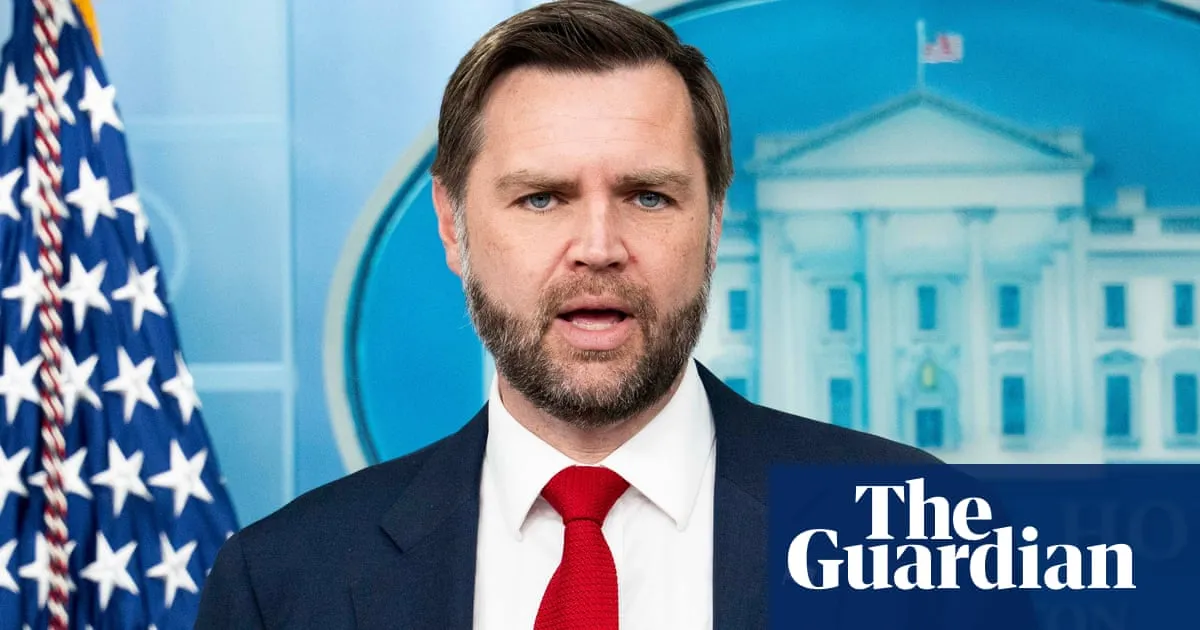
Talks set to take place on Friday between the US and Iran in Switzerland to implement a peace deal were cancelled as Hezbollah targeted Israeli forces and Israel carried out a wave of airstrikes in south Lebanon which killed several people.The talks were set to begin in the tiny Swiss village of Obbürgen on Friday, two days after the signing of a memorandum of understanding (MOU) that opened a 60-day window to negotiate a permanent understanding over Iran’s nuclear program, while getting oil traffic moving through the Strait of Hormuz.The White House said the US looked forward to “beginning technical talks as soon as possible”, as it announced that JD Vance, who is leading negotiations for the Trump administration, would now not be travelling.“The logistics of these negotiations have never been simple or predictable. As of now the vice-president is not departing tonight,” a White House spokesperson said late on Thursday.The cancellation of the talks came as Israel and Hezbollah traded their most violent strikes since the ceasefire was established.Hezbollah targeted Israeli forces near the city of Nabatieh, south Lebanon, with several salvoes of rocket fire late on Thursday after intermittent Israeli shelling throughout the day. Israel responded with a wave of airstrikes on the city and surrounding towns, leaving several people dead and wounded, including children.Hezbollah said it was targeting Israeli forces which were trying to advance towards the foothills surrounding Nabatieh – a flashpoint which has seen intermittent fighting since the US-Iran ceasefire was announced. Prior to the truce, Israeli forces were advancing towards the southern Lebanese city.Israeli artillery shelling in southern Lebanon on Thursday, amid escalating tensions along the border region. Photograph: Abdul Kader Al Bay/ZUMA Press Wire/ShutterstockThe cancellation of the talks between Iran and the US on Friday came so abruptly, that Vance’s staff and a small pack of journalists had even gathered at Joint Base Andrews outside Washington in anticipation of the trip. Dozens of White House officials, advance staffers and media were already in Switzerland to prepare for Vance’s anticipated arrival.Iran’s supreme leader Ayatollah Mojtaba Khamenei said on Thursday that he had approved the MOU despite reservations, while at the same time, the United States officially lifted a blockade of Iranian ports.But before the talks were cancelled, Iran’s semi-official Tasnim news agency said that Iranian negotiators needed to see signs of implementation of the interim agreement from the US before the next rounds of peace talks could begin, and that there was no confirmation that its delegation would travel to Geneva.The cancellation of the talks came after a report from Al-Mayadeen, an Arabic language network that is politically allied with the Iranian-backed Lebanese armed group Hezbollah, that said Tehran was delaying sending its delegation to Switzerland due to Israel’s ongoing military campaign in Lebanon.Israel, which was not included in the peace talks and has distanced itself from the US-Iran agreement, has continued its fighting in Lebanon and launched fresh airstrikes early on Friday, accusing Hezbollah of violating the ceasefire, an accusation the armed group has thrown back at Israel.Hezbollah said on Friday that its fighters destroyed three Israeli tanks in the country’s south and that clashes were “ongoing”. Israel had not confirmed its tanks were hit.Hezbollah drew Lebanon into the Middle East war in March by attacking Israel, in what it said was revenge for the killing of Iran’s supreme leader by the US and Israel. The subsequent Israeli invasion of south Lebanon and bombing campaign has left more than 3,900 people dead in Lebanon. Hezbollah has killed at least 32 Israeli soldiers in Lebanon and 3 Israeli civilians.On Thursday, Israel announced what it called its ‘security zone’ in south Lebanon, which comprises hundreds of square miles of Lebanese territory. Lebanese officials have demanded a complete withdrawal of Israeli forces, something Iran said is required by the MOU it has agreed with the US.The MOU calls for the “permanent termination” of the war in Lebanon and for the country’s “territorial integrity and sovereignty” to be ensured. US president Donald Trump has said he expects a complete ceasefire on all fronts.Israel has so far insisted it will not pull out its troops from south Lebanon, leading to open criticism from Trump and Vance.On Thursday, Vance said Israel needed to respect the peace process.“What the president has grown frustrated with at times, is that we seem to be right on the cusp of a major breakthrough in the agreement, and then all of a sudden, there’s a major explosion that goes off in a civilian population centre in Beirut, and a lot of people who have nothing to do with Hezbollah lose their lives,” Vance told reporters, adding that such actions were “not acceptable.”On Friday, Iran’s chief negotiator Mohammad Ghalibaf, warned against any breach of the agreement, saying “in case of misconduct, breach of treaty and excess of the other side, We have no doubt that decisive respond will be given to the enemy.”The diplomatic back-and-forth over the planned talks adds to the uncertainty over whether a lasting truce can be found to a regional war that has killed at least 7,000 people, sent energy prices soaring and shaken global markets.Khamenei on Thursday said Trump had signed the deal “out of desperation” and signalled that upcoming talks would not be easy.“If the American side wants to be too demanding, we will not accept it,” he said in a written message. The deal gives negotiators 60 days to reach agreement on the status of Iran’s nuclear program unless both sides agree to an extension, and set up a $300bn reconstruction fund for Iran and other financial incentives.On Thursday, US forces lifted their naval blockade of Iranian ports that had prevented ships from sailing to or from the Islamic republic, the US military said, noting that American warships “will remain in the general area”.Activity was still muted in the Strait of Hormuz, the strategic bottleneck for energy shipments that Iran blockaded during the conflict.
SRCThe Guardian - World News
LANGEN
LEANCenter-Left
WORDS987
ENT12
FRI · 2026-06-19 · 04:48 GMTBRIEF NSR-2026-0619-85678
NSR-2026-0619-85678News Report·EN·Diplomatic
US-Iran talks in Switzerland abruptly called off, as Israel and Hezbollah trade attacks in Lebanon
US-Iran talks scheduled for Friday in Switzerland were abruptly canceled due to escalating conflict between Hezbollah and Israel in Lebanon. The negotiations, aimed at implementing a peace deal and addressing Iran's nuclear program, were set to begin two days after a memorandum of understanding was signed.
William Christou in Beirut and Jonathan YerushalmyThe Guardian - World NewsFiled 2026-06-19 · 04:48 GMTLean · Center-LeftRead · 4 min
The Guardian - World NewsFIG 01
Reading time
4min
Word count
987words
Sources cited
4cited
Entities identified
12entities
Quality score
100%
§ 01
Briefing Summary
AI-generatedNEWSAR · AI
US-Iran talks scheduled for Friday in Switzerland were abruptly canceled due to escalating conflict between Hezbollah and Israel in Lebanon. The negotiations, aimed at implementing a peace deal and addressing Iran's nuclear program, were set to begin two days after a memorandum of understanding was signed. The cancellation occurred as Hezbollah launched rockets at Israeli forces and Israel responded with airstrikes in southern Lebanon, resulting in casualties. White House officials stated that technical talks would resume as soon as possible, but the US delegation, led by JD Vance, would not be traveling. Iran's negotiators indicated a need to see US implementation of the interim agreement before proceeding. Israel, not party to the US-Iran talks, continued its military campaign, accusing Hezbollah of ceasefire violations, which Hezbollah reciprocated.
Confidence 0.90Sources 4Claims 5Entities 12
§ 02
Article analysis
Model · rule-basedFraming
Diplomatic
Conflict
Tone
Mixed Tone
AI-assessed
CalmNeutralAlarmist
Factuality
0.70 / 1.00
Factual
LowHigh
Sources cited
4
Well sourced
FewMany
§ 03
Key claims
5 extracted01
The White House stated that the US looked forward to beginning technical talks as soon as possible.
quoteWhite House spokesperson
Confidence
1.00
02
Israel responded with airstrikes on Nabatieh and surrounding towns, causing deaths and injuries.
factual
Confidence
1.00
03
Hezbollah targeted Israeli forces near Nabatieh, south Lebanon, with rocket fire.
factual
Confidence
1.00
04
US-Iran talks in Switzerland to implement a peace deal were cancelled.
factual
Confidence
1.00
05
Iranian negotiators needed to see signs of interim agreement implementation from the US before next talks.
factualTasnim news agency
Confidence
0.90
§ 04
Full report
4 min read · 987 words§ 05
Entities
12 identifiedKey playerOppositionContextPositiveNeutralNegative
Locations7
§ 06
Keywords & salience
9 termsus-iran talks
1.00
nuclear program
0.90
israel hezbollah conflict
0.90
lebanon airstrikes
0.80
memorandum of understanding
0.70
oil traffic
0.60
strait of hormuz
0.50
trump administration
0.40
ceasefire
0.40
§ 07
Topic connections
Interactive graph Network visualization showing 51 related topics
View Full Graph Person Organization Location Event|Click node to navigate|Edge numbers = shared articles