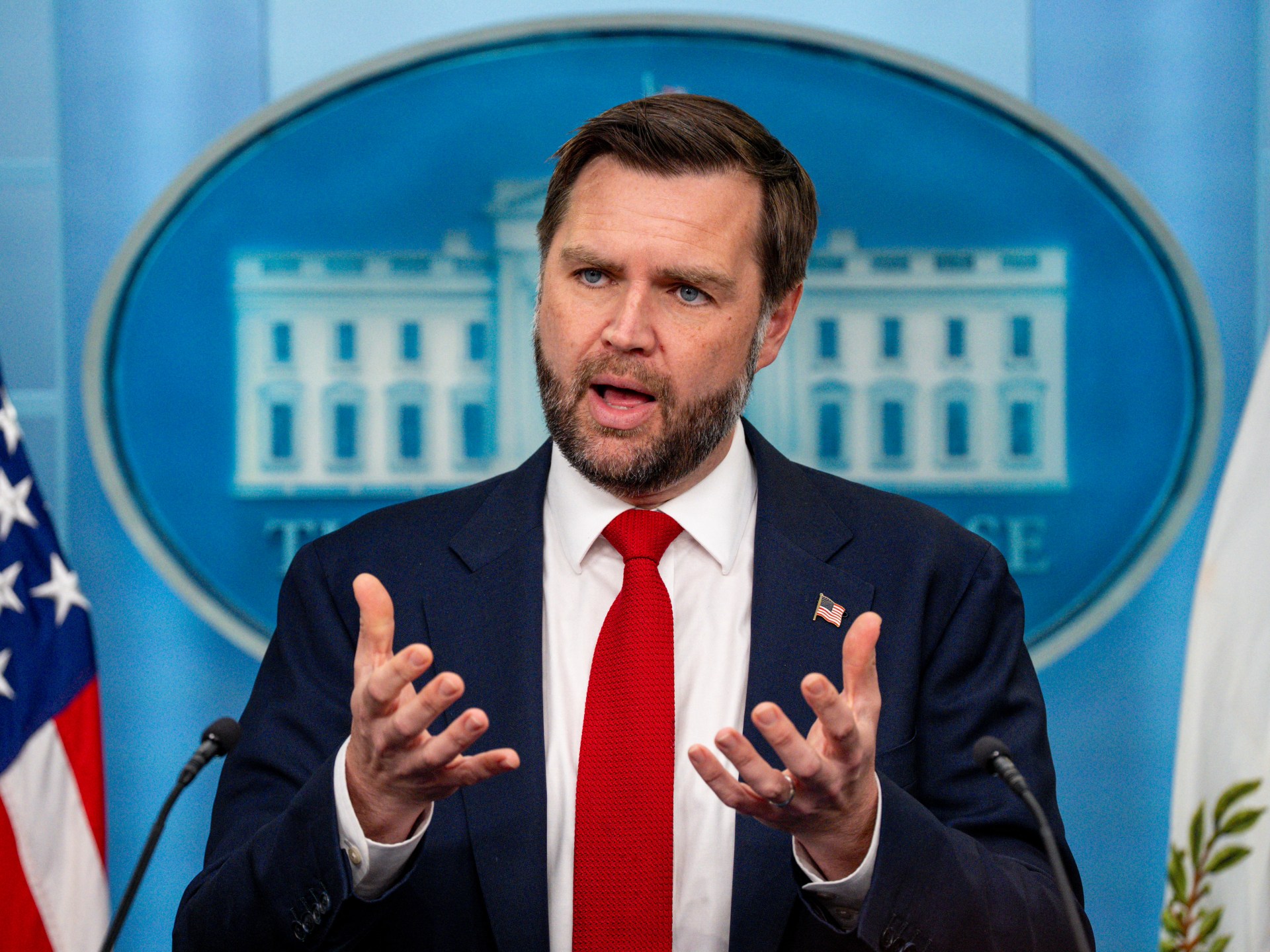
There won’t be a rupture, but there won’t be business as usual, either.Published On 22 Jun 2026Vice President JD Vance speaks during a news conference at the White House on June 18, 2026 in Washington [Andrew Harnik /Getty via AFP]United States Vice President JD Vance’s warning to Israel last week may prove one of the most consequential public statements ever delivered by a senior US official about the US-Israeli relationship. Not because it revealed a disagreement – such tensions have surfaced before – but because it challenged a core assumption underpinning the alliance for decades: That Israel can openly oppose a major US diplomatic initiative and still expect Washington to adjust its course.“If I was in the cabinet of the Israeli government, I might not be attacking the only powerful ally that I have anywhere left in the entire world,” Vance said, while defending President Donald Trump’s newly signed memorandum with Iran.The significance lies in what it implied. Vance was publicly acknowledging what US officials have long preferred to leave unsaid: Israel’s international standing has deteriorated, its diplomatic isolation has deepened, and its dependence on the US has become increasingly pronounced. More importantly, he signalled that the Trump administration is no longer willing to treat Israeli objections as a veto over US policy – a potentially historic shift.The immediate dispute centres on Iran" class="entity-link entity-event" data-entity-id="150473" data-entity-type="event">Trump’s agreement with Iran, which launched a 60-day negotiating process aimed at transforming a fragile ceasefire into a broader regional peace framework. The memorandum envisions sanctions relief, economic rehabilitation, freedom of navigation in the Strait of Hormuz, and restrictions on Iran’s nuclear ambitions. The administration argues that diplomacy offers a better path to regional stability than another cycle of confrontation.For Israeli Prime Minister Benjamin Netanyahu, however, the agreement undermines a strategy he has pursued for years. Few foreign leaders have invested more effort than he did in convincing Washington that Iran should remain isolated, weakened, and constrained through sustained economic and military pressure. A diplomatic opening with Tehran inevitably challenges that approach.Israeli officials have expressed deep concern about the agreement. Netanyahu-aligned media have attacked Trump advisers Steve Witkoff and Jared Kushner, while Israeli allies in Congress and conservative US media have begun mobilising opposition to negotiations with Iran.The goal appears familiar: Generate enough domestic political pressure to force the White House to harden its negotiating position. Netanyahu used similar tactics during the Obama administration, culminating in his 2015 address to Congress opposing the nuclear agreement being negotiated at the time.What appears different today is Washington’s response. Rather than softening its position, the Trump administration has pushed back publicly. When Vance noted that roughly two-thirds of Israel’s defensive weapons are built and financed by Americans, he highlighted a reality US officials have rarely discussed. The implication was unmistakable: While the alliance remains vital, Israel’s strategic freedom depends heavily on US military, financial, and diplomatic support.Coming from a Republican vice president and political heir apparent of a president long viewed as one of Israel’s strongest supporters, the statement was striking.Equally significant was Vance’s criticism of Israeli attacks on Beirut as negotiations approached a breakthrough. He noted that many of those killed were civilians and suggested such actions risked undermining broader diplomatic efforts. The criticism reflected growing frustration within the administration over what some officials view as Israeli attempts to complicate or derail a process that Washington considers strategically important.This is where the disagreement becomes larger than the Iran deal itself. What is emerging is a divergence in strategic vision. The Trump administration increasingly appears convinced that regional stability requires a diplomatic framework capable of managing relations with Iran while reducing incentives for conflict. Netanyahu remains committed to a model centred on pressure, deterrence, and confrontation. These are not merely different tactics; they are competing visions of a Middle East order.For decades, Israeli leaders operated on the assumption that US administrations would ultimately align themselves with Israel’s assessment of regional threats. Vance’s remarks suggest that assumption may no longer hold.His comments also reflected a broader geopolitical reality. Israel today faces mounting criticism across much of the international community. The wars in Gaza and Lebanon have strained relations with many traditional partners and led to growing diplomatic pressure. That reality has narrowed Israel’s room for manoeuvre and increased its reliance on Washington.Vance’s warning acknowledged this with unusual candour. His point was not simply that Israel needs US support. It was that Israel has fewer strategic alternatives than it once did.None of this means a rupture is imminent. The military, intelligence, technological, and political ties connecting the US and Israel remain deep and enduring. But alliances evolve. The most likely outcome is not a break in relations but a recalibration.Washington may continue to guarantee Israel’s security while becoming less willing to subordinate broader regional objectives to Israeli preferences. Future administrations may increasingly distinguish between support for Israel and support for the policies of a particular Israeli government.If Trump’s negotiations with Iran produce tangible results – reduced tensions, economic stabilisation, and limits on Iranian influence – that trend will accelerate.The significance of Vance’s remarks, therefore, lies in what they revealed about the changing balance within the relationship itself. For decades, American leaders rarely spoke publicly about Israel’s dependence on the US. Vance did. For decades, Israeli governments assumed they could pressure Washington into reversing course. Vance suggested otherwise.That is why his warning resonated far beyond the immediate controversy over Iran. It may ultimately be remembered as the moment a senior American official publicly signalled that the era of automatic deference to Israeli priorities is ending, and that the alliance is entering a new phase defined less by habit and more by US interests, regional realities, and shifting political calculations.The views expressed in this article are the author’s own and do not necessarily reflect Al Jazeera’s editorial policy.
SRCAl Jazeera
LANGEN
LEANCenter
WORDS963
ENT10
MON · 2026-06-22 · 10:43 GMTBRIEF NSR-2026-0622-86371
NSR-2026-0622-86371Analysis·EN·Diplomatic
Vance’s warning to Israel signals a new phase in US-Israeli relations
US Vice President JD Vance's recent public warning to Israel signifies a potential shift in US-Israeli relations, moving away from "business as usual." Vance challenged Israel's assumption that it could oppose US diplomatic initiatives, like President Trump's new memorandum with Iran, without consequence. He highlighted Israel's increased international isolation and dependence on US support, suggesting the Trump administration will no longer allow Israeli objections to dictate US policy.
Said ArikatAl JazeeraFiled 2026-06-22 · 10:43 GMTLean · CenterRead · 4 min
Al JazeeraFIG 01
Reading time
4min
Word count
963words
Sources cited
3cited
Entities identified
10entities
Quality score
100%
§ 01
Briefing Summary
AI-generatedNEWSAR · AI
US Vice President JD Vance's recent public warning to Israel signifies a potential shift in US-Israeli relations, moving away from "business as usual." Vance challenged Israel's assumption that it could oppose US diplomatic initiatives, like President Trump's new memorandum with Iran, without consequence. He highlighted Israel's increased international isolation and dependence on US support, suggesting the Trump administration will no longer allow Israeli objections to dictate US policy. The dispute centers on Trump's agreement with Iran, which aims for sanctions relief and regional stability through diplomacy, a strategy that conflicts with Prime Minister Netanyahu's long-held approach of isolating Iran. Vance's remarks also criticized Israeli actions in Beirut, indicating a divergence in strategic visions for Middle East stability between the US administration and Israeli leadership.
Confidence 0.90Sources 3Claims 5Entities 10
§ 02
Article analysis
Model · rule-basedFraming
Diplomatic
Political Strategy
Tone
Mixed Tone
AI-assessed
CalmNeutralAlarmist
Factuality
0.60 / 1.00
Mixed
LowHigh
Sources cited
3
Well sourced
FewMany
§ 03
Key claims
5 extracted01
"If I was in the cabinet of the Israeli government, I might not be attacking the only powerful ally that I have anywhere left in the entire world," Vance said.
quoteJD Vance
Confidence
1.00
02
The US-Iran memorandum envisions sanctions relief, economic rehabilitation, freedom of navigation, and restrictions on Iran’s nuclear ambitions.
factual
Confidence
0.90
03
Netanyahu used similar tactics during the Obama administration, culminating in his 2015 address to Congress opposing the nuclear agreement.
factual
Confidence
0.80
04
Vice President JD Vance's warning to Israel may be a consequential public statement about US-Israeli relations.
factual
Confidence
0.80
05
The Trump administration is signaling it will no longer treat Israeli objections as a veto over US policy.
factual
Confidence
0.70
§ 04
Full report
4 min read · 963 words§ 05
Entities
10 identifiedKey playerOppositionContextPositiveNeutralNegative
People5
§ 06
Keywords & salience
8 termsus-israeli relations
1.00
trump administration
0.90
iran diplomacy
0.80
israel's international standing
0.70
regional peace framework
0.60
us policy
0.50
benjamin netanyahu
0.40
strait of hormuz
0.40
§ 07
Topic connections
Interactive graph Network visualization showing 51 related topics
View Full Graph Person Organization Location Event|Click node to navigate|Edge numbers = shared articles