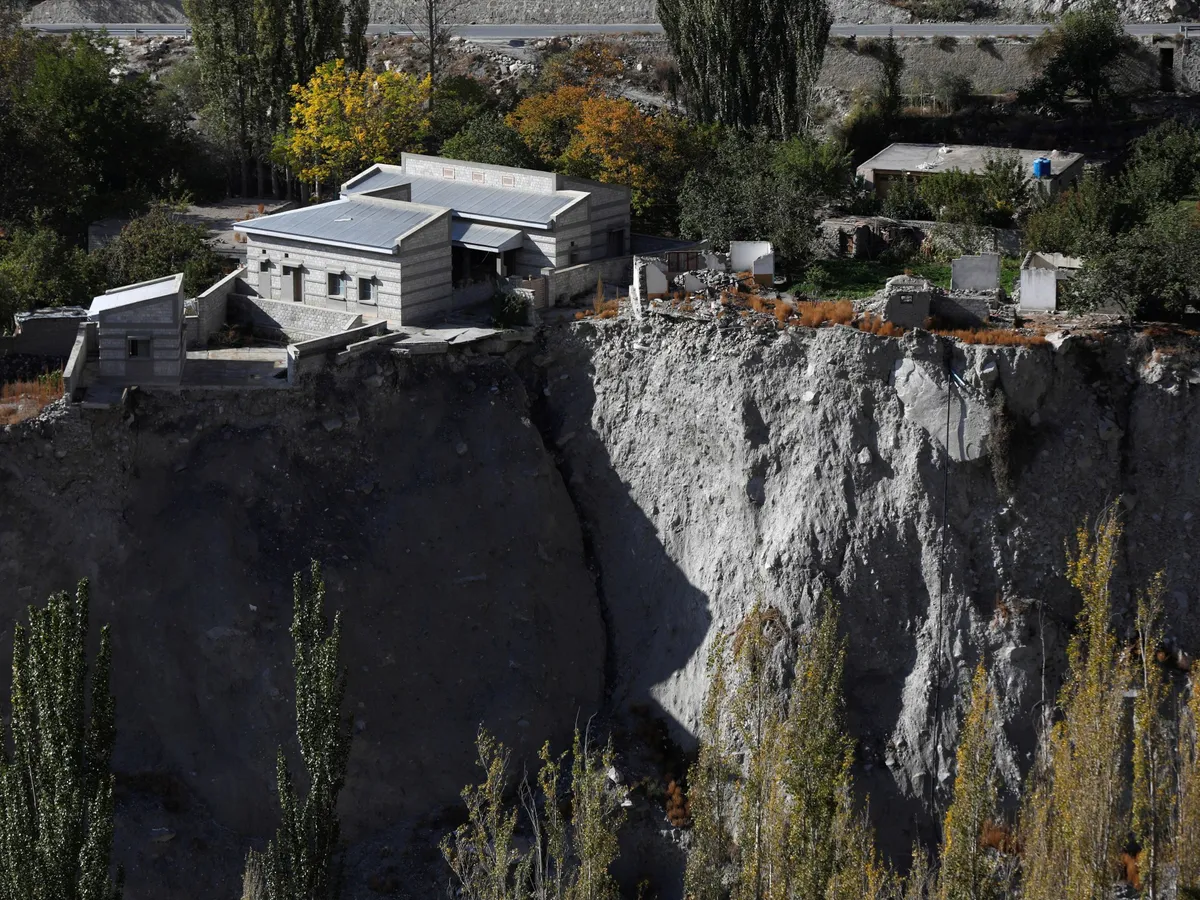
The warning comes as the country braces for a likely fourth consecutive year of punishing Monsoon, expected to arrive later this month.A community hall and houses show signs of damage after a Glacial Lake Outburst Flooding (GLOF) incident occurred from the nearby Shisper glacier, in Hassanabad village, Hunza valley, Karakoram mountain range in the Gilgit-Baltistan region of Pakistan, October 10, 2023 [Akhtar Soomro/Reuters]Published On 22 Jun 2026Islamabad, Pakistan – Pakistan has entered what its disaster authority is calling a “critical” weather window.The National Disaster Management Authority (NDMA) on Sunday issued a nationwide alert, warning of thunderstorms, heavy rainfall, urban flooding, and an elevated risk of Glacial Lake Outburst Floods (GLOFs) across the country’s northern regions over the next 12 to 24 hours.Recommended Stories list of 4 itemslist 1 of 4After the floods of 2025, can we keep 2026 above water?list 2 of 4Why Pakistani farmers are suing two German companies for deadly 2022 floodslist 3 of 4Pakistan’s Climate Change minister lashes out at US, ‘crisis of justice’list 4 of 4Mapping the scale of damage by the catastrophic Pakistan floodsend of listThe alert identified Hunza and Skardu areas in the mountainous Gilgit-Baltistan region in the north and the Khyber Pakhtunkhwa province in the northwest among the most vulnerable areas to a possible climate disaster.Authorities also warned of flooding in capital Islamabad, and other urban areas, including Rawalpindi and its adjoining areas. Provincial and district administrations have been placed on high alert and directed to keep their drainage systems clear.The NDMA advised tourists and travellers to avoid unnecessary travel during heavy rains. People have also been asked to check weather forecasts and road conditions before visiting the northern regions, where landslides could cause closure of some roads.The warning came as Pakistan braces for a likely fourth consecutive year of punishing Monsoon, which is expected to arrive later this month.Melting glaciersLast year, Monsoon rains in Pakistan killed more than 1,000 people, including 275 children, and displaced three million from their homes.But it was the historic floods in 2022 – mainly caused by melting glaciers and submerging nearly a third of the country – that put Pakistan on a global climate crisis watch.Pakistan contributes less than 1 percent of global emissions, yet remains among the five countries most affected by Climate Change.In Gilgit-Baltistan, temperatures this year reached a record 48.5 degrees Celsius (119.3 degrees Fahrenheit), breaking a previous high set in 1971. The heat has accelerated glacial melt, swelling and bursting lakes across the ecologically sensitive region.Pakistan is home to some 13,000 glaciers – the most in the world after the polar icecaps. And global warming is fast melting them.According to the United Nations Development Programme (UNDP), melting glaciers across Pakistan’s Hindu Kush, Himalayas and Karakoram mountain ranges have formed more than 3,000 glacial lakes in Gilgit-Baltistan and Khyber Pakhtunkhwa. Of those, 33 have been assessed as vulnerable to hazardous outbursts, with more than 7.1 million people living around them at risk.GLOFs release millions of cubic metres of water and debris within hours, destroying bridges, farms and entire communities downstream.In partnership with the UNDP, Pakistan in 2017 launched the scaling-up of the Glacial Lake Outburst Flood Risk Reduction project, known as GLOF-II, covering 24 valleys across 15 districts in Gilgit-Baltistan and Khyber Pakhtunkhwa.The initiative focused on early warning systems, flood protection infrastructure, and community-based disaster preparedness.But Zakir Hussain, director general of the Gilgit-Baltistan Disaster Management Authority, told Al Jazeera that the scale of coverage under Pakistan’s early warning infrastructure is widely misunderstood.The GLOF-II project, he said, covered only 16 selected valleys, not Gilgit-Baltistan as a whole, and within those valleys, only a limited number of sites. In many of the areas hit hardest in 2025, including Ghizer, Diamer and parts of Hunza, no early warning system existed at all.“The problem there was the absence of coverage altogether,” Hussain told Al Jazeera.“The one exception is Shishper in Hunza valley. That is the single case where an early warning system was in place but did not generate a warning despite the glacier changing its behaviour. In the other instances, these are very different problems, and we should be clear about the distinction.”Funding gapThe 2022 floods remain the benchmark for how devastating climate disasters in Pakistan could turn. The floods killed nearly 1,700 people, displaced more than 30 million, caused $14.8bn in property damage, and wiped out $15.2bn from Pakistan’s gross domestic product.Pakistan hosted a donor conference in Geneva in January 2023, where about $11bn was pledged by various countries and international financial institutions for flood recovery. But according to the UN’s humanitarian coordination agency, OCHA, only about $4.5bn had been delivered by June 2025, largely for housing, transport and flood risk management projects.Hussain was direct about what that shortfall represents.“It is clear that the parties to the conference are not shouldering their responsibility when it comes to the transfer of funds, the transfer of technology, and the capacity building of countries suffering the consequences of carbon emissions by the developed world,” he said.What compounds the country’s vulnerability, Hussain added, is not only a lack of infrastructure, but also a lack of coordination between various institutions.“There is no single authoritative source of truth,” Hussain told Al Jazeera.“What one institution accepts, another does not, and that creates administrative hurdles and breakdowns in response. Integrating forecasting with response metrics is where the work needs to happen.”
SRCAl Jazeera
LANGEN
LEANCenter
WORDS887
ENT12
MON · 2026-06-22 · 12:54 GMTBRIEF NSR-2026-0622-86390
NSR-2026-0622-86390News Report·EN·Environmental
Pakistan issues nationwide alert over fears of heavy rains, floods
Pakistan's National Disaster Management Authority (NDMA) has issued a nationwide alert due to fears of heavy rains and floods, particularly in northern regions like Gilgit-Baltistan and Khyber Pakhtunkhwa. This warning comes as the country anticipates its fourth consecutive punishing monsoon season, expected to begin this month.
Abid HussainAl JazeeraFiled 2026-06-22 · 12:54 GMTLean · CenterRead · 4 min
Al JazeeraFIG 01
Reading time
4min
Word count
887words
Sources cited
2cited
Entities identified
12entities
Quality score
100%
§ 01
Briefing Summary
AI-generatedNEWSAR · AI
Pakistan's National Disaster Management Authority (NDMA) has issued a nationwide alert due to fears of heavy rains and floods, particularly in northern regions like Gilgit-Baltistan and Khyber Pakhtunkhwa. This warning comes as the country anticipates its fourth consecutive punishing monsoon season, expected to begin this month. The alert highlights the risk of thunderstorms, urban flooding, and Glacial Lake Outburst Floods (GLOFs), exacerbated by record-breaking heat accelerating glacial melt. Authorities are urging caution for tourists and residents, advising against unnecessary travel and recommending preparedness measures. The country, highly vulnerable to climate change despite low emissions, is still recovering from devastating floods in 2022 and 2025.
Confidence 0.90Sources 2Claims 5Entities 12
§ 02
Article analysis
Model · rule-basedFraming
Environmental
Human Interest
Tone
Mixed Tone
AI-assessed
CalmNeutralAlarmist
Factuality
0.80 / 1.00
Factual
LowHigh
Sources cited
2
Limited
FewMany
§ 03
Key claims
5 extracted01
Temperatures in Gilgit-Baltistan reached a record 48.5 degrees Celsius this year, accelerating glacial melt.
statistic
Confidence
1.00
02
Pakistan contributes less than 1% of global emissions but is among the five countries most affected by climate change.
statistic
Confidence
1.00
03
Last year, monsoon rains in Pakistan killed over 1,000 people and displaced three million.
statistic
Confidence
1.00
04
Pakistan's National Disaster Management Authority (NDMA) issued a nationwide alert for thunderstorms, heavy rainfall, urban flooding, and elevated risk of Glacial Lake Outburst Floods (GLOFs).
factualNDMA
Confidence
1.00
05
The country is bracing for a likely fourth consecutive year of punishing monsoon, expected to arrive later this month.
prediction
Confidence
0.90
§ 04
Full report
4 min read · 887 words§ 05
Entities
12 identifiedKey playerOppositionContextPositiveNeutralNegative
Organizations1
Locations8
§ 06
Keywords & salience
10 termsfloods
1.00
heavy rains
1.00
monsoon
0.90
glacial lake outburst floods
0.80
climate change
0.80
pakistan
0.70
nationwide alert
0.60
melting glaciers
0.50
urban flooding
0.50
disaster management
0.40
§ 07
Topic connections
Interactive graph Network visualization showing 51 related topics
View Full Graph Person Organization Location Event|Click node to navigate|Edge numbers = shared articles