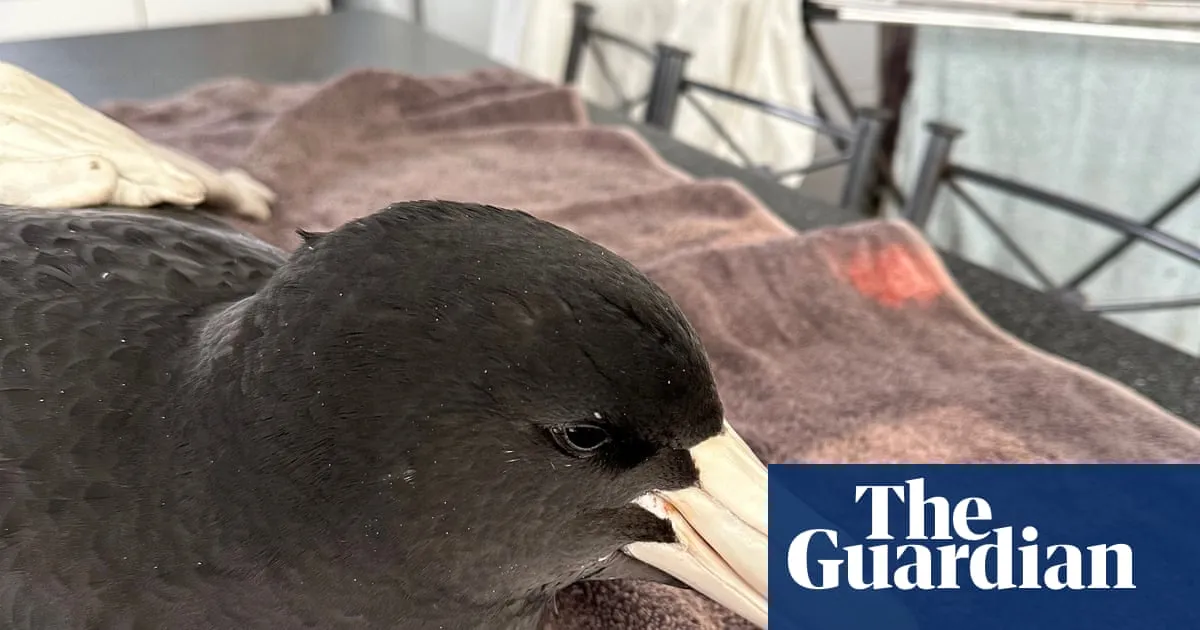
The giant petrel that was found sick on Wylie Bay beach near Esperance in Australia" class="entity-link entity-location" data-entity-id="706" data-entity-type="location">Western Australia. Photograph: Lori-Ann Shibish/Esperance Wildlife Hospital and Sanctuary. View image in fullscreen The giant petrel that was found sick on Wylie Bay beach near Esperance in Australia" class="entity-link entity-location" data-entity-id="706" data-entity-type="location">Western Australia. Photograph: Lori-Ann Shibish/Esperance Wildlife Hospital and Sanctuary. Brown skuas and Giant petrels rarely make landfall. When they were found in WA, scientists feared ‘bad news’ for wildlife Experts thought H5N1 bird flu would more likely reach Australia’s north. But an arrival from Antarctica had always been possible Get our breaking news email, free app or daily news podcast Brown skuas and Giant petrels are a common sight offshore in southern Australian waters in the winter months, but they will rarely risk venturing on to land. So when two of these birds were discovered sick – on beaches a few kilometres apart on Australia" class="entity-link entity-location" data-entity-id="706" data-entity-type="location">Western Australia’s southern coastline – it was a sign something might be wrong. On Monday it was confirmed the giant petrel had tested positive for the H5N1 strain of avian influenza, two days after the case was confirmed in the skua. Both birds have since died. The virus has killed millions of birds and mammals around the world since 2021 but, until now, Australia was the only continent it had failed to reach. Now governments and wildlife experts are waiting anxiously to see if the two cases represent the beginning of a wave of infections, fearing devastating consequences for Australian wildlife and industry. Almost 60 reports of sick and dead birds in Australia" class="entity-link entity-location" data-entity-id="706" data-entity-type="location">Western Australia were made to a nationwide hotline at the weekend.. Australia’s chief veterinary officer, Dr Beth Cookson, said there was no sign that the two infections had spread to other birds. But the cases have put experts and government agencies on high alert. Because the disease first emerged in the northern hemisphere and much of its devastation has occurred there, experts told the Guardian it was thought more likely that if it reached Australia, it would affect the northern coastline first. But an arrival from Antarctica and its surrounds had always been seen as a possibility. “Biosecurity had our eyes on the northern hemisphere,” said Dr Lauren Roman, a seabird researcher at the University of Tasmania’s Institute for Marine and Antarctic Studies. “We had been warned about the arrival of migratory shorebirds and seabirds and that the virus could come in with them.” View image in fullscreen The brown skua that was brought into care after being found on a remote beach in Australia" class="entity-link entity-location" data-entity-id="706" data-entity-type="location">Western Australia. Photograph: Lori-Ann Shibish/Esperance Wildlife Hospital and Sanctuary She said for more than two years there had been ongoing surveillance by agencies and scientists all around Australia, constantly checking for the disease. But until now, all tests had returned negative. Giant petrels and Brown skuas both breed in Antarctica’s summer but leave the frozen continent when temperatures tumble, spending the winter months foraging at sea to the north, including in Australia’s southern waters. Both the birds will also scavenge for food. Roman said this practice is thought to be one way the disease could have spread around Antarctica and how these two birds may have contracted the disease. “Skuas have been implicated in the spread [of the disease], but it’s not inherently their fault,” said Simon Gorta, a researcher and ecologist in the Centre for Ecosystem Science at the University of New South Wales. “It’s a virus that has spread around the world and seabirds are already highly threatened so this is bad news for them too.” More than 13,000 seal pups died from the disease between October last year and January, alongside penguins and petrels, Australian scientists revealed last week. “There’s potential that there could be other birds coming up – other species and other individuals – that could come in to our shores because they are sick,” said Dale Wright, acting director of conservation science at BirdLife Australia. These are pelagic bird species – meaning they sleep and forage at sea – and they rarely come ashore unless they are either sick or they see something inviting on a beach, such as a whale carcass, to feed on. But Roman and Wright both said if a sick bird came ashore and died, it could easily be fed on by other birds – including gulls – which could then move the disease into other populations, making it impossible to eradicate. Anyone who finds sick or dead birds or marine mammals is advised to avoid the animals and not handle them, and instead take photos or a video and call the Emergency Animal Disease Hotline on 1800 675 888. Explore more on these topics Wildlife Bird flu Birds Animals Australia" class="entity-link entity-location" data-entity-id="706" data-entity-type="location">Western Australia Health news Share Reuse this content
SRCThe Guardian - World News
LANGEN
LEANCenter-Left
WORDS789
ENT12
MON · 2026-06-22 · 15:00 GMTBRIEF NSR-2026-0622-86428
NSR-2026-0622-86428News Report·EN·Public Health
Brown skuas and giant petrels rarely make landfall. When they were found in WA, scientists feared ‘bad news’ for wildlife
Two seabirds, a brown skua and a giant petrel, have tested positive for the H5N1 strain of avian influenza on Western Australia's southern coastline, marking the first confirmed cases of the virus in Australia. These species, which typically forage at sea and rarely come ashore, were found sick and have since died.
Graham Readfearn Environment and climate correspondentThe Guardian - World NewsFiled 2026-06-22 · 15:00 GMTLean · Center-LeftRead · 4 min
The Guardian - World NewsFIG 01
Reading time
4min
Word count
789words
Sources cited
2cited
Entities identified
12entities
Quality score
100%
§ 01
Briefing Summary
AI-generatedNEWSAR · AI
Two seabirds, a brown skua and a giant petrel, have tested positive for the H5N1 strain of avian influenza on Western Australia's southern coastline, marking the first confirmed cases of the virus in Australia. These species, which typically forage at sea and rarely come ashore, were found sick and have since died. Scientists had previously anticipated the virus might reach Australia's north via migratory birds, but an arrival from Antarctica was also a possibility. The discovery has placed wildlife experts and government agencies on high alert due to the potential for devastating impacts on Australian wildlife and industry, though current surveillance shows no sign of widespread transmission. Authorities are urging the public to report any sick or dead birds and to avoid handling them.
Confidence 0.90Sources 2Claims 5Entities 12
§ 02
Article analysis
Model · rule-basedFraming
Public Health
Environmental
Tone
Mixed Tone
AI-assessed
CalmNeutralAlarmist
Factuality
0.80 / 1.00
Factual
LowHigh
Sources cited
2
Limited
FewMany
§ 03
Key claims
5 extracted01
Biosecurity efforts had been focused on the northern hemisphere, with an arrival from Antarctica considered a possibility but not the primary concern.
quoteDr Lauren Roman
Confidence
1.00
02
Australia was the only continent that H5N1 bird flu had not reached until these cases.
factualArticle
Confidence
1.00
03
A giant petrel found sick in Western Australia tested positive for the H5N1 strain of avian influenza.
factualArticle
Confidence
1.00
04
Experts feared devastating consequences for Australian wildlife and industry due to the potential spread of H5N1.
factualArticle
Confidence
0.90
05
Brown skuas and giant petrels rarely venture onto land, making their presence on beaches a sign of potential problems.
factualArticle
Confidence
0.90
§ 04
Full report
4 min read · 789 words§ 05
Entities
12 identifiedKey playerOppositionContextPositiveNeutralNegative
Organizations1
Locations5
§ 06
Keywords & salience
8 termsh5n1 avian influenza
1.00
wildlife
0.90
brown skuas
0.80
giant petrels
0.80
australia
0.70
antarctica
0.60
biosecurity
0.50
seabird researcher
0.40
§ 07
Topic connections
Interactive graph Network visualization showing 34 related topics
View Full Graph Person Organization Location Event|Click node to navigate|Edge numbers = shared articles