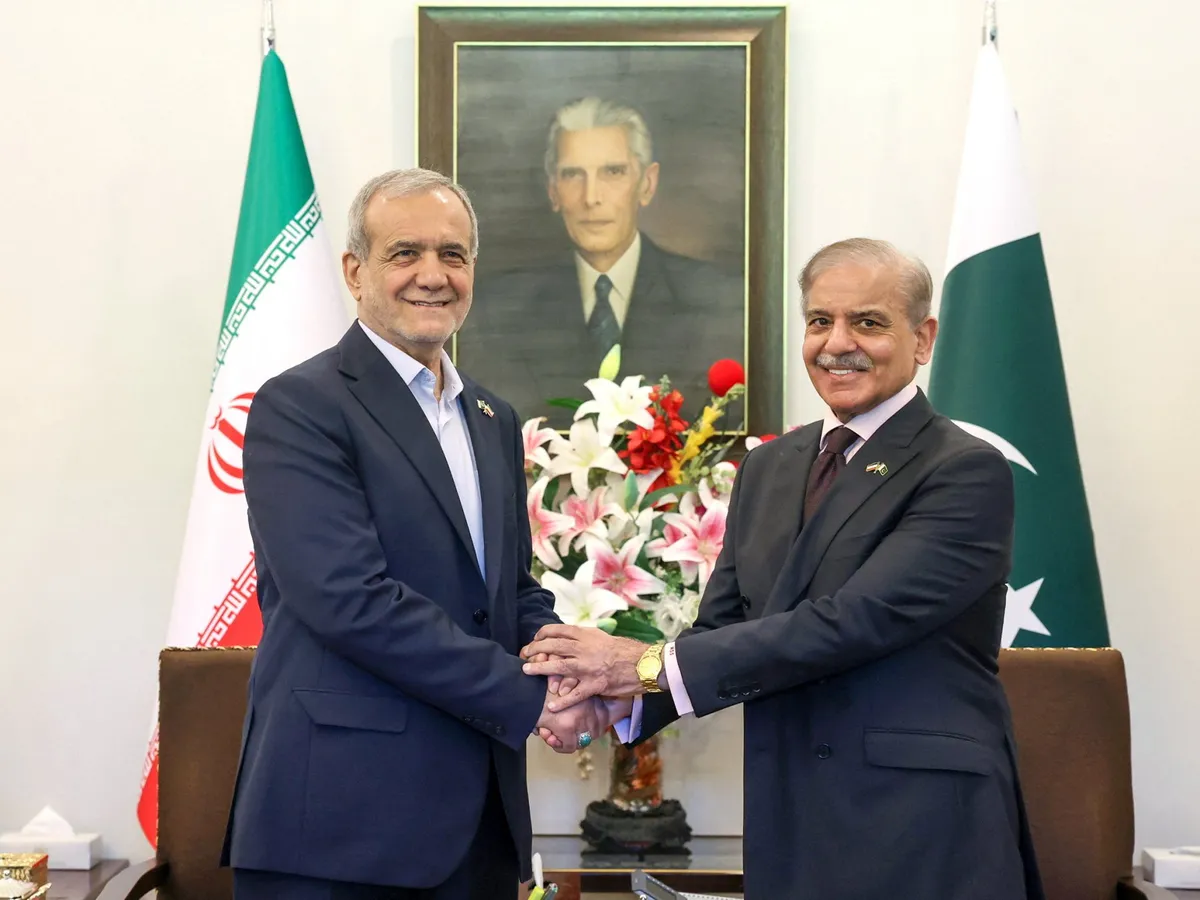
This is Pezeshkian’s first overseas trip since the US and Israel attacked Iran in February, and comes a day after the high-stakes Switzerland talks.Iranian President Masoud Pezeshkian meets with Pakistani Prime Minister Shehbaz Sharif in Islamabad, Pakistan, August 3, 2025, during his first visit to Pakistan last year [West Asia News Agency Handout via Reuters]Published On 23 Jun 2026Islamabad, Pakistan – Iranian President Masoud Pezeshkian is set to arrive in Islamabad for a state visit that is as much a gesture of gratitude as it is a statement of intent.The trip on Tuesday – his first overseas visit since the United States and Israel launched attacks on Iran on February 28 – comes a day after Pakistan and Qatar announced that the first round of high-level US-Iran talks in Burgenstock, Switzerland, had yielded a 60-day roadmap towards a final deal.Recommended Stories list of 4 itemslist 1 of 4US, Iran agree on ‘roadmap’ towards final deal in Switzerland talkslist 2 of 4What are the key outcomes of the Iran-US talks, what next?list 3 of 4Marco Rubio heads to Middle East to address Iran MoU, Hormuzlist 4 of 4Khamenei’s MoU stance stirs debate as Iran and US meet in Switzerlandend of listThe timing is not incidental. Pezeshkian arrives in Islamabad having just signed the most significant diplomatic agreement of his presidency. The deal faces the same factional fault lines at home that overshadowed the 2015 JCPOA negotiations.The 2015 JCPOA, or Joint Comprehensive Plan of Action, was a landmark nuclear agreement between Iran and six world powers – the US, the United Kingdom, France, Germany, Russia and China.According to the deal, Tehran agreed to limit its nuclear programme in exchange for relief from international sanctions. The US withdrew from the deal in 2018, during the first presidency of Donald Trump.“The fact that Pezeshkian is going to Islamabad immediately after signing the MoU tells us that he needs to convert this fragile agreement into political capital – at home, within the state, across the region, and internationally,” Reza Khanzadeh, a Middle East analyst and professor at George Mason University, told Al Jazeera. “He needs this visit more than Pakistan does.”During the visit, Pezeshkian will meet Prime Minister Shehbaz Sharif, who mediated the Switzerland talks, and President Asif Ali Zardari.Pakistani Senate Chairman Yousaf Raza Gilani, National Assembly Speaker Sardar Ayaz Sadiq, and Deputy Prime Minister and Foreign Minister Ishaq Dar will also meet the Iranian president, according to Pakistan’s Ministry of Foreign Affairs.The two sides are expected to discuss the Switzerland talks and ways to deepen bilateral cooperation in trade, energy, border security, and regional connectivity.Relationship forged through crisisThe visit is Pezeshkian’s second to Pakistan as the Iranian president.After the 12-day Iran-Israel war in June 2025, Pezeshkian chose Pakistan as his first foreign destination, travelling to the eastern city of Lahore before heading to the capital Islamabad.Twelve bilateral agreements were signed. A target of $10bn in annual trade – up from roughly $3bn – was pledged.“Pakistan is the first country chosen by President Pezeshkian to come and personally express his gratitude and appreciation for the Pakistani political, military, and people of Pakistan for their commitment, for their help, for their efforts to pursue the mediation mission,” Afzal Reza, bureau chief of Iran’s official state news agency IRNA in Islamabad, told Al Jazeera.But the Pakistan-Iran relationship has not always been congenial. In January 2024, Iran launched missile attacks inside Pakistan’s Balochistan province, claiming to target the armed group, Jaish al-Adl.Pakistan retaliated within 48 hours, launching a series of attacks against hideouts of armed groups in Iran’s Sistan-Baluchestan province.The two neighbours recalled their ambassadors, as the confrontation was described as one of the most serious military escalations between them in decades.However, both sides stepped back quickly. Iran’s then-foreign minister, Hossein Amirabdollahian, travelled to Islamabad to de-escalate tensions, and diplomatic ties were gradually restored.Pakistani PM Shehbaz Sharif travelled to Iran in May 2025, where he met Supreme Leader Ayatollah Ali Khamenei and President Masoud Pezeshkian. Iran’s supreme leader was killed in a strike by the US-Israel forces on February 28, 2026 [Office of the Iranian Supreme Leader/West Asia News Agency/Handout via Reuters]Months later, President Ebrahim Raisi died in a helicopter crash in northwestern Iran alongside Amirabdollahian.Pezeshkian won the snap election that followed and took office in July 2024, inheriting a fragile but repaired relationship with Pakistan.“Pakistan is no longer just facilitating messages,” Khanzadeh said. “Iran is signalling that Islamabad has become politically invested in the outcome of the process.”‘Iran engaging from position of sovereignty’Since the US-Israel attacks on Iran began on February 28, Sharif and Pezeshkian have spoken by phone at least seven times, often in conversations lasting up to an hour, according to officials.Pakistan’s army chief, Field Marshal Asim Munir, travelled to Tehran at least twice, while Interior Minister Mohsin Naqvi also made multiple visits as part of Pakistan’s mediation efforts.The diplomacy culminated in a Memorandum of Understanding (MoU) signed on June 18 by Trump and Pezeshkian, with Sharif signing the document as a mediator.The most recent call between the two leaders took place on June 18 – the day the MoU was signed – and lasted more than 30 minutes. It was during that conversation that Sharif invited Pezeshkian to visit Islamabad.The first round of talks in Burgenstock, which concluded on Sunday, produced several outcomes: A high-level political committee, working groups on nuclear issues and sanctions, a communication line on the Strait of Hormuz, and a de-confliction mechanism for Lebanon. Technical discussions are continuing this week.Khanzadeh argued that while Burgenstock is hosting the technical negotiations, Islamabad provides the political track for the talks.“What Islamabad can achieve that Burgenstock cannot is political trust-building,” he told Al Jazeera.“Technical negotiations can draft mechanisms, timetables, and verification language, but they cannot by themselves create the political cover needed for leaders to absorb concessions or manage spoilers.”Iranian President Masoud Pezeshkian shows the document of the US Memorandum of Understanding in Tehran, Iran, June 18, 2026 [Iran’s Presidential website/West Asia News Agency Handout via Reuters]Asif Durrani, a former Pakistani ambassador to Iran, told Al Jazeera he remains cautiously optimistic about the Iranian president’s visit.On Iran’s nuclear programme, he said Tehran is “comfortable not adopting the nuclear weapon route” and would comply with IAEA safeguards. The bigger prize, he said, is sanctions relief.“Already, for 60 days, Iran has been allowed to export its oil to the world market. So that’s a big relief,” Durrani said.On the issue of Lebanon, Durrani was more direct. The responsibility for ensuring that Israel honours any understanding reached between Washington and Tehran falls on the US, the former envoy said.“The first article of the Islamabad MOU is very specific about peace in the region, including Lebanon,” he told Al Jazeera. “If Israel thinks that it was not part of the deal, that is their headache and their business to deal with the United States.”Pezeshkian’s visit also boosts Pakistan’s diplomatic standing, analysts say. By choosing Islamabad publicly, Khanzadeh said, Iran is validating Pakistan’s role from a facilitator to a recognised regional mediator.For Pezeshkian, too, he added, the trip carries domestic significance.“It allows Pezeshkian to show that diplomacy is not capitulation, that Iran is engaging from a position of sovereignty, with regional partners, and not simply responding to American pressure,” he said.
SRCAl Jazeera
LANGEN
LEANCenter
WORDS1 202
ENT12
TUE · 2026-06-23 · 06:37 GMTBRIEF NSR-2026-0623-86604
NSR-2026-0623-86604News Report·EN·Political Strategy
Why Iran’s President Pezeshkian is heading to Pakistan after US talks
Iranian President Masoud Pezeshkian is visiting Islamabad, Pakistan, for the first time since the US and Israel attacked Iran on February 28. This trip follows high-level US-Iran talks in Switzerland that produced a 60-day roadmap towards a final deal, with Pakistan mediating.
Abid HussainAl JazeeraFiled 2026-06-23 · 06:37 GMTLean · CenterRead · 5 min
Al JazeeraFIG 01
Reading time
5min
Word count
1 202words
Sources cited
2cited
Entities identified
12entities
Quality score
100%
§ 01
Briefing Summary
AI-generatedNEWSAR · AI
Iranian President Masoud Pezeshkian is visiting Islamabad, Pakistan, for the first time since the US and Israel attacked Iran on February 28. This trip follows high-level US-Iran talks in Switzerland that produced a 60-day roadmap towards a final deal, with Pakistan mediating. Pezeshkian's visit is seen as a way to leverage the fragile agreement for political capital and to express gratitude for Pakistan's mediation efforts. He will meet with Pakistani Prime Minister Shehbaz Sharif and President Asif Ali Zardari to discuss the Switzerland talks and deepen bilateral cooperation in trade, energy, border security, and regional connectivity. This visit marks a significant diplomatic engagement for Pezeshkian, especially given recent tensions between Iran and Pakistan, which were resolved after a military escalation in January 2024.
Confidence 0.90Sources 2Claims 5Entities 12
§ 02
Article analysis
Model · rule-basedFraming
Political Strategy
Diplomatic
Tone
Measured
AI-assessed
CalmNeutralAlarmist
Factuality
0.60 / 1.00
Mixed
LowHigh
Sources cited
2
Limited
FewMany
§ 03
Key claims
5 extracted01
Pezeshkian needs to convert this fragile agreement into political capital.
quoteReza Khanzadeh
Confidence
1.00
02
The visit comes a day after Pakistan and Qatar announced that the first round of high-level US-Iran talks in Switzerland had yielded a 60-day roadmap towards a final deal.
factual
Confidence
1.00
03
This is Pezeshkian’s first overseas visit since the United States and Israel launched attacks on Iran on February 28.
factual
Confidence
1.00
04
Iranian President Masoud Pezeshkian is set to arrive in Islamabad for a state visit.
factual
Confidence
1.00
05
The two sides are expected to discuss the Switzerland talks and ways to deepen bilateral cooperation in trade, energy, border security, and regional connectivity.
factual
Confidence
0.90
§ 04
Full report
5 min read · 1 202 words§ 05
Entities
12 identifiedKey playerOppositionContextPositiveNeutralNegative
People3
Organizations1
Locations7
§ 06
Keywords & salience
9 termsiran-us talks
1.00
nuclear agreement
0.90
masoud pezeshkian
0.80
pakistan visit
0.80
jcpoa
0.70
diplomatic agreement
0.60
sanctions relief
0.50
shehbaz sharif
0.40
switzerland talks
0.40
§ 07
Topic connections
Interactive graph Network visualization showing 51 related topics
View Full Graph Person Organization Location Event|Click node to navigate|Edge numbers = shared articles