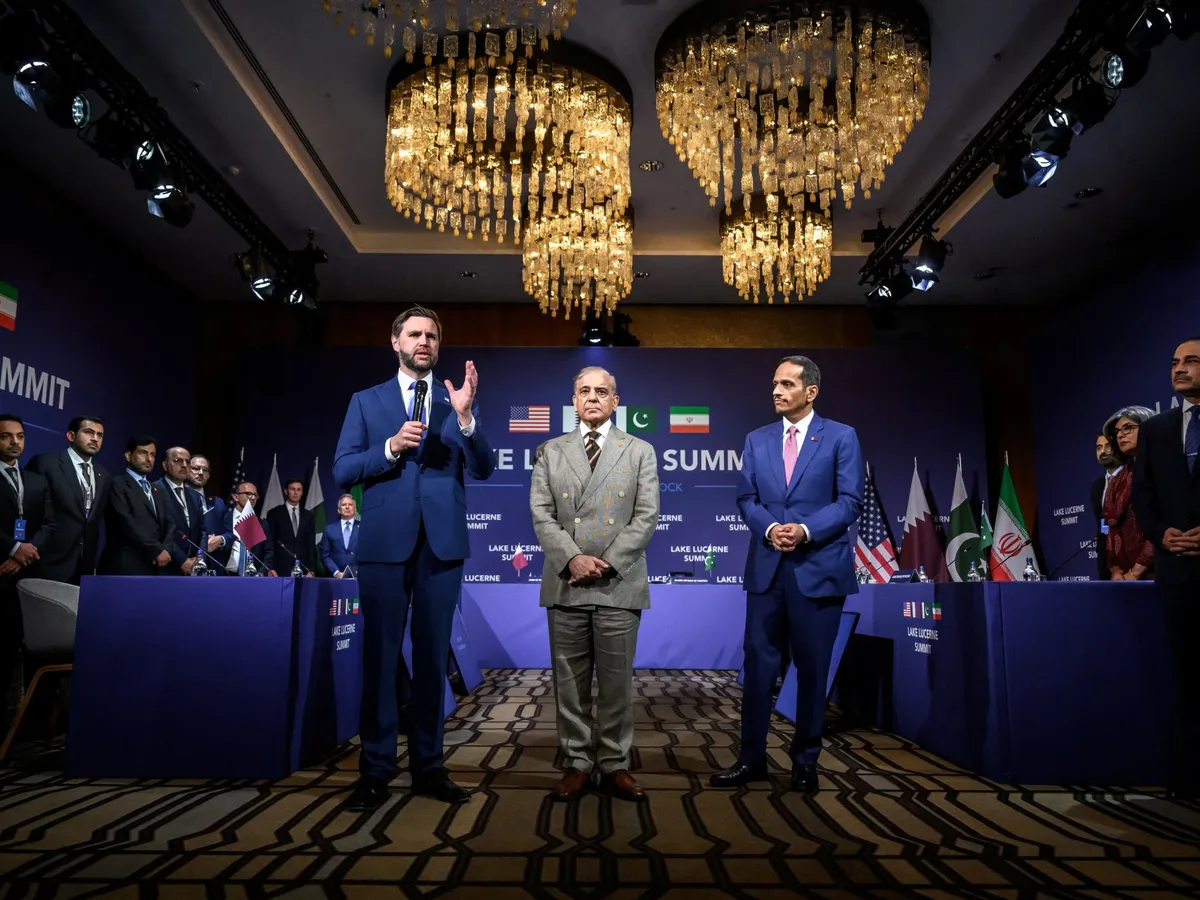
Pakistan sees strategic opportunity in the US-Iran thaw, including trade, energy access and renewed regional relevance.US Vice President JD Vance speaks next to Pakistani Prime Minister Shehbaz Sharif and Qatari Prime Minister Sheikh Mohammed bin Abdulrahman bin Jassim Al Thani during a meeting of the US, Iran, Pakistan and Qatar at the Burgenstock hotel complex overlooking Lake Lucerne, Switzerland, on June 21, 2026 [Fabrice Coffrini/Pool via Reuters]Published On 24 Jun 2026Islamabad, Pakistan – At the alpine resort of Burgenstock in Switzerland last weekend, United States Vice President JD Vance stood alongside Pakistani Prime Minister Shehbaz Sharif and Qatari Prime Minister Sheikh Mohammed bin Abdulrahman bin Jassim Al Thani.Standing a few metres away was Pakistani military chief Asim Munir, whom Vance pointed to as he began delivering remarks.Recommended Stories list of 4 itemslist 1 of 4Why Iran’s President Pezeshkian is heading to Pakistan after US talkslist 2 of 4Iran’s President Pezeshkian lands in Pakistan for talks after US deallist 3 of 4US, Iran agree on ‘roadmap’ towards final deal in Switzerland talkslist 4 of 4What are the key outcomes of the Iran-US talks, what next?end of list“Since Field Marshal Asim Munir welcomed us with the prime minister in Islamabad [in April], I have joked that I have two very, very important people in my life, an Indian and a Pakistani. The Indian is my wife, and the Pakistani is Field Marshal Munir,” he said to laughter in the room.The vice president, whose wife, Usha Vance, is the daughter of Indian immigrants, added that he had spoken to Munir more than anyone else over the previous three months. “We would not have been here without his statesmanship and military leadership,” Vance said, mirroring compliments also offered by US President Donald Trump.The praise has not been limited to Washington.Iranian President Masoud Pezeshkian arrived in Pakistan’s capital, Islamabad, on Monday for a state visit, his first foreign trip since Iran was attacked by the US and Israel on February 28, and offered thanks for Islamabad’s help in bringing Washington and Tehran to the negotiation table.The visit underscored how the past four months have repositioned Islamabad in Tehran’s calculations.Pakistan has spent much of that period acting as an indispensable intermediary between the US and Iran, facilitating backchannel contacts, hosting talks in Islamabad and managing the political risks of opening transit routes to Iran while balancing its Gulf relationships.The peace framework agreed on June 18 and the 60-day negotiations now under way are partly the result of that effort.The question now confronting Islamabad is more immediate: What does Pakistan actually gain?The economic pictureFor Pakistan’s fragile economy, the answers cannot come soon enough.A labourer pulls a cart at a wholesale market in Karachi, Pakistan [File: Akhtar Soomro/Reuters]The country recorded gross domestic product growth of 3.7 percent over the past financial year, its fastest pace in four years, while remittances rose 8.2 percent to $30.3bn. The fiscal deficit also narrowed sharply.But Hina Shaikh, a Lahore-based economist with the International Growth Centre, said the picture behind those numbers is less encouraging.“Pakistan’s mediation may yield only narrow economic gains, mainly in the form of reduced energy import costs as the Strait of Hormuz reopens and potentially renewed momentum on the Iran-Pakistan gas pipeline if sanctions relief sustains,” she told Al Jazeera. “The recent growth is mainly a result of a drop in oil and gas imports due to the Hormuz closure rather than any expansion in production,” she added, referring to the shutdown of the critical waterway during the US-Israel war on Iran.Pakistan remains in a $7bn loan programme with the International Monetary Fund, its 25th arrangement with the lender since the 1950s. It was approved in 2024.Western governments have spoken positively about developing deeper economic ties with Pakistan, but diplomatic goodwill does not automatically translate into investment or structural relief, according to analysts.Pakistan has been here before. After the September 11, 2001, attacks on the US, alignment with Washington brought debt rescheduling and multilateral support, but they did not fix the structural weaknesses that continue to weigh on its economy: a narrow tax base, weak exports and chronic current account pressures.Shaikh said those diplomatic relationships still matter.“Pakistan’s binding economic constraints are not a consequence of geopolitics, nor can they be resolved by diplomatic prestige,” she said. “But there is no doubt that goodwill will buy Islamabad breathing room, which it can use to accelerate reform.”The regional prizeInside Pakistani policy circles, the argument is that the real reward lies less in bilateral economic concessions and more in regional dividends as a durable Iran-US deal could reshape Pakistan’s neighbourhood.Sanctions relief on Iran could reopen trade flows along the Balochistan border, which have been constrained for years.The Iran-Pakistan gas pipeline, stalled for more than a decade under US sanctions pressure, could return to the agenda.Iranian President Masoud Pezeshkian, left, meets Pakistani Prime Minister Shehbaz Sharif in Islamabad on his daylong visit to Islamabad on June 23, 2026, his first visit outside Tehran since the US-Israel war on Iran began in February [Handout/Pakistan Prime Minister’s Office]But the diplomatic picture is more complicated than Islamabad’s public messaging suggests.Umer Karim, an associate fellow at the Riyadh-based King Faisal Center for Islamic Research and Studies, who specialises in Gulf and Pakistani affairs, said Pakistan entered the crisis by filling a specific vacuum that may now be narrowing.“Pakistan entered this regional crisis as a communication enabler between the US and Iran at a time when the Trump administration didn’t trust any possible mediator,” he said. “It was this vacuum that Pakistan filled while also being acceptable to the Iranian side and coordinating the mediation with Egypt, Turkiye and Saudi Arabia, thus bringing all the big regional players on board.”Karim said Pakistan’s influence still had limits.“Pakistan has to a degree integrated itself in the Middle Eastern security framework, but it still has not achieved the kind of leverage which may equip it to pressure Iran to give certain concessions or to persuade the US to accept certain Iranian demands and also to keep its relations even with all Gulf players,” he added.Who benefits?There is another question running beneath the diplomacy.Vance’s remarks at Burgenstock singled out Munir, who is not a civilian government figure.Pakistani Field Marshal Asim Munir at the Burgenstock hotel complex for the US-Iran talks [Fabrice Coffrini/Pool via Reuters]Observers said the Pakistani institution that has most visibly benefitted from the past four months is the military.It has directly ruled Pakistan for more than 30 years of its nearly 80-year history as an independent nation. It continues to dominate and influence domestic politics and foreign affairs with the army chief – and Munir in particular – seen by detractors as the de facto ruler of the country.The costs, some argued, will fall hardest on those furthest from the diplomatic table.Tughral Yamin, a retired brigadier and Islamabad-based defence analyst, said the real domestic test would be whether any economic gains reach the southwestern province of Balochistan, Pakistan’s most impoverished region, which has been facing a more than two-decade armed campaign involving rebel groups seeking secession.“If the economic benefits are shared with the people of Balochistan, the scourge of terrorism can be eliminated,” he told Al Jazeera“We stand at the cusp of great economic opportunity, though we have missed too many opportunities in the past.”
SRCAl Jazeera
LANGEN
LEANCenter
WORDS1 205
ENT12
WED · 2026-06-24 · 12:59 GMTBRIEF NSR-2026-0624-87037
NSR-2026-0624-87037Analysis·EN·Political Strategy
What does Pakistan stand to gain from helping broker the US-Iran deal?
Pakistan is positioning itself as a key mediator in the US-Iran thaw, a role that could yield significant strategic benefits. Pakistani Prime Minister Shehbaz Sharif and military chief Asim Munir played crucial roles in facilitating backchannel contacts and hosting talks in Switzerland, earning praise from US Vice President JD Vance and Iranian President Masoud Pezeshkian.
Abid HussainAl JazeeraFiled 2026-06-24 · 12:59 GMTLean · CenterRead · 5 min
Al JazeeraFIG 01
Reading time
5min
Word count
1 205words
Sources cited
3cited
Entities identified
12entities
Quality score
100%
§ 01
Briefing Summary
AI-generatedNEWSAR · AI
Pakistan is positioning itself as a key mediator in the US-Iran thaw, a role that could yield significant strategic benefits. Pakistani Prime Minister Shehbaz Sharif and military chief Asim Munir played crucial roles in facilitating backchannel contacts and hosting talks in Switzerland, earning praise from US Vice President JD Vance and Iranian President Masoud Pezeshkian. While Pakistan's economy could see reduced energy import costs and potential progress on the Iran-Pakistan gas pipeline, economists suggest these gains may be narrow. The broader prize for Pakistan lies in renewed regional relevance and stability, as a durable Iran-US deal could reshape its neighborhood. This diplomatic engagement offers Pakistan breathing room to pursue necessary economic reforms.
Confidence 0.90Sources 3Claims 5Entities 12
§ 02
Article analysis
Model · rule-basedFraming
Political Strategy
Diplomatic
Tone
Measured
AI-assessed
CalmNeutralAlarmist
Factuality
0.60 / 1.00
Mixed
LowHigh
Sources cited
3
Well sourced
FewMany
§ 03
Key claims
5 extracted01
Iranian President Masoud Pezeshkian thanked Pakistan for its help in bringing Washington and Tehran to the negotiation table.
quoteMasoud Pezeshkian
Confidence
1.00
02
US Vice President JD Vance praised Pakistani military chief Asim Munir, stating, 'We would not have been here without his statesmanship and military leadership.'
quoteJD Vance
Confidence
1.00
03
Pakistan has acted as an intermediary between the US and Iran, facilitating backchannel contacts and hosting talks.
factual
Confidence
0.95
04
A peace framework was agreed upon on June 18, followed by 60-day negotiations.
factual
Confidence
0.90
05
Pakistan sees strategic opportunity in the US-Iran thaw, including trade, energy access and renewed regional relevance.
factual
Confidence
0.90
§ 04
Full report
5 min read · 1 205 words§ 05
Entities
12 identifiedKey playerOppositionContextPositiveNeutralNegative
People5
Locations6
Events1
§ 06
Keywords & salience
10 termspakistan
1.00
us-iran deal
1.00
regional relevance
0.90
strategic opportunity
0.80
intermediary
0.70
energy access
0.60
trade
0.60
masoud pezeshkian
0.50
shehbaz sharif
0.50
negotiation
0.40
§ 07
Topic connections
Interactive graph Network visualization showing 51 related topics
View Full Graph Person Organization Location Event|Click node to navigate|Edge numbers = shared articles