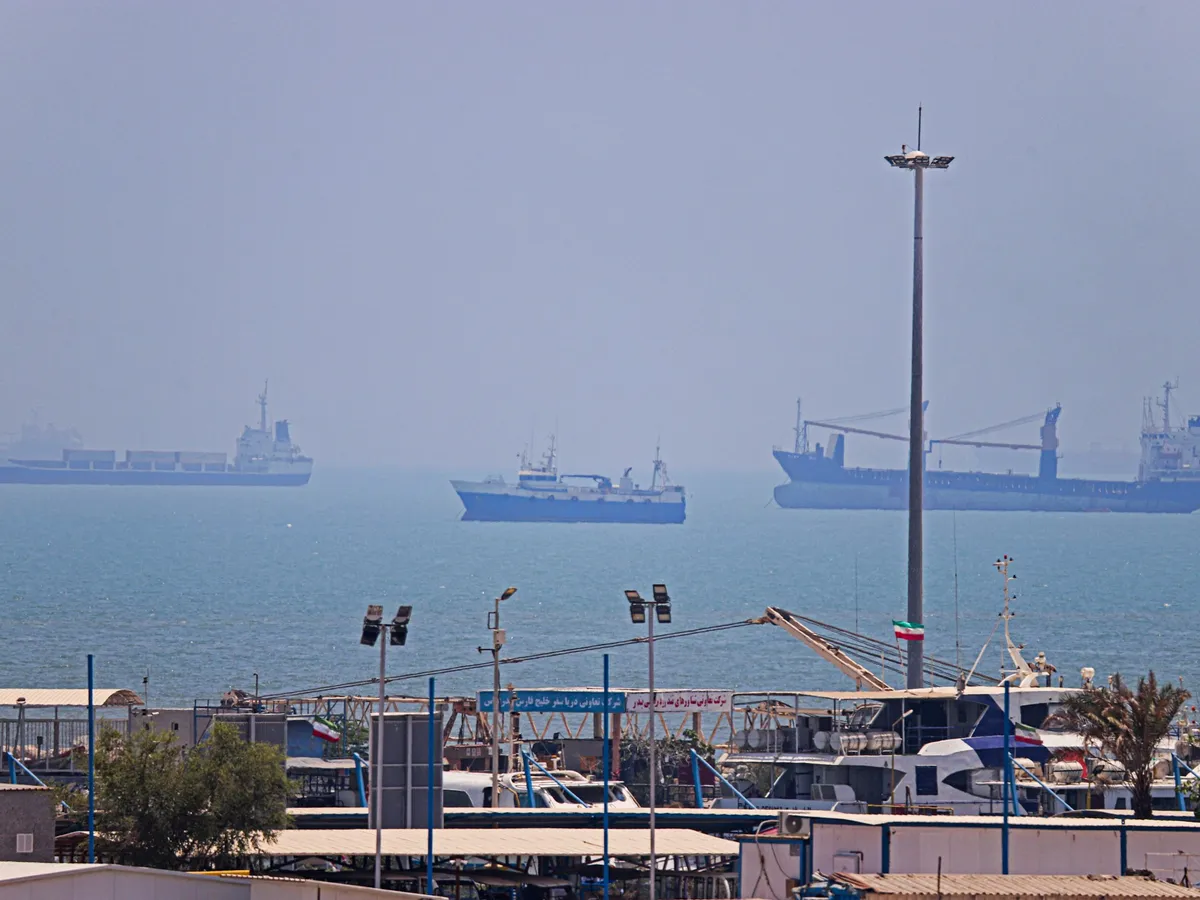
EXPLAINERA cargo vessel had been struck by a projectile near Oman, as Iran says all ships must pass with its permission.In this picture obtained from Iran's ISNA news agency on June 18, 2026, vessels are seen anchored in Bandar Abbas along the Strait of Hormuz [AFP]Published On 26 Jun 2026The United Nations’ International Maritime Organization (IMO) has suspended plans to evacuate more than 11,000 sailors stranded in the Strait of Hormuz after a cargo ship transiting the waterway was struck by a projectile.IMO Secretary-General Arsenio Dominguez said several crews had already been evacuated, but the agency had decided to pause the operation until there were “necessary safety guarantees” for those involved.Recommended Stories list of 4 itemslist 1 of 4Ukraine decimates Russian logistics, bringing chaos to Crimealist 2 of 4Which countries have pledged aid to Venezuela after powerful earthquakes?list 3 of 4Everything we know so far about the deadly earthquakes in Venezuelalist 4 of 4Thermal cameras reveal intense heat for outdoor workers in Europeend of listThe United Kingdom Maritime Trade Operations (UKMTO), a Royal Navy maritime security agency, said on Thursday that a cargo vessel had been struck by “an unknown projectile” about 7.5 nautical miles (14km) southeast of Dahit, Oman. No casualties were reported.The incident comes despite a memorandum of understanding (MoU) signed by the United States and Iran last week that ended hostilities and included provisions aimed at reopening the strategic waterway. Iran had restricted passage through the strait in early March after the US and Israel attacked it on February 28. In April, the US imposed a Iran-linked-vessels" class="entity-link entity-event" data-entity-id="153330" data-entity-type="event">Naval Blockade on Iran-linked Vessels trying to pass through the waterway.Since the MoU was signed, commercial traffic has restarted through the strait, but key disagreements remain over which shipping routes vessels should use — and whether Iran gets to charge a toll or fee.Oman and the IMO have proposed a new shipping corridor that would partially bypass waters under Iran’s direct control. Tehran has rejected the plan, saying it was announced without consultation and raises safety concerns while demining operations are still under way. While Iran has not claimed responsibility for Thursday’s attack on the ship off Oman, it has not denied any role, either.The latest attack has heightened concerns that tensions over navigation through the strait remain unresolved. Here’s what we know.Why is the UN evacuating sailors?Following the outbreak of the US-Israel war on Iran on February 28, Tehran and Washington imposed counter restrictions on the passage of ships through the Strait of Hormuz, leaving thousands of seafarers unable to leave vessels trapped in the waterway.More than a dozen sailors have also been killed in attacks on ships — some from American missiles, others from Iranian projectiles. Most of those killed were from India.Even with last week’s agreement between Washington and Tehran to end the conflict, more than 11,000 sailors remain stranded in the strait.Announcing the evacuation plan on Tuesday, the IMO’s Dominguez said the operation would be conducted in “close cooperation with Iran, Oman, all other coastal states in the region, the United States and the maritime industry”.Oman’s Ministry of Defence said the operation, which had been under discussion for months, would be carried out in phases.Denmark also announced on Tuesday that it would join a multinational maritime mission led by France and Britain to help restore safe navigation through the strait.Why was the ship attacked?The Singapore-flagged cargo vessel Ever Lovely was struck by what authorities described as an “unknown projectile” while transiting the Strait of Hormuz on Thursday.Ship-tracking data from MarineTraffic showed the vessel had been following the southern shipping route proposed by the IMO earlier that day, a corridor that passes closer to Oman’s coastline and has been rejected by Iran.Singapore’s Maritime and Port Authority (MPA) said the vessel had since completed its transit through the strait and was continuing its voyage, adding that all 21 crew members were safe.The authority said it was “deeply concerned” by an attack it described as “unprovoked, unjustifiable, and a breach of international law”.“All actions affecting international shipping must fully comply with international law, in particular the United Nations Convention on the Law of the Sea, and not endanger the safety of seafarers and ships at sea,” the MPA said.The incident prompted the IMO to suspend its planned evacuation of stranded sailors. Dominguez said the Ever Lovely “did not transit under IMO’s evacuation framework”.“I have always reiterated that the safety of the seafarers remains paramount. Therefore, to ensure a coordinated approach and navigational safety, the evacuation plan will be paused until further clarity is obtained,” he said.What has Iran said?While it remains unclear if the attack was carried out by Iran, the country’s Islamic Revolutionary Guard Corps had criticised the new shipping corridor announced by Oman and the IMO, while also warning that passage through the strait, “is only possible via routes announced by Iran,” the state broadcaster IRIB reported.Kazem Gharibabadi, Iran’s deputy foreign minister, has said safe passage through the Strait of Hormuz cannot be guaranteed for vessels transiting “with ambiguous arrangements, parallel routes, or decision-making outside of Iran’s considerations as the coastal state”.“Any credible framework must be based on coordination with Iran and the provisions of paragraph five of the Islamabad Memorandum of Understanding,” he said in a statement on X. “Otherwise, the outcome will be the suspension of the designated parallel route.”Iran first published its own map of approved navigation routes in April, directing ships to sail much closer to the Iranian coastline than before the conflict.The IRGC’s latest warning came after a Liberian-flagged oil tanker transited the strait on Thursday using a route closer to Oman’s coast.On Friday, a further three foreign oil tankers that attempted to cross the Strait of Hormuz “without authorisation” were turned back after a warning from the IRGC, Iranian state TV reported.Analysts say control over the Strait of Hormuz has long been one of Tehran’s most important sources of strategic leverage, allowing it to exert pressure on the US, whose economy is inextricably tied to global markets.Why was the evacuation suspended?Reporting from Tehran, Al Jazeera’s Resul Serdar Atas said the attack appeared to show Iran was prepared to enforce its warnings over navigation through the Strait of Hormuz, after Tehran insisted vessels using either the Iranian or Omani route must coordinate with its authorities.“Yesterday, Oman announced new routes for the passage of the ships. But then the IRGC released a statement, saying that whether the ships go through the Iranian or Omani territorial waters, they need to be in full coordination with Iranian authorities,” Atas said.“And if they violate that, then Iran is going to act accordingly. So the question was whether Iran is going to really act or not?“The answer is yes. Now, we have seen that a tanker has been attacked by some projectiles in the Strait of Hormuz. The Revolutionary Guards did not claim responsibility but did not deny it either.”Atas added that Gharibabadi, Iran’s deputy foreign minister, had also warned that any shipping arrangements made without taking Iran’s position as a coastal state into account would be unacceptable.“Perhaps, in the coming days and weeks, we are going to see that the Strait of Hormuz will be one of the main sticking points.”What other disputes remain?Under last week’s memorandum of understanding, Iran agreed it would “make arrangements using its best efforts for the safe passage of commercial vessels with no charge, for 60 days only, from the Persian Gulf to the Sea of Oman and vice versa”.
SRCAl Jazeera
LANGEN
LEANCenter
WORDS1 238
ENT12
FRI · 2026-06-26 · 14:59 GMTBRIEF NSR-2026-0626-87695
NSR-2026-0626-87695News Report·EN·Conflict
Why has the UN paused plans to evacuate sailors from the Strait of Hormuz?
The UN's International Maritime Organization (IMO) has paused plans to evacuate over 11,000 sailors stranded in the Strait of Hormuz following an incident where a cargo vessel was struck by an unknown projectile near Oman. The IMO Secretary-General cited the need for "necessary safety guarantees" as the reason for the suspension.
Caolán MageeAl JazeeraFiled 2026-06-26 · 14:59 GMTLean · CenterRead · 5 min
Al JazeeraFIG 01
Reading time
5min
Word count
1 238words
Sources cited
3cited
Entities identified
12entities
Quality score
100%
§ 01
Briefing Summary
AI-generatedNEWSAR · AI
The UN's International Maritime Organization (IMO) has paused plans to evacuate over 11,000 sailors stranded in the Strait of Hormuz following an incident where a cargo vessel was struck by an unknown projectile near Oman. The IMO Secretary-General cited the need for "necessary safety guarantees" as the reason for the suspension. This attack occurred despite a recent memorandum of understanding between the US and Iran aimed at reopening the strait, though disagreements persist over shipping routes and potential tolls. The struck vessel was reportedly using a southern shipping corridor proposed by the IMO that Iran has rejected. The IMO stated the attacked ship was not transiting under their evacuation framework.
Confidence 0.90Sources 3Claims 5Entities 12
§ 02
Article analysis
Model · rule-basedFraming
Conflict
Diplomatic
Tone
Mixed Tone
AI-assessed
CalmNeutralAlarmist
Factuality
0.70 / 1.00
Factual
LowHigh
Sources cited
3
Well sourced
FewMany
§ 03
Key claims
5 extracted01
A cargo vessel was struck by an unknown projectile 7.5 nautical miles southeast of Dahit, Oman, with no casualties reported.
factualUnited Kingdom Maritime Trade Operations (UKMTO)
Confidence
0.95
02
The UN's International Maritime Organization (IMO) has suspended plans to evacuate over 11,000 sailors from the Strait of Hormuz after a cargo ship was struck by a projectile.
factualIMO Secretary-General Arsenio Dominguez
Confidence
0.90
03
Iran has restricted passage through the Strait of Hormuz since early March, following US and Israeli attacks.
factualArticle
Confidence
0.85
04
Oman and the IMO proposed a new shipping corridor to bypass waters under Iran's direct control, which Tehran rejected.
factualArticle
Confidence
0.80
05
Tensions over navigation through the Strait of Hormuz remain unresolved following the latest attack.
factualArticle
Confidence
0.75
§ 04
Full report
5 min read · 1 238 words§ 05
Entities
12 identifiedKey playerOppositionContextPositiveNeutralNegative
Organizations4
Locations6
§ 06
Keywords & salience
10 termsstrait of hormuz
1.00
un international maritime organization (imo)
0.90
maritime security
0.80
projectile attack
0.70
sailor evacuation
0.70
iran
0.60
memorandum of understanding (mou)
0.50
united states
0.50
shipping routes
0.40
oman
0.40
§ 07
Topic connections
Interactive graph No topic relationship data available yet. This graph will appear once topic relationships have been computed.