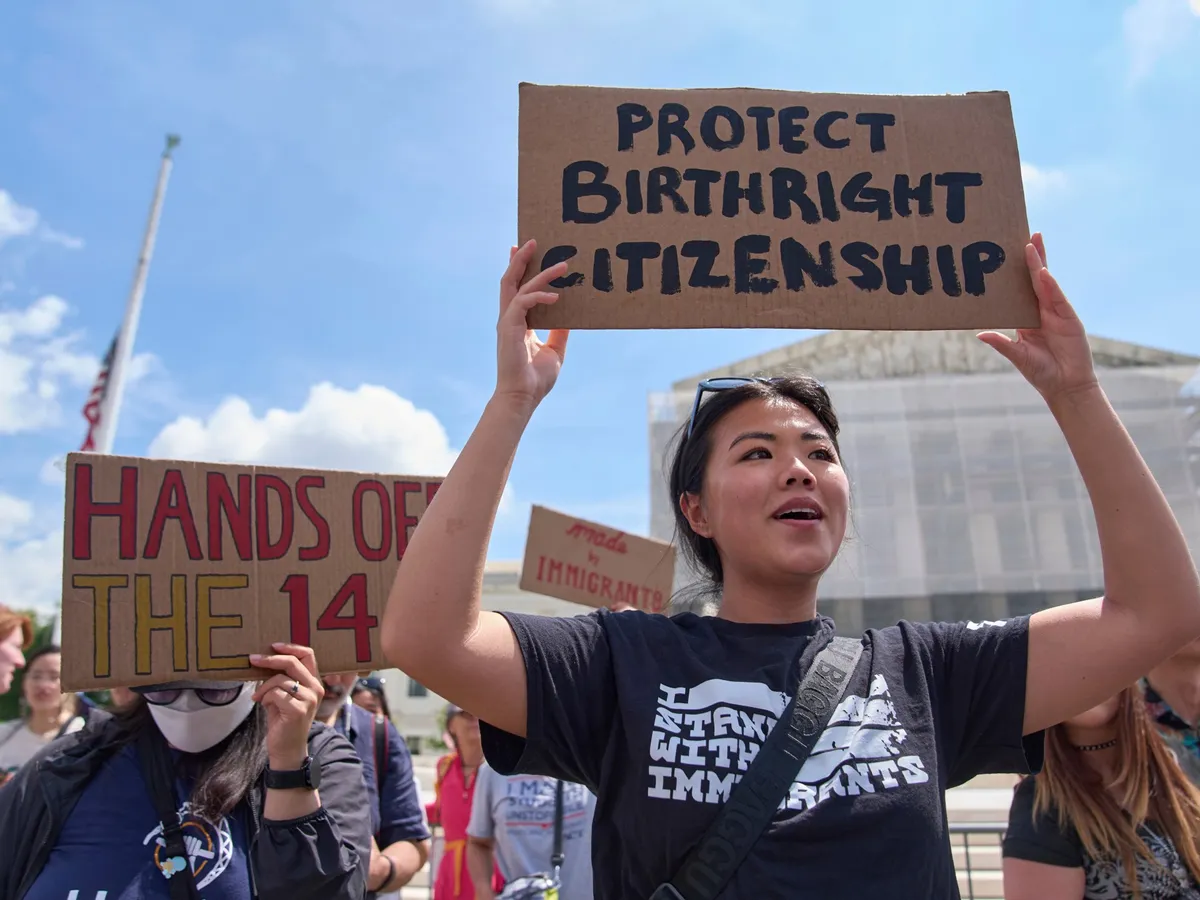
EXPLAINERThe nation’s highest court strikes down Trump’s executive order, which would have restricted a right established in the US Constitution.Hannah Liu, 26, holds up a sign in support of birthright citizenship outside the Supreme Court on May 15 [File: Jacquelyn Martin/AP Photo]Published On 30 Jun 2026The United States Supreme Court has upheld the concept of birthright citizenship, a long-established constitutional right that guarantees citizenship to virtually all children born in the country.The court’s ruling on Tuesday is seen as a blow to President Donald Trump, who sought to overturn birthright citizenship through an executive order.Recommended Stories list of 3 itemslist 1 of 3US Supreme Court rules against Trump order to end birthright citizenshiplist 2 of 3US Supreme Court upholds transgender sports banlist 3 of 3Supreme Court strikes down US campaign spending limits in landmark rulingend of listBut in Tuesday’s decision, the court’s majority ruled that Trump’s actions ran afoul of the Fourteenth Amendment of the Constitution.That law provides citizenship to “all persons born or naturalized in the United States”, excepting the children of foreign diplomats.“Citizenship, then and now, was the right to have rights — to freely participate in our political community. The Framers of the Fourteenth Amendment extended that promise to ‘every free-born person in this land,’” Chief Justice John Roberts wrote in the majority’s ruling. “We keep that promise today.”What is birthright citizenship, what did the court say in its ruling, and how might Trump react? We look at those questions and more in this brief explainer.What is birthright citizenship?birthright citizenship is the concept of granting citizenship to anybody born in the United States, with only a handful of very narrow exceptions. The children of foreign diplomats are notably excluded.The concept was formalised in the 14th Amendment of the US Constitution, which was added after the US Civil War.It was written to ensure that Black people, including former slaves, would enjoy the equal protections conferred by citizenship.Multiple Supreme Court cases have since upheld that right. One of the key precedents was set in an 1898 case called the United States versus Wong Kim Ark.That case concerned a man born in San Francisco to Chinese parents. After one of his trips to visit family in China, he was denied re-entry into the US, on the basis that he was not a citizen. The Supreme Court, however, ruled that Wong was indeed a US citizen, and that his travels did not negate that fact.What is the difference between a birthright citizen and a naturalised citizen?Any person born in the US obtains their citizenship automatically through birthright citizenship.A naturalised citizen is someone who is not originally a citizen of the country, but has obtained citizenship through one of the available legal pathways.Once someone becomes a naturalised citizen, however, they enjoy full and equal rights with native-born US citizens.The 14th Amendment protects the rights of both birthright citizens and naturalised citizens, barring the government from attempting to “abridge the privileges or immunities” of either one.What does the 14th Amendment say on the subject?The 14th Amendment of the Constitution has five parts. The first section, however, concentrates on citizenship:“All persons born or naturalised in the United States, and subject to the jurisdiction thereof, are citizens of the United States and of the State wherein they reside. No State shall make or enforce any law which shall abridge the privileges or immunities of citizens of the United States; nor shall any State deprive any person of life, liberty, or property, without due process of law; nor deny to any person within its jurisdiction the equal protection of the laws.”What triggered the Supreme Court case?While campaigning for a second term during the 2024 presidential election, Trump, a Republican, pledged to end birthright citizenship.In 2023, for instance, he posted a video statement on social media claiming that birthright citizenship was contributing to an immigrant “invasion” into the US.“It’s things like this that bring millions of people to our country,” Trump said. “My policy will choke off a major incentive for continued illegal immigration, deter more migrants from coming and encourage many of the aliens Joe Biden has unlawfully let into our country to go back to their home countries.”Restricting immigration was a major pillar of Trump’s second-term platform, and on his very first day back in office — January 20, 2025 — he signed an executive order that barred certain children from receiving birthright citizenship.They included babies born to undocumented immigrants and those whose parents were not permanent residents at the time of their birth, even if they were otherwise in the country legally.Critics, however, immediately challenged the order in court, arguing it would render some infants essentially stateless.The executive order ultimately never took effect, with lower courts blocking its implementation.Demonstrators hold letters to form the slogan ‘Born in the USA = citizen!’ outside the US Supreme Court on April 1, 2026 [File: Kylie Cooper/Reuters]What does the US Supreme Court ruling say?In a six-to-three decision, the Supreme Court struck down the 2025 executive order in a case called Trump v Barbara.Chief Justice John Roberts, a conservative appointed by former President George W Bush, authored the majority decision.He pointed out that the 14th Amendment does not support Trump’s view of limiting birthright citizenship to the children of existing citizens or permanent residents.“If Congress intended to limit American citizenship to the children of those domiciled in the United States, nothing in the succinct language of the Citizenship Clause conveyed that design,” Roberts wrote.He pointed to the 1898 case of Wong Kim Ark as establishing the precedent that continues to this day.“In the 128 years since, we have repeatedly understood the rule of Wong Kim Ark to guarantee citizenship to all children born in the United States and subject to its power,” Roberts wrote. “We see no reason to depart from that view today.”Conservative Justice Amy Coney Barrett and the court’s three left-leaning members — Sonia Sotomayor, Ketanji Brown Jackson and Elena Kagan — joined Roberts in his opinion.But one of the six justices who formed the majority disagreed with Roberts’s rationale: Brett Kavanaugh.He argued that it was not the 14th Amendment that guaranteed birthright citizenship, but rather the US legal code.Kavanaugh agreed with the overall result of the case — but he did leave open the possibility that Congress might amend the federal law to exclude the children of temporary or unlawful immigrants, as Trump attempted in his executive order.Who among the Supreme Court dissented?Three conservative justices opposed Tuesday’s ruling: Justices Clarence Thomas, Neil Gorsuch and Samuel Alito.In a 91-page dissent, Thomas argued that Trump’s restrictions were legitimate.“The Court today takes the extraordinary step of holding facially unconstitutional the President’s Order excluding from citizenship the children of foreign temporary visitors and illegal aliens,” Thomas wrote.Thomas argued that the court had strayed from the 14th Amendment’s original intent, which was to ensure rights for freed Black people after slavery was abolished.How could Trump respond?Trump has said he will seek a path forward despite the court’s latest ruling, suggesting that Congress could address the issue without amending the US Constitution, a complex and lengthy process.“The Supreme Court upheld birthright citizenship, which is too bad for our Country, but we can easily make it up in Congress through Legislation, with the support of the President,” Trump wrote in a post on social media.
SRCAl Jazeera
LANGEN
LEANCenter
WORDS1 212
ENT9
TUE · 2026-06-30 · 21:30 GMTBRIEF NSR-2026-0630-88768
NSR-2026-0630-88768News Report·EN·Legal & Judicial
What is birthright citizenship, and what does the Supreme Court ruling say?
The U.S. Supreme Court has upheld birthright citizenship, a constitutional right guaranteeing citizenship to nearly all individuals born in the United States.
Al Jazeera StaffAl JazeeraFiled 2026-06-30 · 21:30 GMTLean · CenterRead · 5 min
Al JazeeraFIG 01
Reading time
5min
Word count
1 212words
Sources cited
2cited
Entities identified
9entities
Quality score
100%
§ 01
Briefing Summary
AI-generatedNEWSAR · AI
The U.S. Supreme Court has upheld birthright citizenship, a constitutional right guaranteeing citizenship to nearly all individuals born in the United States. This ruling strikes down an executive order by President Donald Trump that sought to restrict this right. The court determined that Trump's order violated the Fourteenth Amendment, which states that "all persons born or naturalized in the United States" are citizens. Birthright citizenship, formalized by the Fourteenth Amendment after the Civil War, has been upheld by multiple Supreme Court cases, including *United States v. Wong Kim Ark*. Trump had pledged to end birthright citizenship, viewing it as an incentive for illegal immigration, and signed an executive order on his first day back in office in 2025 to restrict it for children of undocumented immigrants and non-permanent residents.
Confidence 0.90Sources 2Claims 5Entities 9
§ 02
Article analysis
Model · rule-basedFraming
Legal & Judicial
Social Justice
Tone
Measured
AI-assessed
CalmNeutralAlarmist
Factuality
0.90 / 1.00
Factual
LowHigh
Sources cited
2
Limited
FewMany
§ 03
Key claims
5 extracted01
The concept was formalised in the 14th Amendment of the US Constitution, which was added after the US Civil War.
factual
Confidence
1.00
02
Birthright citizenship is the concept of granting citizenship to anybody born in the United States, with only a handful of very narrow exceptions.
factual
Confidence
1.00
03
The court’s majority ruled that Trump’s actions ran afoul of the Fourteenth Amendment of the Constitution.
factual
Confidence
1.00
04
The United States Supreme Court has upheld the concept of birthright citizenship, a long-established constitutional right.
factual
Confidence
1.00
05
The court’s ruling on Tuesday is seen as a blow to President Donald Trump, who sought to overturn birthright citizenship through an executive order.
factual
Confidence
0.90
§ 04
Full report
5 min read · 1 212 words§ 05
Entities
9 identifiedKey playerOppositionContextPositiveNeutralNegative
People3
Locations1
§ 06
Keywords & salience
9 termsbirthright citizenship
1.00
supreme court
0.90
fourteenth amendment
0.80
us constitution
0.70
donald trump
0.60
citizenship
0.50
executive order
0.50
constitutional right
0.40
united states versus wong kim ark
0.40
§ 07
Topic connections
Interactive graph Network visualization showing 51 related topics
View Full Graph Person Organization Location Event|Click node to navigate|Edge numbers = shared articles