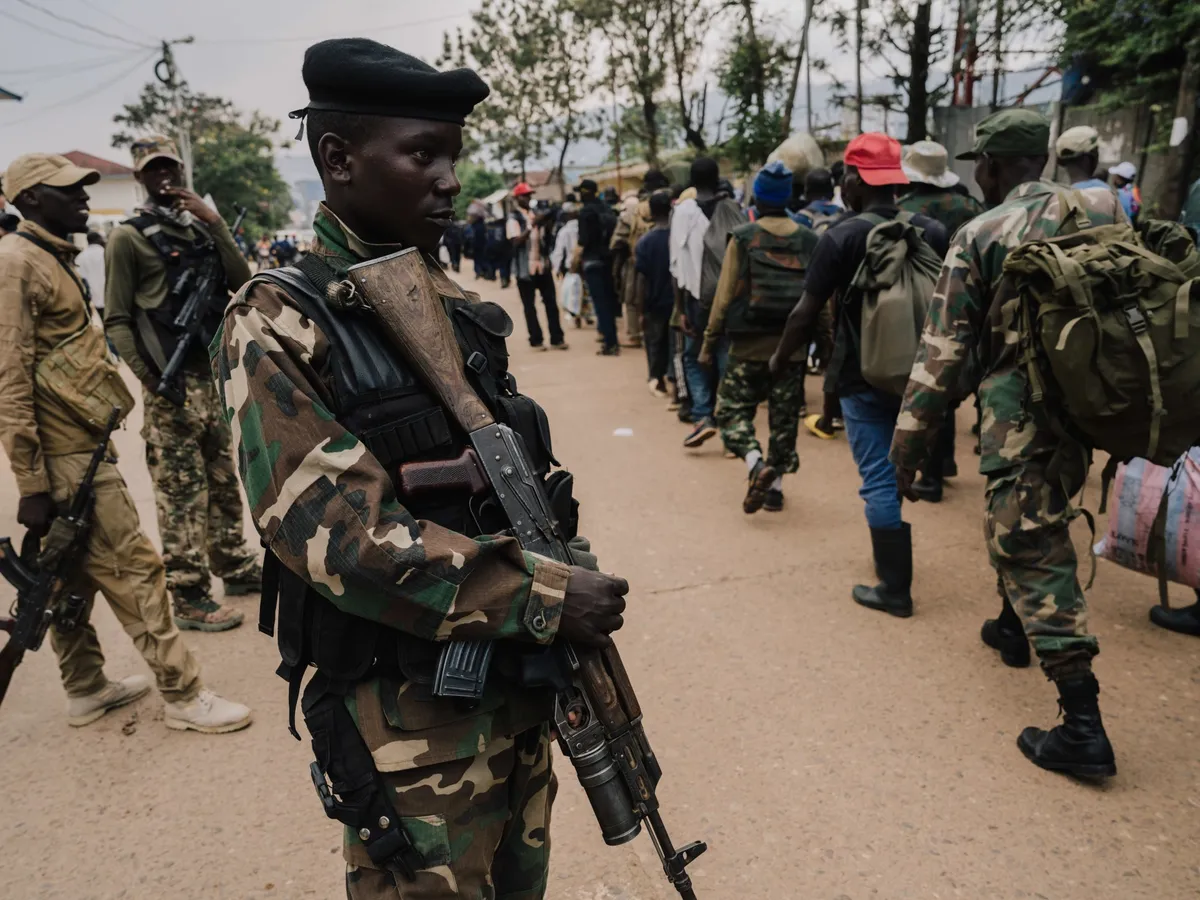
The move underscores growing scrutiny of the conflict mineral trade fuelling violence in eastern DR Congo.M23 rebels guard a unit of surrendering Congolese soldiers in Bukavu [Hugh Kinsella Cunningham/Getty Images]Published On 6 Jul 2026Bukavu, Democratic Republic of the Congo – The United States has imposed sanctions on Rwandan businessmen and companies it says are helping finance the M23 rebellion in the eastern Democratic Republic of the Congo (DRC) through the illicit trade in conflict minerals, signalling growing international pressure over a conflict spurred by the region’s vast mineral wealth.The US Department of the Treasury said the measures are intended to disrupt networks smuggling minerals out of the DRC to finance the Rwandan-backed armed group M23.The two individuals sanctioned are Jean Malic Kalima, chairman of Gasabo Gold Refinery, and Bosco Kayobotsi, the company’s managing director. The sanctioned companies are Gasabo Gold Refinery Ltd, Bugambira Mines Ltd, Wolfram Mining and Processing Ltd, and Rwinkwavu Mining Corporation Ltd, all based in Rwanda.“The M23 and its supporters are exploiting the DRC’s vast mineral resources – wealth that rightfully belongs to the Congolese people – to finance the purchase of weapons, pay combatants and sustain a destabilising insurgency that has triggered a serious humanitarian crisis,” the Treasury said in a statement received by Al Jazeera on June 25.Conflict driven by mineralsDady Saleh, an economist based in Kinshasa, said the conflict in the eastern DRC has long been shaped by competition over natural resources.“Let there be no mistake. The wars we have been experiencing for 30 years in the eastern region of the country are, above all, economic in nature,” he told Al Jazeera.He argued that external powers often pursue strategic economic interests in conflict zones, citing Russia’s invasion of Ukraine and US policy towards Venezuela as examples.The Treasury said the region’s mineral wealth should be a driver of development rather than conflict, arguing that curbing illicit mineral flows would create space for legitimate business while securing critical minerals for global industries.Saleh said the latest sanctions suggest international attitudes towards Kigali may be shifting.“The DRC’s natural resources have been plundered for decades, both before and after independence. Today, that plundering has intensified and increasingly takes place through proxy actors,” he said.For many Congolese, the sanctions are also seen as a long-overdue acknowledgement of what they say has been happening for years.“We are pleased that the US is gradually coming to understand the underhand tactics Kigali is employing on our territory and that the masks are slowly beginning to slip. We have suffered so much because of our natural resources, which were given to us by the Creator, and that is not fair,” said Nestor Sadiki, a resident of Goma, the capital of North Kivu province.Rwanda’s rejection of the allegationsRwandan officials have rejected allegations linking Kigali to mineral trafficking or support for armed groups.Foreign Minister Olivier Nduhungirehe described the US sanctions as “biased” and “unjustified”, arguing that punitive measures do not resolve the conflict.From Kinshasa to Goma, Congolese hope the latest US sanctions will disrupt illicit mineral networks, though many doubt they will end the conflict on their own [Gallo/Getty Images]He said that if sanctions alone could bring peace to eastern DRC, the war would have ended long ago, and that lasting solutions require shared regional responsibility rather than selective blame.Evidence of cross-border mineral flowsRwanda’s rejection contrasts with findings by United Nations experts and Global Witness, which have documented the movement of conflict minerals from eastern DRC through regional supply chains into international markets.The United Kingdom-based organisation says its research traced links between mines in eastern DRC and export networks in the region, alleging that a significant share of shipments is controlled by a small number of companies.It also says smuggled minerals may enter global electronics supply chains before reaching consumer products.According to the UN Panel of Experts, large volumes of coltan continue to be moved monthly from Rubaya into Rwanda following M23’s takeover of the mine in 2024.The Treasury said ending the illicit mineral trade is essential because it finances armed groups, leads to forced labour and violence, and undermines legitimate mining.“The United States remains committed to a peaceful and prosperous Great Lakes region, with a mining sector free from illicit flows or conflict financing,” the Treasury said.Congolese response and rebel positionKinshasa welcomed the sanctions, arguing they reinforce longstanding accusations that Rwanda benefits from minerals extracted in rebel-held territory.Government spokesperson Patrick Muyaya accused Rwanda of profiting from regional mineral flows, pointing to its refining capacity despite limited domestic production.He wrote on X: “A state, Rwanda, which excels in the role of plunderer, middleman and fence for resources extracted through massacres, rapes and bloodshed,” adding that the sanctions had disrupted what he called a chain of “state-sponsored theft”.Displaced people gather at a camp near Goma after fleeing fighting in eastern DR Congo, where conflict linked to armed groups has forced millions from their homes [Alexis Huguet/AFP]The M23 rebels, who control large areas of eastern DRC, deny benefitting from the mineral trade, saying local miners sell the minerals independently while their fighters provide security around mining sites. The group also accuses Kinshasa of using mineral trafficking allegations to distract from military and diplomatic setbacks.“We have no interest whatsoever in minerals. What matters to us is the survival of the people. We are fighting so that the people can feel safe… We are fighting for strong institutions, not strong individuals,” Kambere Muyisa Lumumba, spokesperson for the AFC-appointed governor based in Goma, told Al Jazeera.Even as international pressure on Rwanda increases, Saleh argued that sanctions should not obscure the broader geopolitical interests shaping the conflict.“The Rwandan leaders had the US’s green light. They were allowed to do whatever they wanted,” he said, describing Washington’s latest actions as “a double-edged sword”.Despite increased international pressure, he said the country’s long-term future ultimately depends on domestic leadership.“We Congolese must not think that the Americans are our solution. They are part of the solution, just like the Chinese and the rest of the world. We must be able to take charge of our own affairs,” he said.
SRCAl Jazeera
LANGEN
LEANCenter
WORDS1 003
ENT12
MON · 2026-07-06 · 02:10 GMTBRIEF NSR-2026-0706-90353
NSR-2026-0706-90353News Report·EN·Conflict
How conflict minerals fuel war in eastern DR Congo amid US sanctions
The United States has imposed sanctions on Rwandan businessmen and companies accused of financing the M23 rebellion in eastern Democratic Republic of Congo (DRC) through the illicit trade of conflict minerals. The US Treasury stated these measures aim to disrupt smuggling networks that fund the Rwandan-backed armed group, which has been exploiting the DRC's mineral wealth to sustain its insurgency and cause a humanitarian crisis.
Al Jazeera StaffAl JazeeraFiled 2026-07-06 · 02:10 GMTLean · CenterRead · 5 min
Al JazeeraFIG 01
Reading time
5min
Word count
1 003words
Sources cited
3cited
Entities identified
12entities
Quality score
100%
§ 01
Briefing Summary
AI-generatedNEWSAR · AI
The United States has imposed sanctions on Rwandan businessmen and companies accused of financing the M23 rebellion in eastern Democratic Republic of Congo (DRC) through the illicit trade of conflict minerals. The US Treasury stated these measures aim to disrupt smuggling networks that fund the Rwandan-backed armed group, which has been exploiting the DRC's mineral wealth to sustain its insurgency and cause a humanitarian crisis. Congolese officials and residents welcomed the sanctions, seeing them as an acknowledgment of long-standing accusations against Rwanda, while Rwandan officials have rejected the allegations as biased and unjustified. UN experts and Global Witness have documented cross-border mineral flows from the DRC through regional supply chains into international markets, with significant volumes of coltan reportedly moved into Rwanda following the M23's takeover of a mine. The US aims to curb illicit mineral flows to promote development and secure critical minerals for global industries.
Confidence 0.90Sources 3Claims 5Entities 12
§ 02
Article analysis
Model · rule-basedFraming
Conflict
Economic Impact
Tone
Measured
AI-assessed
CalmNeutralAlarmist
Factuality
0.70 / 1.00
Factual
LowHigh
Sources cited
3
Well sourced
FewMany
§ 03
Key claims
5 extracted01
Sanctions are seen by some Congolese as an overdue acknowledgement of Kigali's alleged tactics and the suffering caused by resource exploitation.
quoteNestor Sadiki
Confidence
1.00
02
The DRC's natural resources have been plundered for decades, a practice that has intensified and increasingly involves proxy actors.
quoteDady Saleh
Confidence
1.00
03
The wars in eastern DRC for 30 years are primarily economic in nature, driven by competition over natural resources.
quoteDady Saleh
Confidence
1.00
04
The M23 and its supporters exploit DRC's mineral resources to finance weapons, pay combatants, and sustain an insurgency causing a humanitarian crisis.
quoteUS Department of the Treasury
Confidence
1.00
05
The US has imposed sanctions on Rwandan businessmen and companies accused of financing the M23 rebellion through illicit conflict mineral trade.
factualUS Department of the Treasury
Confidence
1.00
§ 04
Full report
5 min read · 1 003 words§ 05
Entities
12 identifiedKey playerOppositionContextPositiveNeutralNegative
Organizations5
Locations4
§ 06
Keywords & salience
10 termsconflict minerals
1.00
m23 rebellion
0.90
eastern dr congo
0.90
us sanctions
0.80
illicit trade
0.70
mineral wealth
0.60
natural resources
0.50
humanitarian crisis
0.50
rwandan businessmen
0.40
proxy actors
0.40
§ 07
Topic connections
Interactive graph Network visualization showing 23 related topics
View Full Graph Person Organization Location Event|Click node to navigate|Edge numbers = shared articles