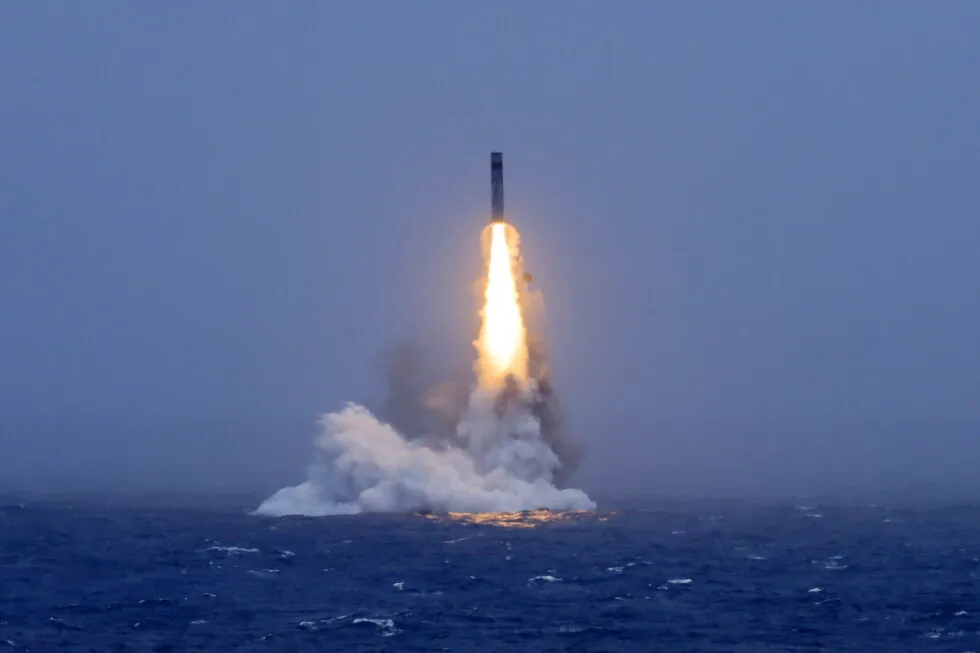
What to know about China’s rare ballistic missile test and why it raises concerns 1 of 3 | In this photo released by Xinhua News Agency, a long-range ballistic missile bursts out of the sea during a test launched from a Chinese nuclear-powered submarines in the South Pacific on Monday, July 6, 2026. (Li Xiangchao/Xinhua via AP) 2 of 3 | In this photo released by Xinhua News Agency, a long-range ballistic missile bursts out of the sea during a test launched from a Chinese nuclear-powered submarine in the South Pacific on Monday, July 6, 2026. (Li Xiangchao/Xinhua via AP) 3 of 3 | Spectators wave Chinese flags as military vehicles carrying JL-2 submarine-launched missiles roll during a parade to commemorate the 70th anniversary of the founding of China" class="entity-link entity-location" data-entity-id="160346" data-entity-type="location">Communist China in Beijing, Oct. 1, 2019. (AP Photo/Mark Schiefelbein, File) By Huizhong Wu Updated 11:12 AM MESZ, July 7, 2026 Add AP News on Google Add AP News as your preferred source to see more of our stories on Google. Share Share Facebook Copy Link copied Print Email X LinkedIn Bluesky Flipboard Pinterest Reddit BANGKOK (AP) — China’s navy test-launched a long-range ballistic missile Monday from a nuclear-powered submarine — a move that experts said showed Beijing’s increasing skill and capability as part of its nuclear deterrence strategy. The move also drew protests from the U.S. as well as countries in Asia and the Pacific. It was the second time China had fired a ballistic missile into international waters in recent years. While it gave some countries in the region prior notice, some said it was not enough notice, and experts say the launch exacerbates tensions around increasing militarization in Asia. Here’s what we know, and what we don’t, about the missile launch. Experts think it could be a JL-2 or a JL-3 ballistic missile China announced the missile test publicly on Monday only after the launch, saying that it was fired into the Pacific Ocean. In a brief statement, the official Xinhua News Agency said the launch was part of routine annual training, complied with international law and practice, and was not directed against any country or target. It didn’t provide details about the type of missile. The missile was carrying a dummy warhead, not a nuclear one. The act of launching in international waters was rare, although the U.S. has also done so with its own missile testing. Xinhua published a photo of the missile on Tuesday without additional details. Experts say it could be either a JL-2 or a JL-3, both submarine-launched ballistic missiles, though most said the available imagery was not clear enough to tell. Australia and Fiji seal a new mutual defense pact in a push to counter China in the Pacific 3 MIN READ 35 Australian prime minister condemns delay of changes to child social media ban 3 MIN READ A long-awaited Australia-Vanuatu pact blocks China from building a military base 2 MIN READ 20 The state-owned tabloid Global Times said it was “most likely” a JL-3 missile with a range exceeding 10,000 kilometers (6,200 miles). The JL-2 has a shorter range. The New Zealand government said the missile was launched into treaty waters in the South Pacific Nuclear Free Zone, violating the intention of the agreement. The zone was established by the 1986 Treaty of Rarotonga, which prohibits nuclear weapons throughout the region. China ratified the protocols in 1987, pledging not to test nuclear weapons within the zone or threaten to use them against signatories with territory in the region. While China has told other countries to “avoid overinterpretation” in response to the criticism, experts say the concerns from other countries have some basis. Much of the concern is a result of lack of clear information, said Drew Thompson, a senior fellow at the S. Rajaratnam School of International Studies in Singapore. “China’s military modernization and buildup have occurred without concurrent increases in openness and transparency, resulting in uncertainty about China’s intentions.” Australian Prime Minister Anthony Albanese said that China did not provide enough notice to the government. “There is no doubt that this is a provocative act by China which does destabilize the region,” he told reporters Tuesday while in Honiara, in the Solomon Islands. “This was a test of a nuclear-capable intercontinental ballistic missile fired from a nuclear-powered submarine. That is of real concern because what we need is less nuclear weapons, certainly not more. And the fact that this test took place yesterday with very little notice is of real concern,” Albanese added. New Zealand had said the same Monday, with Foreign Minister Winston Peters calling it “unwelcome and concerning.” Solomon Islands Prime Minister Matthew Wale, also speaking to reporters in Honiara Tuesday, said that “China is a good friend of Solomon Islands, but this is not something a friend does. This is not … good in our region.” “We don’t want to see any more countries — China, America, anybody — we don’t want anybody testing their ICBMs in the Pacific Islands region. Be our friend, but don’t threaten us,” Wale added. China’s leader Xi Jinping has made modernization of the People’s Liberation Army a top priority in his rule. China already has the largest standing army in the world and the world’s largest navy. While its nuclear arsenal lags that of the U.S. and Russia, it has been actively expanding its stock of nuclear warheads. It has also actively been developing new longer-range missiles and advanced drones. China’s defense budget, which is projected to be at $270 billion in 2026, has grown at roughly 7% for the past four years, and hovers below 2% of its gross domestic product. However, independent analysis suggests the real spending could be much higher. For example, the Stockholm International Peace Research Institute estimates the overall figure for 2024 at $313.7 billion. Much of the security worries about whether or not China’s military would get involved in a war centers on Taiwan, the self-ruled island that China claims as its own and for which it has not ruled out the use of force to bring it under its control. China also regularly sends warplanes and navy ships in the waters around the island in what it says are military exercises. In response to China’s expanding military and activity, countries in the region have increased their own defense spending, including Japan which is breaking with its long-held cap of 1% of GDP to double the budget to 2%. Meanwhile, the Philippines agreed to allow the U.S. to expand its military presence in the country by adding access to four more bases. “The Chinese launch exacerbates already deeply strained relations between Beijing and Tokyo. Since (Prime Minister Sanae) Takaichi’s comments last year suggesting that Japan would engage in a conflict over Taiwan, China has tightened export controls on Japan and accused it of embracing a ‘new time of militarism,’” said Emma Chanlett-Avery, director of Political-Security Affairs at the Asia Society Policy Institute. AP writer Rod McGuirk contributed to this report from Sydney. Huizhong Wu Wu covers Chinese culture, society, and politics for The Associated Press, as well as the country’s growing overseas influence from Bangkok. She was previously based in Taiwan and China. twitter
SRCAssociated Press (AP)
LANGEN
LEANCenter
WORDS1 198
ENT12
TUE · 2026-07-07 · 08:53 GMTBRIEF NSR-2026-0707-90799
NSR-2026-0707-90799News Report·EN·National Security
What to know about China’s rare ballistic missile test and why it raises concerns
China's navy conducted a rare test launch of a long-range ballistic missile from a nuclear-powered submarine in the South Pacific on Monday, July 6, 2026. Experts suggest this demonstrates Beijing's growing nuclear deterrence capabilities, potentially involving a JL-2 or JL-3 missile.
Associated Press (AP)Filed 2026-07-07 · 08:53 GMTLean · CenterRead · 5 min
Associated Press (AP)FIG 01
Reading time
5min
Word count
1 198words
Sources cited
3cited
Entities identified
12entities
Quality score
100%
§ 01
Briefing Summary
AI-generatedNEWSAR · AI
China's navy conducted a rare test launch of a long-range ballistic missile from a nuclear-powered submarine in the South Pacific on Monday, July 6, 2026. Experts suggest this demonstrates Beijing's growing nuclear deterrence capabilities, potentially involving a JL-2 or JL-3 missile. The launch, announced after it occurred, was described by China as routine training compliant with international law and not directed at any specific target. However, the test has drawn protests from the U.S. and several Asian and Pacific nations, including Australia and New Zealand, who cited insufficient notice and concerns about regional militarization. The missile was reportedly carrying a dummy warhead.
Confidence 0.90Sources 3Claims 5Entities 12
§ 02
Article analysis
Model · rule-basedFraming
National Security
Diplomatic
Tone
Mixed Tone
AI-assessed
CalmNeutralAlarmist
Factuality
0.70 / 1.00
Factual
LowHigh
Sources cited
3
Well sourced
FewMany
§ 03
Key claims
5 extracted01
China announced the missile test publicly on Monday only after the launch.
factualAP News
Confidence
1.00
02
China's navy test-launched a long-range ballistic missile from a nuclear-powered submarine in the South Pacific.
factualAP News
Confidence
1.00
03
The launch drew protests from the U.S. as well as countries in Asia and the Pacific.
factualAP News
Confidence
0.90
04
The missile test showed Beijing's increasing skill and capability as part of its nuclear deterrence strategy.
quoteexperts
Confidence
0.80
05
Experts say it could be either a JL-2 or a JL-3 ballistic missile, but imagery is not clear enough to tell.
quoteexperts
Confidence
0.70
§ 04
Full report
5 min read · 1 198 words§ 05
Entities
12 identifiedKey playerOppositionContextPositiveNeutralNegative
People3
Locations6
Topics1
§ 06
Keywords & salience
9 termschina
1.00
ballistic missile test
1.00
nuclear deterrence
0.90
submarine-launched missile
0.80
asia-pacific tensions
0.70
militarization
0.60
international waters
0.50
jl-2
0.40
jl-3
0.40
§ 07
Topic connections
Interactive graph Network visualization showing 51 related topics
View Full Graph Person Organization Location Event|Click node to navigate|Edge numbers = shared articles