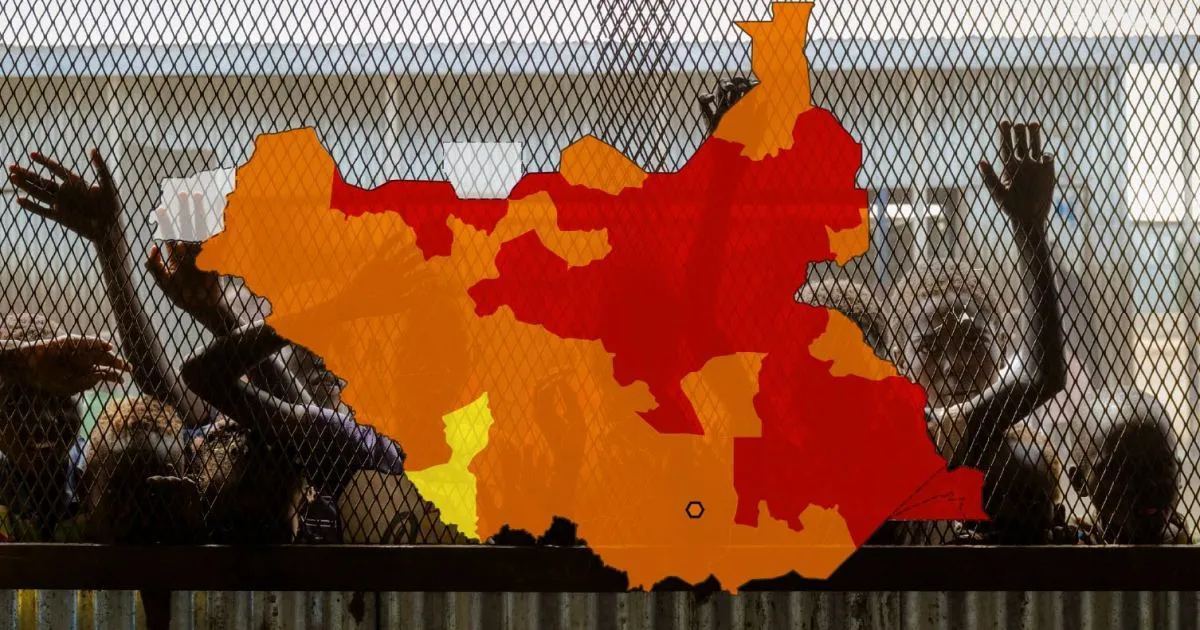
EXPLAINERAJLabs breaks down the 15 years of liberation from Khartoum and the impact on 12 million people.Published On 9 Jul 2026South Sudan became the world’s newest country in July 2011 after nearly 99 percent of voters chose independence from Sudan.Fifteen years later, most of the major promises that came with independence remain unfulfilled.Recommended Stories list of 4 itemslist 1 of 4Fears of new massacre in Sudan’s el-Obeid: What do we know?list 2 of 4El-Obeid is surrounded by the RSF: Could it be the next el-Fasher?list 3 of 4How the US-Iran conflict is reshaping Africa’s geopolitical opportunitieslist 4 of 4South Sudan, 15 years on: Still fighting for peaceend of listSouth Sudan remains one of the world’s most fragile states.Oil finances nearly 90 percent of the government’s revenue, but the country remains wracked by deep inequality and violence: 82 percent of the population lives below the poverty line, and political jostling between rival groups has left the young nation in a perpetual state of conflict.A woman poses with her three-year-old daughter in their house, which is made out of straw, bamboo and plastic sheeting, at the Protection of Civilian site (PoC) in Bentiu, Sudan" class="entity-link entity-location" data-entity-id="3169" data-entity-type="location">South Sudan, on February 15, 2018 [Stefanie Glinski/AFP]Elections have never been held since independence, millions remain displaced, and the country’s economy depends on pipelines running through Sudan, the very nation it fought to leave.‘A failed promise’Jok Madut Jok, 57, a professor and director of graduate studies at Syracuse University, is from Warrap, Sudan" class="entity-link entity-location" data-entity-id="3169" data-entity-type="location">South Sudan, and still has family in both rural and urban parts of the country.Jok says he recalls the joy of the time when Sudan" class="entity-link entity-location" data-entity-id="3169" data-entity-type="location">South Sudan broke away to establish a new beginning. It was a moment of hope. Today, though, he feels as though he has been denied all that was promised at the time.“Sudan" class="entity-link entity-location" data-entity-id="3169" data-entity-type="location">South Sudan at the moment is a failed promise,” he says. “South Sudanese who had lived under brutal regimes in Sudan and had been excluded from money and development programmes, and were victims of security operations in the southern part, had hung their hopes on independence.”Jok says people are now looking towards possibilities of political transitions to hold their government accountable.Who controls what in Sudan" class="entity-link entity-location" data-entity-id="3169" data-entity-type="location">South Sudan?The country is technically governed by a transitional unity government created under the 2018 peace agreement.But that peace remains fragile.Violence continues across Jonglei, Upper Nile, Unity and Equatoria states with clashes involving government forces, opposition fighters and other armed groups.Elections scheduled several times since independence have again been delayed, with the latest vote planned for late 2026.Main political and armed groups:Sudan People’s Liberation Movement (SPLM)The ruling party which led the independence movement.Sudan People’s Liberation Movement-in-Opposition (SPLM-IO)Led by Riek Machar, it is part of the unity government. It still maintains armed forces in parts of the country.Sudan" class="entity-link entity-location" data-entity-id="3169" data-entity-type="location">South Sudan People’s Defence Forces (SSPDF)The national army, formerly known as the SPLA, it is loyal to President Salva Kiir.White ArmyA loose network of armed youth, mainly from the Nuer ethnic group.National Salvation Front (NAS)It remains active, mainly in Equatoria province. The NAS never fully joined the peace agreement.A South Sudanese military police officer sits on a pickup truck while monitoring the area as troops belonging to the South Sudanese Unified Forces take part in a deployment ceremony at the Luri Military Training Centre, in Juba, on November 15, 2023 [Peter Louis Gume/AFP]Who runs the government?Salva Kiir – President since independence. Leader of the governing SPLM. Supported largely by influential sections of the Dinka, Sudan" class="entity-link entity-location" data-entity-id="3169" data-entity-type="location">South Sudan’s largest ethnic community. Sudan" class="entity-link entity-location" data-entity-id="3169" data-entity-type="location">South Sudan’s President Salva Kiir attends the swearing-in ceremony for Kenya’s new president William Ruto, at Kasarani stadium in Nairobi, Kenya on September 13, 2022 [Brian Inganga/AP]Riek Machar – Vice President. Leader of SPLM-IO. Historically backed by many Nuer supporters. His rivalry with Kiir triggered the 2013 civil war after political tensions exploded inside the ruling party. Sudan" class="entity-link entity-location" data-entity-id="3169" data-entity-type="location">South Sudan’s rebel leader Riek Machar speaks to the media about the situation in Sudan" class="entity-link entity-location" data-entity-id="3169" data-entity-type="location">South Sudan, following a peace agreement with the government in Addis Ababa, Ethiopia, on August 31, 2015 [Mulugeta Ayene/AP]Independence delivered, violence continuedBetween 2011 and 2026, according to data compiled by the United States-headquartered Armed Conflict Location and Event Data (ACLED), there were 13,256 attacks in Sudan" class="entity-link entity-location" data-entity-id="3169" data-entity-type="location">South Sudan, which means 883 attacks per year on average – or more than two a day.The majority of the attacks have been led by: Various communal and clan-based armed groups. These constituted 6,168, or just over 46 percent, of all attacks. The armed forces and police, who were responsible for 3,278 attacks. Unidentified armed groups, behind 2,276 attacks. Sudan’s People’s Liberation Movement-in-Opposition, responsible for 900 attacks. National Salvation Front, behind 269 attacksForeign actors, behind 154 attacks. Others, responsible for the remaining 184 attacks. Jan Pospisil, 52, a researcher at the Austria-based Peace and Conflict Evidence Platform, recently conducted a survey of more than 22,000 respondents in Sudan" class="entity-link entity-location" data-entity-id="3169" data-entity-type="location">South Sudan.Of them, 98 percent said they were proud of being South Sudanese. At the same time, more than 52 percent of respondents said in 2023 that they didn’t feel safe speaking up politically, and in 2025, the results were approximately the same.Hunger persists after 15 years of violenceHunger is worsening across Sudan" class="entity-link entity-location" data-entity-id="3169" data-entity-type="location">South Sudan, where an estimated 7.8 million people are facing crisis levels of food insecurity between April and July 2026, about 280,000 more than projected last year, according to the Integrated Food Security Phase Classification.Of those, about 73,000 people are living in catastrophic conditions, facing starvation, extreme food shortages and a heightened risk of death.Another 2.5 million are in emergency conditions, while 5.3 million more are struggling to meet daily food needs without exhausting what little they have left.The nutrition crisis is worsening alongside this.An estimated 2.2 million children under five now require treatment for acute malnutrition, an increase of about 90,000 cases since the previous assessment.Another 1.2 million pregnant and breastfeeding women also need urgent nutritional support.The crisis is being fuelled by conflict, displacement and repeated shocks that have destroyed livelihoods, disrupted markets and cut communities off from aid.“My family is living in rural areas, some in the cities but have no access to quality healthcare, no clean drinking water, no road infrastructure,” Jok says. “Even if they were to farm and raise cattle, and create their own livelihoods, they usually are cut off from markets and from basic services that are the responsibility of the state, especially a state that extracts public resources from underneath the people.”“It’s a feeling that people are totally excluded from the gains of independence,” he added. “It verges on criminal neglect.”Villagers collect food aid dropped from a plane in gunny bags at a village in Ayod county, Sudan" class="entity-link entity-location" data-entity-id="3169" data-entity-type="location">South Sudan, by the World Food Programme (WFP) on February 6, 2020 [Tony Karumba/AFP]Economic inequalityPospisil says despite the riches of the 150,000 barrels of oil that are extracted, sold and mainly exported every day, broader economic gains are not a reality for most of the public.In most rankings, Sudan" class="entity-link entity-location" data-entity-id="3169" data-entity-type="location">South Sudan languishes as the poorest nation in the world.Sudan" class="entity-link entity-location" data-entity-id="3169" data-entity-type="location">South Sudan mainly exports crude to China, but also has Chinese and Indian companies invested alongside state-held organisations that own blocks in the oil fields.(Al Jazeera)(Al Jazeera)(Al Jazeera)
SRCAl Jazeera
LANGEN
LEANCenter
WORDS1 181
ENT12
THU · 2026-07-09 · 08:35 GMTBRIEF NSR-2026-0709-91522
NSR-2026-0709-91522Analysis·EN·Conflict
In maps and charts: South Sudan’s 15 years of independence
South Sudan, which gained independence from Sudan in July 2011, remains one of the world's most fragile states fifteen years later. Despite overwhelming support for independence, major promises remain unfulfilled, with 82 percent of the population living below the poverty line.
AJLabsAl JazeeraFiled 2026-07-09 · 08:35 GMTLean · CenterRead · 5 min
Al JazeeraFIG 01
Reading time
5min
Word count
1 181words
Sources cited
1cited
Entities identified
12entities
Quality score
100%
§ 01
Briefing Summary
AI-generatedNEWSAR · AI
South Sudan, which gained independence from Sudan in July 2011, remains one of the world's most fragile states fifteen years later. Despite overwhelming support for independence, major promises remain unfulfilled, with 82 percent of the population living below the poverty line. The nation's economy is heavily reliant on oil, accounting for nearly 90 percent of government revenue, yet it is plagued by deep inequality and ongoing conflict. Elections have been repeatedly delayed, with the latest planned for late 2026. Violence persists across several states, involving government forces, opposition fighters, and other armed groups, with thousands of attacks recorded annually since independence.
Confidence 0.90Sources 1Claims 5Entities 12
§ 02
Article analysis
Model · rule-basedFraming
Conflict
Social Justice
Tone
Measured
AI-assessed
CalmNeutralAlarmist
Factuality
0.70 / 1.00
Factual
LowHigh
Sources cited
1
Limited
FewMany
§ 03
Key claims
5 extracted01
South Sudan at the moment is a failed promise.
quoteJok Madut Jok
Confidence
1.00
02
South Sudan became the world's newest country in July 2011 after nearly 99 percent of voters chose independence from Sudan.
factual
Confidence
1.00
03
South Sudan remains one of the world’s most fragile states.
factual
Confidence
0.95
04
82 percent of the population lives below the poverty line.
statistic
Confidence
0.90
05
Fifteen years later, most of the major promises that came with independence remain unfulfilled.
factual
Confidence
0.90
§ 04
Full report
5 min read · 1 181 words§ 05
Entities
12 identifiedKey playerOppositionContextPositiveNeutralNegative
People1
§ 06
Keywords & salience
10 termssouth sudan independence
1.00
unfulfilled promises
0.90
fragile state
0.80
deep inequality
0.70
oil revenue
0.70
perpetual conflict
0.70
displaced millions
0.60
transitional unity government
0.50
2018 peace agreement
0.50
political accountability
0.40
§ 07
Topic connections
Interactive graph Network visualization showing 14 related topics
View Full Graph Person Organization Location Event|Click node to navigate|Edge numbers = shared articles