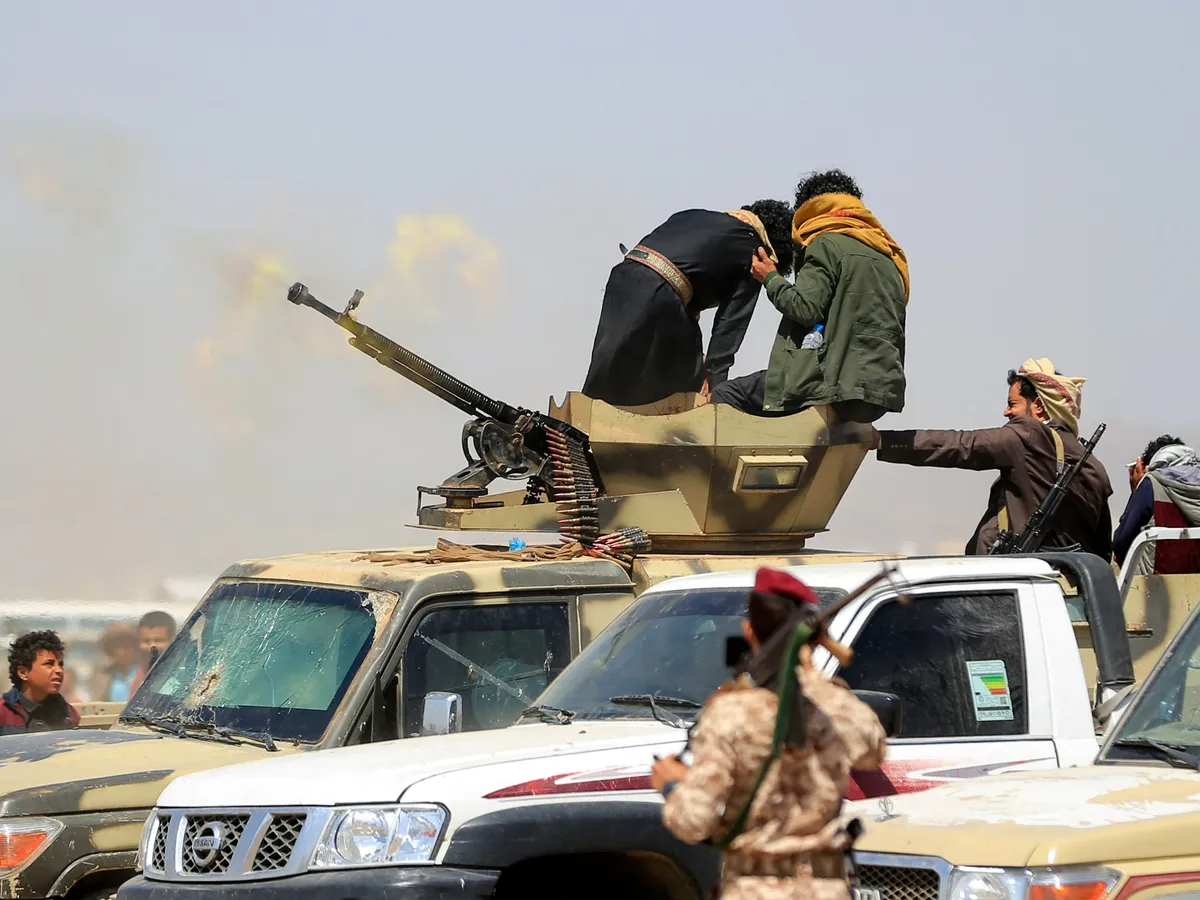
ANALYSISTensions are rising in the battlefield and political sphere. Will the conflict reignite?Yemenis fire a heavy machinegun during a rally in solidarity with Lebanon and Iran on the outskirts of the Houthi-controlled capital Sanaa on July 2, 2026 [AFP]Published On 11 Jul 2026In recent weeks, there have been renewed tensions in Yemen. Attacks by the Houthi group – which has controlled Sanaa and large parts of northern Yemen since 2014 – have coincided with controversy prompted by the arrival of an Iranian plane at Sanaa airport and renewed concern over navigation in the Red Sea.This comes in the context of a stalled peace process and the failure to reach an agreement on de-escalation mechanisms.Recommended Stories list of 2 itemslist 1 of 2Houthi rebels kill 16 Yemeni government troops in fiercest clashes in yearslist 2 of 250 Houthi fighters killed in renewed clashes in Yemenend of listIn this climate, movements on the front lines appear to be an attempt by the Houthis to exert pressure and to test the limits of the response of the internationally recognised government, its ally, Saudi Arabia, and the international community at large.So far, these developments do not point to a decision to launch a broad military confrontation, but they show that the truce announced in 2022 can no longer contain the conflict.From Hays to Al-Jawf: Limited clashes and tribal mobilisationThe Hays district in Hodeidah-governorate" class="entity-link entity-location" data-entity-id="163492" data-entity-type="location">Hodeidah governorate near the port of Hodeidah on the Red Sea has been one of the main flashpoints in recent weeks.On July 5, Houthi rebels attacked government forces’ positions using mortar shells, drones and sniper fire. According to medical and military sources cited by Al Jazeera, 16 government soldiers were killed in the attack and 22 others were wounded. The Houthis did not announce their casualty toll or provide a detailed account of how the clashes began.Hays is of particular importance because it has remained relatively calm since the truce, and because its location is close to the coast and shipping lanes.The tensions are not confined to Hodeidah. Marib, Taiz and al-Dhale have also witnessed varying levels of military mobilisation.In al-Jawf, the picture is different. A tribal disturbance was triggered by a dispute over a house in Sanaa and then turned into a test of the Houthis’ influence and their relationship with the tribes. Sheikh Hamad bin Rashid bin Fadgham al-Hazmi intervened in the dispute, per tribal custom, but was detained by the Houthis.This turned discontent into an anti-Houthi tribal movement, which is accompanied by calls for a “tribal nakaf”, a traditional call for mobilisation and support, alongside the “al-Rayyan sit-ins”, temporary tribal gatherings to rally supporters.This development points to how developments in the battlefield are causing tensions in the tribal and social sphere.Al-Jawf lies near Marib and within a sensitive military and tribal zone, and any prolonged unrest there could open an additional pressure front on the Houthis and complicate their calculations in one of the most important fronts of Yemen’s northeast.Tensions have also extended to the Red Sea. On July 5, the British military said that a cargo ship had come under attack off the coast of Hodeidah, which did not result in any injuries. No one claimed responsibility, but the incident took place near an area under Houthi control and at a time when the group has renewed its threats regarding navigation.The attack highlights the continuing risks ships face in transiting in the vicinity of Hodeidah and Bab al-Mandab, one of the world’s busiest straits.Sanaa airport tensions and a frozen prisoner exchange dealTensions between Yemen’s internationally recognised government and the Houthis havе not been confined to the battlefield. On July 3, an Iranian aircraft arrived at Sanaa airport to pick up a Houthi delegation to attend the funeral of the late Iranian Supreme Leader Ayatollah Ali Khamenei.A week later, the internationally recognised government announced that Iran had submitted a request to operate a Mahan Air flight from Tehran to Sanaa to return the Houthi delegation. It rejected the request and proposed returning the individuals on an aircraft chartered by Yemenia Airways.In response, some Houthi leaders insisted on the continuation of Mahan Air flights to Sanaa, presenting them as part of their right to operate the airport and open direct routes with the outside world. Thus, the dispute went beyond a single flight to the issue of managing an international airport and airspace outside government institutions, and the resulting struggle over sovereignty and de facto recognition of Houthi authority over the entry point.Saudi Arabia is also affected by the dispute. The operation of a direct route between Sanaa and Tehran would affect the security and political arrangements that accompanied the reopening of the airport during the truce. Riyadh views the expansion of airport traffic outside an agreement as a factor that strengthens the Houthis’ relationship with Iran near the kingdom’s southern border. Therefore, its position is linked to keeping flights within declared arrangements while continuing to operate the national carrier.Another issue that has heated up in the past few days is a long-negotiated prisoner and detainee exchange deal, which has stalled.On July 10, Hadi Haig, head of the government negotiating team on the prisoners and abductees file, announced that the team had received notification from the International Committee of the Red Cross and the office of the United Nations envoy that the Houthis have refused to implement the agreement on its scheduled date and have postponed it indefinitely.In response, the head of the Houthis’ Prisoners Affairs Committee, Abdulqader al-Murtada, blamed the government side for the delay, accusing it of failing to abide by the terms of the agreement and of refusing to add names to the agreed list.The deal includes more than 1,600 detainees and requires field arrangements and an air bridge under the supervision of the International Committee of the Red Cross. Regardless of each side’s responsibility, the postponement places the negotiation track before a new test and confirms the continued use of humanitarian files as tools of political and military pressure.Regional tension and the limits of confrontationRegional developments have directly impacted Yemen. The US-Israel war on Iran and tensions between the Houthis and Saudi Arabia have reduced the ability of Yemeni parties to control escalation and increased the influence of external calculations on the course of the conflict.This has given the Houthis greater room for political and military manoeuvre, while the government has struggled to assert its sovereign presence.Saudi Arabia wants to contain the Houthi threat while preserving the gains of de-escalation. The Houthis, for their part, are betting on combining military action with pressure over the airport, prisoners, and navigation files to extract broader recognition of their authority and their direct relationship with Iran.These developments reflect the fragility of the de-escalation process and the growing political and military pressures.Limited clashes and mobilisation are likely to continue, with each side using the leverage it possesses to apply pressure. So far, there is no evidence of a decision to engage in a full-scale confrontation, but repeated attacks and faltering negotiations could end the state of relative calm that has persisted since 2022.The risk of confrontation will remain as long as the root causes of the war remain unresolved, and as long as the parties use weapons to impose their vision and improve their political fortunes.
SRCAl Jazeera
LANGEN
LEANCenter
WORDS1 206
ENT12
SAT · 2026-07-11 · 12:53 GMTBRIEF NSR-2026-0711-92242
NSR-2026-0711-92242Analysis·EN·Conflict
What is going on in Yemen?
Tensions are escalating in Yemen, with renewed Houthi attacks on government forces in Hodeidah and other fronts, coinciding with tribal discontent in al-Jawf. These battlefield movements, occurring after the 2022 truce, appear to be Houthi attempts to exert pressure.
Saeed ThabetAl JazeeraFiled 2026-07-11 · 12:53 GMTLean · CenterRead · 5 min
Al JazeeraFIG 01
Reading time
5min
Word count
1 206words
Sources cited
2cited
Entities identified
12entities
Quality score
100%
§ 01
Briefing Summary
AI-generatedNEWSAR · AI
Tensions are escalating in Yemen, with renewed Houthi attacks on government forces in Hodeidah and other fronts, coinciding with tribal discontent in al-Jawf. These battlefield movements, occurring after the 2022 truce, appear to be Houthi attempts to exert pressure. Simultaneously, controversy surrounds an Iranian plane's arrival at Sanaa airport and a dispute over subsequent flights, highlighting a struggle over control of the airport and de facto recognition of Houthi authority. These developments, alongside a Red Sea cargo ship attack, indicate the 2022 truce is no longer containing the conflict, raising concerns about a potential reignition of broader hostilities.
Confidence 0.90Sources 2Claims 5Entities 12
§ 02
Article analysis
Model · rule-basedFraming
Conflict
Political Strategy
Tone
Mixed Tone
AI-assessed
CalmNeutralAlarmist
Factuality
0.60 / 1.00
Mixed
LowHigh
Sources cited
2
Limited
FewMany
§ 03
Key claims
5 extracted01
Houthi rebels attacked government forces in Hays on July 5, killing 16 soldiers and wounding 22, according to Al Jazeera-cited sources.
factualAl Jazeera
Confidence
0.90
02
Renewed tensions in Yemen are marked by Houthi attacks coinciding with controversy over an Iranian plane and Red Sea navigation concerns.
factual
Confidence
0.90
03
A tribal disturbance in al-Jawf, initially over a house dispute, escalated into a test of Houthi influence and led to a tribal mobilization movement.
factual
Confidence
0.85
04
The 2022 truce can no longer contain the conflict, as evidenced by recent front-line movements.
factual
Confidence
0.80
05
The current developments do not indicate a decision for broad military confrontation but show the truce is insufficient.
prediction
Confidence
0.70
§ 04
Full report
5 min read · 1 206 words§ 05
Entities
12 identifiedKey playerOppositionContextPositiveNeutralNegative
§ 06
Keywords & salience
9 termsyemen conflict
1.00
houthi group
0.90
red sea navigation
0.80
peace process
0.70
military confrontation
0.60
tribal mobilisation
0.50
truce
0.50
saudi arabia
0.40
iran
0.40
§ 07
Topic connections
Interactive graph Network visualization showing 4 related topics
View Full Graph Person Organization Location Event|Click node to navigate|Edge numbers = shared articles