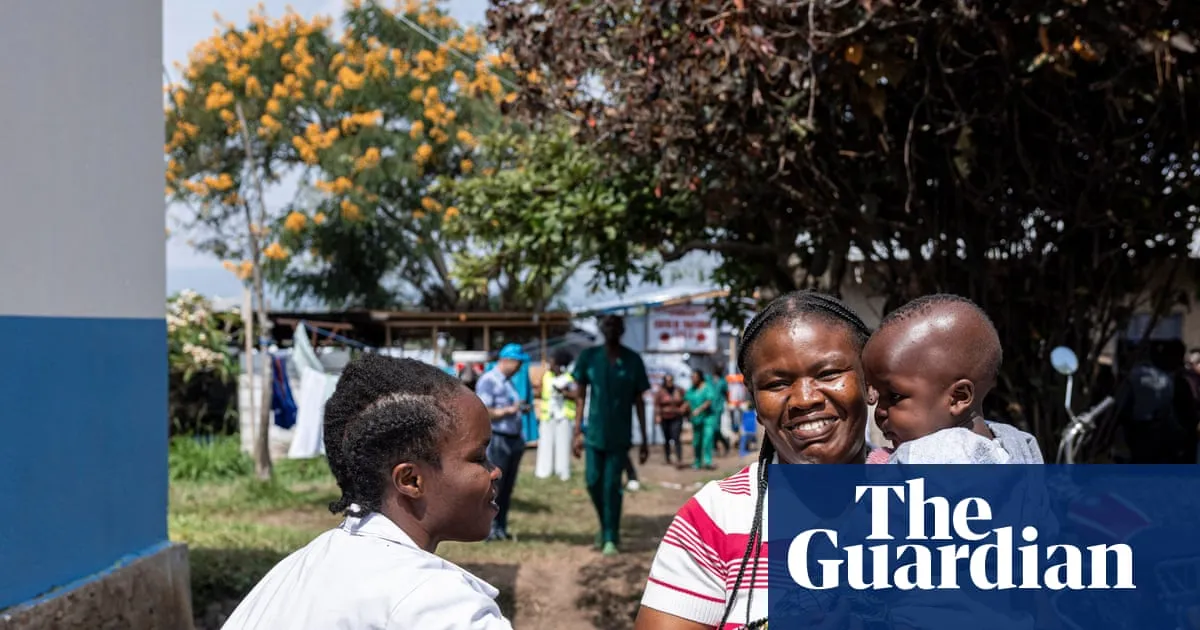
There is no approved drug to help the medical teams scrabbling to save lives in the Ebola outbreak in the Democratic Republic of the Congo – but there are hopes that could change within months as the first patients are enrolled in a treatment trial.It is a record pace to set up and start this kind of research, scientists said, with patients enrolled just six weeks after the outbreak being declared a public health emergency of international concern by the World Health Organization (WHO) on 17 May.Nevertheless, in Bunia, the capital of Ituri province, where the virus is raging, people are impatient.“I hope these drug trials proceed quickly,” said Neema Haba, a mother of three and banana seller. “Financially, we are being driven to the brink by this outbreak and nothing is going right. We are struggling to provide for our children.”As of 9 July, there had been 1,792 confirmed cases and 625 deaths caused by the Bundibugyo strain of the virus, for which there is no vaccine and no approved treatment. It is still “in the expansion phase”, according to the WHO.A patient at an Ebola treatment centre in Rwampara, Ituri, 20 June 2026. Photograph: Dieudonne Dirole/EPAThe response is reliant on the basic techniques of identifying cases, isolating them for care and tracking and monitoring people they have been in contact with.The latest figures show about 75% of known contacts are being traced, but low trust in authorities and a highly mobile population are hampering efforts. In addition, some frontline workers stopped work this week in protest at a lack of pay.The bodies of Ebola victims are highly contagious, and must be safely buried by properly trained professional teams. Ovide Maliabo, a driver for one of the teams in Rwampara, a mining town in Ituri, said the work was dangerous in the face of community mistrust and he and his colleagues “see no point in risking our lives”.“At one point, we narrowly escaped being lynched,” he said. “It’s a shame that we aren’t being financially supported.”Bahati John, head of the team, said he had lost a tooth after being attacked by local people.“Honestly, since we started working on 15 May, with all the insults we’ve had to put up with, we haven’t seen a single penny,” he said. “We are the breadwinners of our families, and our families are suffering.”Frontline workers have faced shortages of essential equipment, including personal protective wear and vehicles to transport dead bodies. Photograph: Dieudonne Dirole/EPADRC officials said payments had been made but it is unclear whether activities have fully resumed. The closure of the local airport in Bunia was hampering the response, including by impeding the supply of banknotes, they said.Hopes of turning the tide now rest with scientists searching for effective medicines.The Partners treatment trial has opened with two drugs on its books – remdesivir, and MBP134. Patients will be randomly allocated to receive either drug, a combination of the two, or simply standard, supportive care.Remdesivir is an antiviral made by pharma company Gilead Sciences, while MBP134 is a monoclonal antibody developed by Mapp Biopharmaceutical, containing two specially engineered immune proteins that recognise and neutralise the virus.Both are given intravenously – MBP134 as a one-off infusion, and remdesivir as 10 days of intravenous therapy.“These two drugs actually have been proven to work against the Bundibugyo virus in animal models,” said Prof Laurens Liesenborghs of the Institute of Tropical Medicine, Antwerp, who is working on the trial in Ituri.“They showed great efficacy, but now we need to test it in humans. Basically, what we want to see is if they indeed can lower mortality.”Bundibugyo typically has a lower death rate than the Zaire strain of Ebola, which has caused most previous outbreaks, but it still kills about one in three of those infected.A staff member checks medicine stocks at an Ebola treatment centre run by the NGO Alliance for Medical Action in Rwampara, Ituri. Photograph: Dieudonne Dirole/EPAResearchers are watching carefully for any difference in death rates between the groups given experimental drugs and the group receiving standard care. “Any improvement is good,” said Liesenborghs. “But it needs to be statistically detected, so we need to see a substantial drop.”skip past newsletter promotionafter newsletter promotionIn trials looking at the impact of monoclonal antibodies on Ebola cases caused by the Zaire strain, it lowered death rates from 50% to 35%, he said. “Hopefully we will see something in the order of that magnitude.”The trial’s design allows other potential treatments to be added should they become available. A result is likely to need between 700 and 1,000 patients to be enrolled, Liesenborghs said. “We opened one site, hopefully we’ll open additional sites very quickly, but still then it will take a couple of months, depending on how the outbreak is going, obviously.”WHO officials said enough remdesivir and MBP134 had been donated, by Gilead and the US government respectively, for 1,200 patients to be enrolled. The WHO is in discussions to ensure sufficient supplies will be available after the trial, should they prove safe and effective, it said.Patients of any age, including pregnant and breastfeeding women, who are often excluded from medical research, can enrol in the trial.“We always think of risk-benefit,” says Liesenborghs. “Here the benefit is potentially very high because you offer a potentially life-saving treatment to someone who has a very high chance of dying.”Medical staff at a hospital in Mongbwalu, Ituri. Photograph: Dieudonne Dirole/EPAEbola causes miscarriages, while there is no sign of risk to pregnancies from animal experiments on the drugs, he added.“It’s just fantastic we’ve managed to get started so quickly,” says Prof Amanda Rojek, international principal investigator for Partners, of the University of Oxford.She said strong scientific leadership in the DRC, which has hosted major trials during earlier outbreaks of Ebola and other diseases such as mpox, had been vital.“If we look back at west Africa [an Ebola outbreak in 2014-16 that saw more than 28,000 cases and 11,000 deaths], where it took us over a year to start clinical trials, we’re very proud of the team led by INRB [the DRC’s National Biomedical Research Institute] that we’ve managed to achieve that in kind of six weeks since the outbreak was first announced.”The focus, Rojek said – as in the Recovery trial during Covid, delivered by the same Oxford group – was on keeping the trial as simple as possible.Partners is sponsored by the WHO, with funding from the Wellcome Trust, FCDO and UKRI.Prof Yap Boum, head of emergency response with continental health watchdog Africa CDC, warned that the danger was not over, but added: “What limits an outbreak is our capacity to provide care, our surveillance capacity and our ability to isolate people. These trials will enable us to access treatment, and when we treat people, it also sends a message to the community.”Another trial is due to begin this week, looking at whether giving people who have been in contact with Bundibugyo cases a drug called obeldesivir can stop them developing the disease.Africa CDC said that trial needed around $18m to proceed, with $6m committed to date.
SRCThe Guardian - World News
LANGEN
LeanCenter-Left
WORDS1,177
ENT10
SUN · 2026-07-12 · 08:00 GMTBRIEF NSR-2026-0712-92366
NSR-2026-0712-92366News Report·EN·Public Health
First patients enrolled in record-breaking Ebola treatment trial in DRC
In the Democratic Republic of the Congo's Ituri region, the first patients have been enrolled in a record-breaking Ebola treatment trial just six weeks after the outbreak was declared a public health emergency. This trial, a collaboration involving scientists, aims to reduce mortality rates by testing two drugs: remdesivir and MBP134.
Kat Lay, Global health correspondent and Prosper Heri in BuniaThe Guardian - World NewsFiled 2026-07-12 · 08:00 GMTLean · Center-LeftRead · 5 min
The Guardian - World NewsFIG 01
Reading time
5min
Word count
1,177words
Sources cited
3cited
Entities identified
10entities
Quality score
100%
NEWSAR · AI
In the Democratic Republic of the Congo's Ituri region, the first patients have been enrolled in a record-breaking Ebola treatment trial just six weeks after the outbreak was declared a public health emergency. This trial, a collaboration involving scientists, aims to reduce mortality rates by testing two drugs: remdesivir and MBP134. These drugs have shown efficacy in animal models against the Bundibugyo strain of Ebola, which has caused 1,792 confirmed cases and 625 deaths as of July 9th. The trial randomly assigns patients to receive either drug, a combination, or standard supportive care. The research is crucial as there are currently no approved treatments for this strain, and frontline workers are facing challenges including lack of pay and community mistrust.
Confidence 0.90Sources 3Claims 5Entities 10
Framing
Public Health
Human Interest
Tone
Measured
AI-assessed
CalmNeutralAlarmist
Factuality
0.70 / 1.00
Factual
LowHigh
Sources cited
3
Well sourced
FewMany
01
As of July 9, there had been 1,792 confirmed cases and 625 deaths caused by the Bundibugyo strain of the virus in DRC.
statistic
Confidence
0.95
02
The Partners treatment trial is testing remdesivir, MBP134, or a combination of both against the Ebola virus.
factual
Confidence
0.90
03
First patients enrolled in a record-breaking Ebola treatment trial in the DRC.
factual
Confidence
0.90
04
Frontline workers in the DRC are protesting a lack of pay and essential equipment, impacting the Ebola response.
factual
Confidence
0.85
05
Community mistrust and a mobile population are hampering efforts to trace Ebola contacts in the DRC.
factual
Confidence
0.80
§ 04
Full report
5 min read · 1,177 wordsKey playerOppositionContextPositiveNeutralNegative
Organizations1
Locations4
Events1
ebola treatment trial
1.00
ebola outbreak
0.90
democratic republic of the congo
0.90
public health emergency
0.80
treatment trial
0.70
bundibugyo strain
0.70
frontline workers
0.60
community mistrust
0.50
safe burial
0.40
§ 07
Topic connections
Interactive graph Network visualization showing 50 related topics
View Full Graph Person Organization Location Event|Click node to navigate|Edge numbers = shared articles