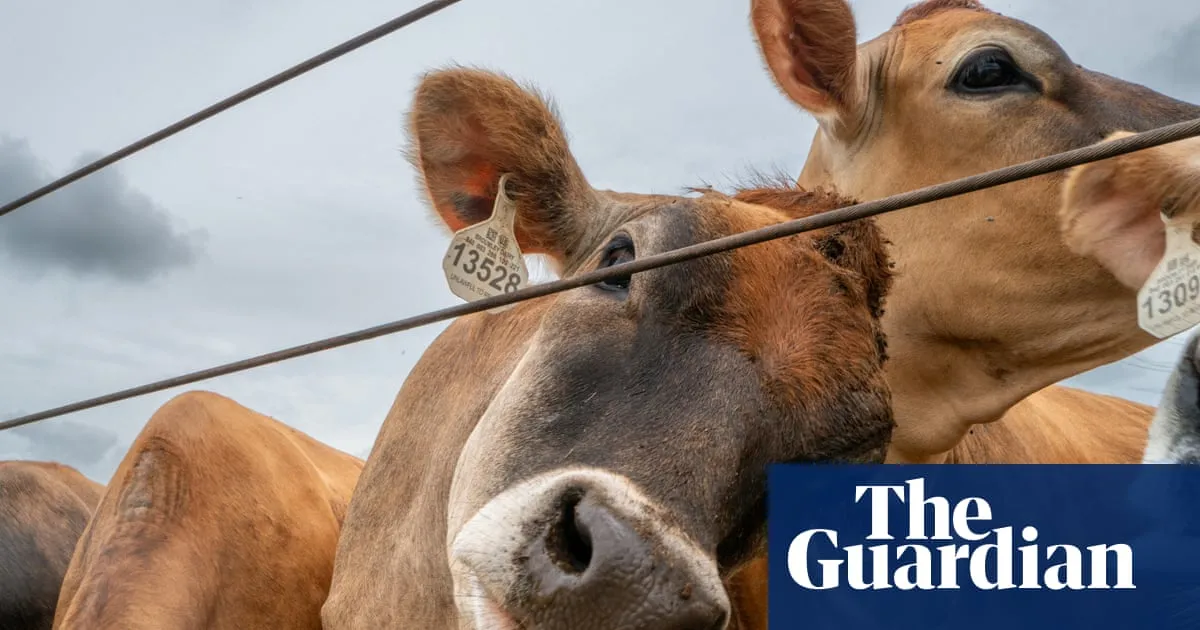
When conservationists set up cameras in remote regions of Central American forests, they wanted to monitor illegal cattle movement, which can lead to deforestation. But in recent months, they discovered another alarming development: wildlife rapidly infected with the New World Screwworm.It’s a warning sign of how the fly could spread in the US – and it signals new difficulties in pushing it back south, a process that will probably take years, experts say.“We got a really unique perspective throughout the beginning of the process,” said Jeremy Radachowsky, director of the Mesoamerica and Caribbean program at the Wildlife Conservation Society, which recently released a study on the phenomenon.The cameras captured all types of wildlife – jaguar, puma, tapir, deer, white-lipped peccary, even porcupines – covered in the unmistakable wounds caused by the parasitic fly. Some of the mammals shared water sources with the cattle, which were moved across national borders without requisite health and safety checks. From there, the fly ripped through wildlife.“We see infestations in the deepest parts of the interiors of the forest, so now it’s become endemic in wildlife, far from the cattle infestations,” Radachowsky said.The Texas operations center during the state’s response to the infestation, in Austin, on 5 June 2026. Photograph: Austin American-Statesman/Hearst Newspapers/Getty ImagesScrewworm has been detected in 34 animals in the US – most in Texas, with one in Mexico" class="entity-link entity-location" data-entity-id="2257" data-entity-type="location">New Mexico. So far, they have only been found in livestock and pets, with no wildlife detections in the US.The US is now dropping 100 million sterile flies in the south-west and Mexico – which may be enough to slow the northward movement of the parasitic fly, but will not be enough to eradicate it from the region. For that, they would need about 500 million sterile flies.“What we lack are sufficient flies in order to start pushing the population back south,” said Phillip Kaufman, professor and department head of entomology at Texas A&M University.Officials are now rushing to expand the capacity for breeding sterile flies. One facility opened in Mexico in late June, with another facility in Texas planned to open in late 2027. These flies are irradiated so that they cannot reproduce; when the males mate with females, the eggs are not fertilized and thus the population crashes.There are new potential innovations for battling the screwworm on the horizon, like only raising sterile male flies (instead of male and female flies) or designing better bait traps to catch the wild flies. These methods could prove more effective, but they also take time to develop.“We have to have things that work,” Kaufman said. “We can’t stop doing things we know work in order to try things that don’t have any data to support. We are relying on science to solve this problem.”There are other potential solutions that would rely on stopping illicit activities.Efforts have mainly focused on the screwworm itself, instead of the underlying cause of the rapid move north, Radachowsky said.A scientist conducts tests at a sterile-fly production plant created by Mexico and the US in Metapa, Mexico, on 9 July 2026. Photograph: Anadolu/Getty Images“They’re either eradicating the fly, making a fly that can’t reproduce or trying to trap the fly. What they’re not doing is addressing the root cause of the cattle trafficking,” he said. “If you’re only using sterile fly technique and you have other factors that are moving beyond your efforts to blanket those areas with sterile flies, you’re never going to have the capacity to clear huge areas.”The livestock industry, especially illegal cattle movement, has changed significantly since the flies were pushed out in 1966, Radachowsky argued.skip past newsletter promotionafter newsletter promotion“There’s this expectation and this simple argument that the sterile fly technique worked once, so it will work again,” he said. “But the problem is in the 60s, when we first eradicated screwworm, we didn’t have this high density of cattle like we do now. The human population and cattle population is just incredibly different from what it was back then, and the [illicit] cattle movements didn’t exist before.”The screwworm got through the Darién Gap in 2022, working its way north until it hit Nicaragua. From there, “it basically shot northward through Central America”, moving thousands of kilometers in only four or five months – “at the speed of a truck, and exactly along those illegal cattle-trafficking routes that we had already documented”, Radachowsky said.Illegally moving animals does seem like the primary driver for the return of the screwworm, Kaufman said.“There’s not a lot of wildlife that go on long-distance migrations” in this region, he added. “When you see it jump 50 or 100 miles, that wasn’t an adult fly flying that far. They don’t do that. It was people,” he said, who were transporting livestock or pets.The US agriculture secretary, Brooke Rollins, greets ranchers at the conclusion of a press conference at on 8 June 2026 in Kerrville, Texas. Photograph: Brandon Bell/Getty ImagesFor the US, the biggest alarm bells started sounding about 18 months ago when the screwworm re-entered Mexico. Officials and experts scrambled to understand how to push it back.“Mexico had not had the pest in probably 35 years or so, so all the people who knew what to do have either passed or long retired,” Kaufman said.In the US, the screwworm is considered a foreign animal disease pest, so there are restrictions on how scientists may study it. “We were not permitted to have the fly in research facilities in the US for the last 50 years, because it’s such a dangerous organism,” Kaufman said. Scientists don’t know which odors attract the fly, for instance, in order to create effective bait traps. That’s the kind of work being started now through grants from the US Department of Agriculture.Conservationists are “extremely worried” that “basically the door is wide open for infectious disease transmission”, Radachowsky said – not just the screwworm but also other livestock-borne illnesses, such tuberculosis, brucellosis, hoof and mouth disease, and bird flu.“It frightens me that we’re not learning the main lesson here,” Radachowsky said. More disease monitoring is also needed to examine wildlife populations in the Americas, he added. “There’s a lot of wildlife that’s probably disappearing without anybody ever having any evidence of it. It’s guaranteed that we’re just scratching the surface.”
SRCThe Guardian - World News
LANGEN
LEANCenter-Left
WORDS1 040
ENT10
SUN · 2026-07-12 · 11:00 GMTBRIEF NSR-2026-0712-92735
NSR-2026-0712-92735News Report·EN·Environmental
Experts warn of ways screwworm could spread in the US and new difficulties in keeping it at bay
Experts are concerned about the spread of the New World screwworm into the US, as it has become endemic in wildlife in Central America. Conservationists observed wildlife, including jaguars and deer, infected with the parasitic fly, indicating a potential pathway for its northward movement.
Melody SchreiberThe Guardian - World NewsFiled 2026-07-12 · 11:00 GMTLean · Center-LeftRead · 5 min
The Guardian - World NewsFIG 01
Reading time
5min
Word count
1 040words
Sources cited
2cited
Entities identified
10entities
Quality score
100%
§ 01
Briefing Summary
AI-generatedNEWSAR · AI
Experts are concerned about the spread of the New World screwworm into the US, as it has become endemic in wildlife in Central America. Conservationists observed wildlife, including jaguars and deer, infected with the parasitic fly, indicating a potential pathway for its northward movement. While the US is releasing sterile flies to slow the infestation, current efforts are insufficient for eradication, requiring significantly more sterile flies. The rapid spread is attributed to illegal cattle movement along documented trafficking routes, a factor not adequately addressed by current eradication strategies. New methods for combating the screwworm are being developed, but experts emphasize the need to address the root cause of animal trafficking to effectively contain the parasite.
Confidence 0.90Sources 2Claims 5Entities 10
§ 02
Article analysis
Model · rule-basedFraming
Environmental
Public Health
Tone
Mixed Tone
AI-assessed
CalmNeutralAlarmist
Factuality
0.70 / 1.00
Factual
LowHigh
Sources cited
2
Limited
FewMany
§ 03
Key claims
5 extracted01
New facilities for breeding sterile flies are opening in Mexico and Texas to combat the screwworm infestation.
factual
Confidence
0.95
02
Screwworm has been detected in 34 animals in the US, primarily livestock and pets, with no wildlife detections yet.
factual
Confidence
0.95
03
The US is dropping 100 million sterile flies to slow the northward movement of screwworm, but 500 million are needed for eradication.
statisticPhillip Kaufman
Confidence
0.90
04
Screwworm infestations have been detected in wildlife in Central American forests, indicating a potential spread to the US.
factualJeremy Radachowsky
Confidence
0.90
05
Pushing the screwworm population back south will likely take years.
predictionexperts
Confidence
0.75
§ 04
Full report
5 min read · 1 040 words§ 05
Entities
10 identifiedKey playerOppositionContextPositiveNeutralNegative
Locations5
§ 06
Keywords & salience
10 termsnew world screwworm
1.00
sterile flies
0.90
parasitic fly
0.90
wildlife infestation
0.80
disease spread
0.70
eradication efforts
0.60
cattle movement
0.60
entomology
0.50
conservation
0.40
texas
0.40
§ 07
Topic connections
Interactive graph Network visualization showing 7 related topics
View Full Graph Person Organization Location Event|Click node to navigate|Edge numbers = shared articles