EXPLAINERPort Sudan trial of paramilitary leaders centres on atrocities in West Darfur.Mohamed Hamdan Dagalo, better known as Hemedti, the head of the RSF paramilitary force, appears in Khartoum in 2019 when he was the deputy head of the military council that governed Sudan after the overthrow of President Omar al-Bashir [File: AP]Published On 14 Jul 2026A Sudanese court has sentenced Rapid Support Forces (RSF) leader Mohamed Hamdan Dagalo, also known as Hemedti, to death after convicting him of war crimes, crimes against humanity and genocide over atrocities committed in West Darfur.The court, sitting in the army-controlled city of Sudan" class="entity-link entity-location" data-entity-id="9948" data-entity-type="location">Port Sudan, also sentenced 15 other senior figures of the RSF, a paramilitary group locked in a war with the Sudanese army since 2023, to death over the same crimes.Recommended Stories list of 4 itemslist 1 of 4Photos: Wildfires ravage historic forest near Parislist 2 of 4US bombs Iran again, Tehran strikes Gulf, tankers: What’s the latest?list 3 of 4World Cup Day 34: Semifinals begin as France face Spain in Dallaslist 4 of 4Emir of Qatar receives condolences on the death of the Father Emirend of listThe Sudan Founding Alliance, a political coalition that includes the RSF, reportedly rejected the ruling, while Hemedti was tried in absentia and his whereabouts are not publicly known. The RSF itself has not directly commented on the verdict but has repeatedly denied accusations that it has committed war crimes.The judgement was issued during a humanitarian crisis as fighting that continues across the country has displaced millions of people.Here’s what we know:What’s the background to the ruling?Sudan descended into civil war on April 15, 2023, after a bitter power struggle between the army chief, General Abdel Fattah al-Burhan, and Hemedti. Their forces had operated alongside one another before they turned their weapons on each other.The dispute centred partly on how and when the RSF would be integrated into the regular army as Sudan tried to transition back to civilian rule. Fighting erupted in the capital, Khartoum, and quickly spread across the country with RSF fighters seizing much of the capital while the army retained key military positions and relied on its advantage in the air.In the western region of Darfur, the RSF and its allied militias were accused of ethnically targeted killings, sexual violence, looting and mass displacements of non-Arab communities, particularly the Massalit in and around el-Geneina, the capital of West Darfur state.The balance began to shift after the army launched a counteroffensive, retaking Wad Madani, a city in east-central Sudan, and advancing through the capital. In March 2025, it recaptured the presidential palace and pushed the RSF out of most of Khartoum, dealing the paramilitary force one of its most significant defeats of the war.But the army’s victory in the capital did not end the conflict. Most of the fighting then moved westwards. The RSF consolidated its position across much of Darfur and captured el-Fasher, the capital of North Darfur state and the army’s last major stronghold in the region, in October 2025. Fighting also intensified across Kordofan, the vast region connecting Darfur with central Sudan.Recent attention has focused on el-Obeid, the capital of North Kordofan state about 360km (224 miles) southwest of Khartoum, where the RSF has massed forces around one of the army’s most strategically important strongholds in southwestern Sudan.El-Obeid lies at the intersection of roads linking central Sudan with Darfur and the country’s southern states. Control of the city, therefore, could shape the movement of troops, weapons and supplies across several fronts.The United Kingdom and more than two dozen other states have warned that about half a million civilians face the risk of large-scale atrocities as fighting intensifies around el-Obeid. The United Nations says civilians have endured siege-like conditions and repeated drone attacks as the two sides battle for territory surrounding the city.Who is Hemedti?Born about 1974 into the Mahariya branch of the Rizeigat community in Darfur, Hemedti first rose to prominence through the Janjaweed, a collection of predominantly Arab militias deployed by former President Omar al-Bashir’s government during the Darfur war in the early 2000s.In 2013, al-Bashir’s government brought many Janjaweed fighters into the newly created RSF, placing Hemedti at its head.Despite becoming one of al-Bashir’s most powerful allies and benefitting politically and economically under his government, Hemedti joined Sudan’s military leadership in removing the longtime president during a popular uprising in 2019.Hemedti and al-Burhan subsequently became the two dominant figures in Sudan’s military-led political order. Together, they removed the civilian-led transitional government in an October 2021 coup before their alliance fractured over the proposed integration of the RSF into the army and control of the state, leading to the breakout of the Sudan war.What were Hemedti and other RSF leaders convicted of?The Sudan" class="entity-link entity-location" data-entity-id="9948" data-entity-type="location">Port Sudan trial centred on atrocities committed in el-Geneina, including the June 2023 killing of West Darfur Governor Khamis Abakar.The court found Hemedti and the other defendants guilty of orchestrating attacks on civilians, widespread destruction and looting, and the targeting of schools, places of worship and residential neighbourhoods.Among those sentenced were Hemedti’s brother and deputy, Abdelrahim Hamdan Dagalo; another brother, al-Qoni Hamdan Dagalo; and the RSF’s West Darfur commander, Abdul Rahman Juma Barkallah.Judge Mohamed al-Amin ordered the confiscation of RSF assets and instructed the authorities to seek Interpol red notices for the arrests and extraditions of those convicted.The ruling marks the first conviction of the RSF’s top leaders since the civil war began. Its practical impact remains unclear, however, because the group controls large parts of western Sudan and those convicted remain beyond the army-led authorities’ reach.International actionGlobal pressure has mounted on the RSF outside Sudan’s courts with the United States sanctioning Hemedti after determining that members of the RSF and its allied militias had committed genocide in Sudan in January 2025.The International Criminal Court’s deputy prosecutor said this month that investigators had obtained evidence connecting atrocities in el-Geneina and el-Fasher to top RSF leaders although the court has not publicly identified potential suspects.On Wednesday, a UN fact-finding mission concluded that the RSF had committed genocide during its siege and capture of el-Fasher, citing mass killings, gang rapes, abductions and the deliberate use of starvation against civilians as part of an intentional and systematic policy.The RSF has denied committing genocide or war crimes.The Sudanese army has also faced accusations of war crimes. UN investigators found that both the army and RSF have carried out large-scale attacks on civilians and vital infrastructure.
SRCAl Jazeera
LANGEN
LEANCenter
WORDS1 063
ENT12
TUE · 2026-07-14 · 12:02 GMTBRIEF NSR-2026-0714-92932
NSR-2026-0714-92932News Report·EN·Legal & Judicial
Sudan sentences RSF chief Hemedti to death: Who’s he, what’s he accused of?
A Sudanese court in Port Sudan has sentenced Rapid Support Forces (RSF) leader Mohamed Hamdan Dagalo, known as Hemedti, and 15 other senior RSF figures to death for war crimes, crimes against humanity, and genocide. The convictions stem from atrocities committed in West Darfur, particularly against non-Arab communities.
Caolán MageeAl JazeeraFiled 2026-07-14 · 12:02 GMTLean · CenterRead · 5 min
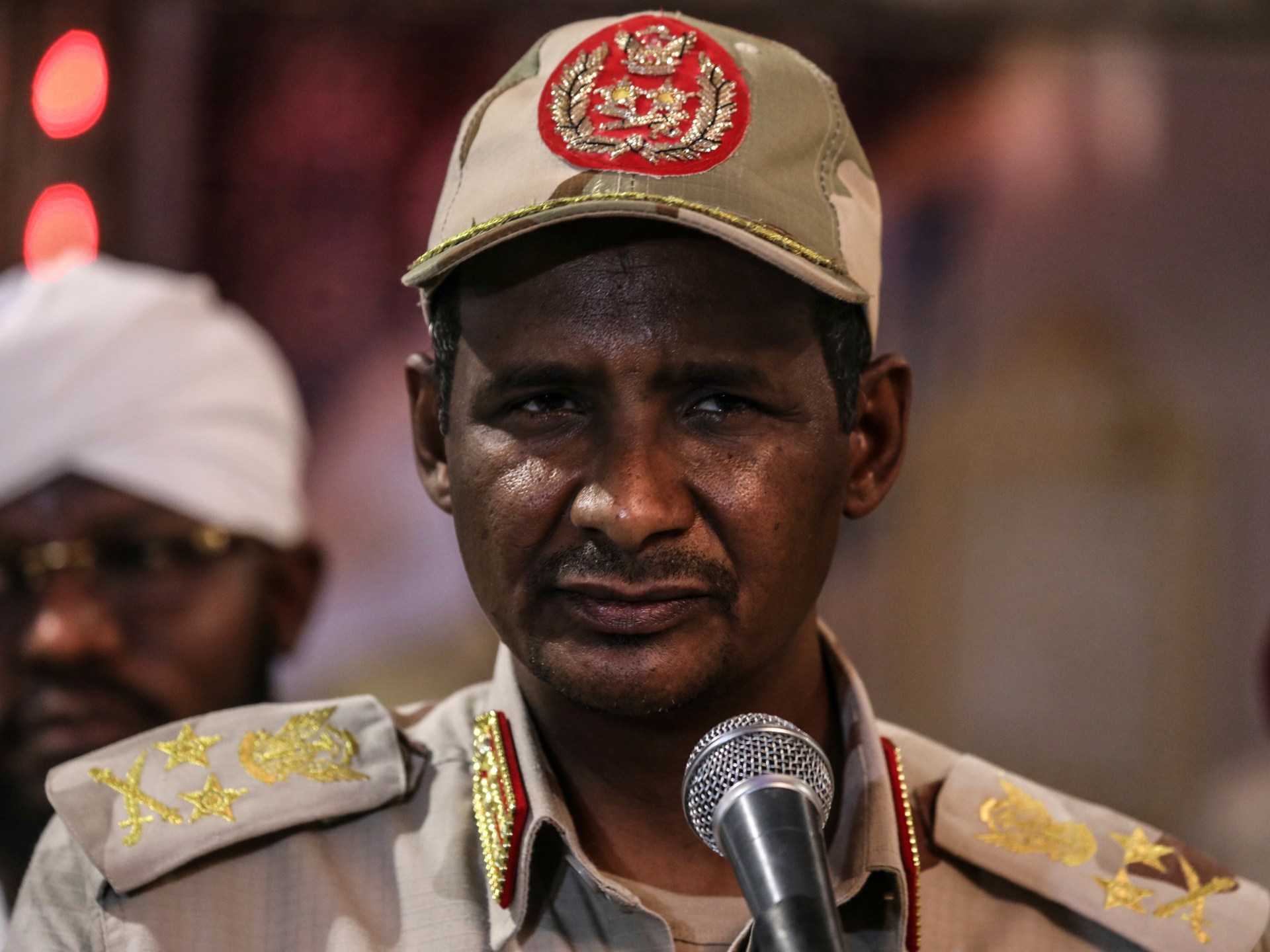
Al JazeeraFIG 01
Reading time
5min
Word count
1 063words
Sources cited
1cited
Entities identified
12entities
Quality score
100%
§ 01
Briefing Summary
AI-generatedNEWSAR · AI
A Sudanese court in Port Sudan has sentenced Rapid Support Forces (RSF) leader Mohamed Hamdan Dagalo, known as Hemedti, and 15 other senior RSF figures to death for war crimes, crimes against humanity, and genocide. The convictions stem from atrocities committed in West Darfur, particularly against non-Arab communities. Hemedti was tried in absentia, and his current whereabouts are unknown. The Sudan Founding Alliance reportedly rejected the ruling. The conflict began in April 2023 as a power struggle between Hemedti and army chief General Abdel Fattah al-Burhan, escalating into a civil war with widespread displacement and a severe humanitarian crisis. Hemedti previously led the Janjaweed militias and later the RSF, becoming a prominent figure after the 2019 overthrow of Omar al-Bashir.
Confidence 0.90Sources 1Claims 5Entities 12
§ 02
Article analysis
Model · rule-basedFraming
Legal & Judicial
Conflict
Tone
Measured
AI-assessed
CalmNeutralAlarmist
Factuality
0.80 / 1.00
Factual
LowHigh
Sources cited
1
Limited
FewMany
§ 03
Key claims
5 extracted01
Sudan descended into civil war on April 15, 2023, due to a power struggle between General Abdel Fattah al-Burhan and Hemedti.
factual
Confidence
1.00
02
Fifteen other senior RSF figures were also sentenced to death for the same crimes.
factualSudanese court
Confidence
1.00
03
Sudanese court sentenced RSF leader Mohamed Hamdan Dagalo (Hemedti) to death for war crimes, crimes against humanity, and genocide.
factualSudanese court
Confidence
1.00
04
Hemedti was tried in absentia and his whereabouts are not publicly known.
factual
Confidence
0.90
05
The Sudan Founding Alliance reportedly rejected the ruling.
factualSudan Founding Alliance
Confidence
0.80
§ 04
Full report
5 min read · 1 063 words§ 05
Entities
12 identifiedKey playerOppositionContextPositiveNeutralNegative
People4
Organizations3
§ 06
Keywords & salience
10 termshemedti
1.00
rsf
1.00
war crimes
0.90
sudan
0.80
west darfur
0.70
crimes against humanity
0.60
genocide
0.60
civil war
0.50
sudanese army
0.50
paramilitary force
0.40
§ 07
Topic connections
Interactive graph Network visualization showing 7 related topics
View Full Graph Person Organization Location Event|Click node to navigate|Edge numbers = shared articles