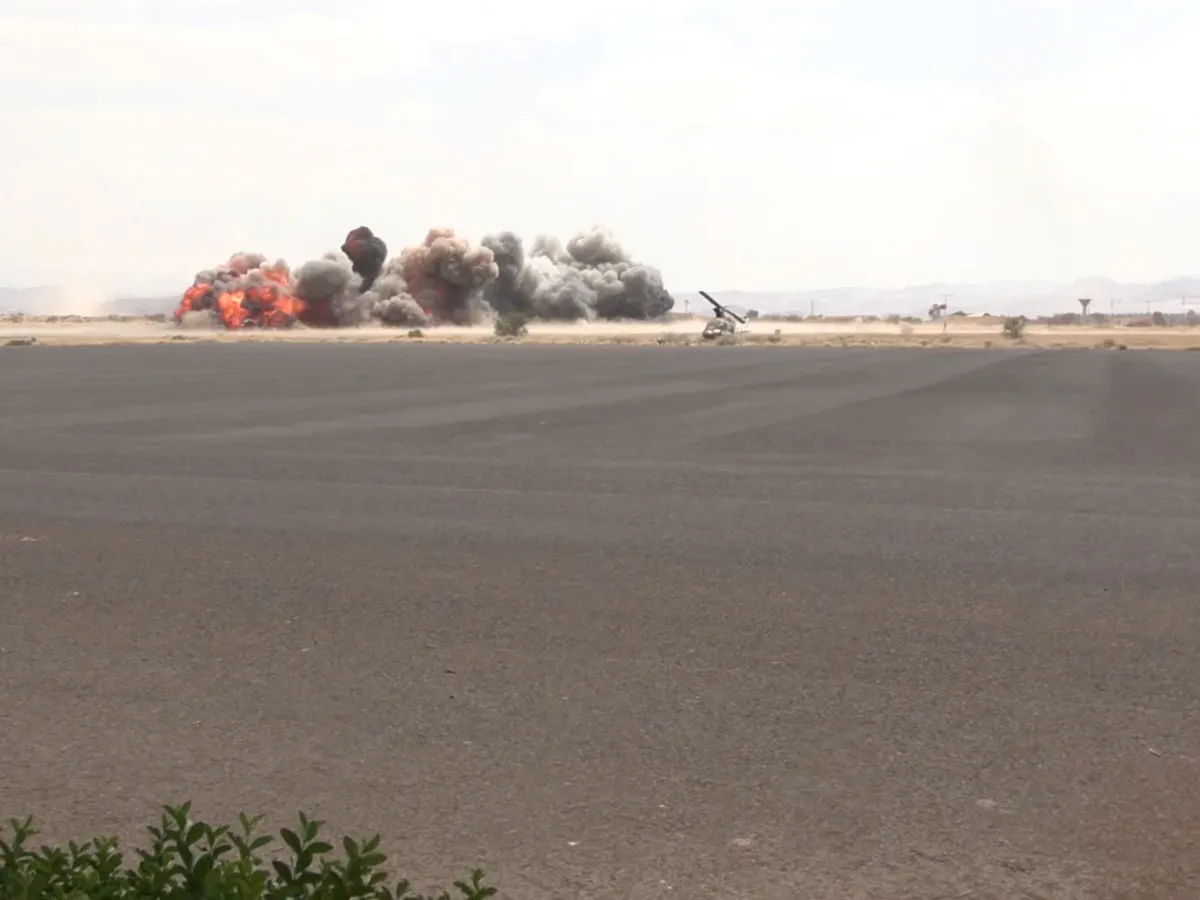
The Iranian aircraft incident has exposed a fragile calm that may not survive a wider regional escalation.Al Jazeera’s Yemen affairs editor.Published On 16 Jul 2026Smoke rises following an air strike at Sanaa airport in Yemen, July 13, 2026, in this screengrab taken from a video [Handout/Al Masirah via Reuters]In the space of just a few days, Yemen appeared to be slipping out of its fragile de-escalation and back into the heart of regional tensions.The incident involving the Iranian aircraft that entered Yemeni airspace was not merely a dispute over a flight. It exposed the extent to which the war in Yemen has become intertwined with the confrontation between the United States and Iran, and raised an old question in a new form: Can Yemen remain outside any broader regional escalation?The Iranian aircraft’s attempt to land in Sanaa, the subsequent targeting of the airport runway to prevent it from doing so and its eventual landing in Hodeidah opened a dispute that extends far beyond civil aviation.The internationally recognised Yemeni government and Saudi Arabia treated the flight as a test of sovereignty and of Iran’s ability to establish a direct link with Houthi-controlled areas. The Houthis and Tehran, meanwhile, presented it as an attempt to break the restrictions imposed on Sanaa.The Houthis’ response against Saudi Arabia was therefore not entirely unexpected. Their targeting of Abha airport in retaliation for the strike on Sanaa airport that prevented the aircraft from landing marked the first Houthi-claimed attack on Saudi Arabia since the informal truce began in March 2022.So far, however, the attack has remained limited, and Saudi Arabia has not responded with a full-scale military campaign. This suggests that, despite the heightened escalation, both sides are still proceeding with careful calculations.It was in this context that the US Department of State responded to a question from a television channel about reports that President Donald Trump had given Saudi Arabia the green light to act against the Houthis.Washington did not explicitly confirm those reports. It said it was monitoring them, before firmly affirming its support for Saudi Arabia in confronting what it described as Iranian aggression, including attacks by the Iran-backed Houthis.More importantly, the State Department directly linked Houthi attacks and the threats the group has issued to core US interests in the region, foremost among them freedom of navigation in the Red Sea and preventing the export of terrorism.This language does not mean that a decision to go to war has been made. But it does indicate that the Houthis’ place in US calculations has changed.The group is no longer viewed solely as a Yemeni actor, but as part of Iran’s network of influence, capable of threatening both Saudi Arabia and the Red Sea.Against this backdrop, Saudi Chief of the General Staff General Fayyad al-Ruwaili met Lieutenant-General Patrick Frank, deputy commander of US Central Command.The official announcement referred to developing military cooperation and did not mention Yemen. But the timing of the meeting gives it additional significance. It came after the attack on Saudi Arabia, the Iranian aircraft crisis and amid an ongoing escalation between the US and Iran.The situation, then, cannot be separated from the region’s wider tensions. Iran is under direct pressure in its confrontation with the United States, and the Strait of Hormuz lies at the heart of those tensions, while the Bab al-Mandab, the narrow strait linking the Red Sea to the Gulf of Aden and a vital trade route between Europe and Asia, remains one of the region’s most sensitive sources of leverage.Should the confrontation expand, the Houthis would be among Iran’s allies best placed to open another pressure front.This is what gives the military movements in Marib, al-Jawf, Harf Sufyan and elsewhere in Yemen their importance.There is not yet sufficient evidence that a decision has been made to launch a major ground war. But forces are being placed on heightened alert and mobilised across several fronts at an extremely sensitive moment. As regional escalation intensifies, any internal confrontation becomes more likely to expand.In the opposite direction, United Nations Special Envoy Hans Grundberg travelled to Muscat, where he met Omani officials and Mohammed Abdul Salam, the head of the Houthi negotiating delegation.His primary mission now appears to be not to launch a comprehensive settlement, but to prevent this round of escalation from turning into a new war.De-escalation, the attack on Saudi Arabia, Iranian flights and the rules governing the use of Sanaa airport are likely to be at the heart of the current discussions, even if their details have not been made public. Those efforts may succeed, or they may not.Calm remains the most likely scenario in the short term. Saudi Arabia does not appear eager to return quickly to a broad war, while the Houthis understand that an open confrontation with the kingdom, coinciding with the US-Israel war on Iran, could expose them to an entirely different level of pressure.The responses may therefore remain measured. The escalation may stop at a certain point, and Muscat may succeed in bringing both parties back towards restraint. But that does not mean the underlying causes of the confrontation have disappeared.The Iranian aircraft incident exposed the fragility of the current de-escalation. The targeting of Abha airport reopened the Saudi front. The US position has also become clearer in linking the Houthis to Iran and to security in the Red Sea.Meanwhile, military movements on the ground indicate that the parties are not behaving as though a settlement is close.For these reasons, I believe the confrontation has been postponed, not cancelled. Any expansion of the regional conflict will make it increasingly difficult to keep Yemen out of it.The views expressed in this article are the author’s own and do not necessarily reflect Al Jazeera’s editorial policy.
SRCAl Jazeera
LANGEN
LEANCenter
WORDS952
ENT12
THU · 2026-07-16 · 09:36 GMTBRIEF NSR-2026-0716-93445
NSR-2026-0716-93445Analysis·EN·Conflict
Yemen is edging closer to renewed confrontation
An incident involving an Iranian aircraft entering Yemeni airspace has exposed the fragility of a de-escalation in Yemen, linking the conflict to wider regional tensions between the US and Iran. The Yemeni government and Saudi Arabia viewed the flight as a challenge to sovereignty and Iran's direct link to Houthi-controlled areas, while the Houthis and Tehran framed it as an attempt to break restrictions on Sanaa.
Ahmed al-ShalafiAl JazeeraFiled 2026-07-16 · 09:36 GMTLean · CenterRead · 4 min
Al JazeeraFIG 01
Reading time
4min
Word count
952words
Sources cited
3cited
Entities identified
12entities
Quality score
100%
§ 01
Briefing Summary
AI-generatedNEWSAR · AI
An incident involving an Iranian aircraft entering Yemeni airspace has exposed the fragility of a de-escalation in Yemen, linking the conflict to wider regional tensions between the US and Iran. The Yemeni government and Saudi Arabia viewed the flight as a challenge to sovereignty and Iran's direct link to Houthi-controlled areas, while the Houthis and Tehran framed it as an attempt to break restrictions on Sanaa. In response to an airstrike on Sanaa airport, the Houthis attacked Abha airport in Saudi Arabia, marking their first claimed attack since a March 2022 truce, though the response has so far been limited. The US affirmed support for Saudi Arabia against Iranian aggression, including Houthi attacks, and now views the Houthis as a threat to US interests like freedom of navigation in the Red Sea. Military cooperation between Saudi Arabia and the US has increased amidst these developments, while UN efforts focus on preventing the current escalation from devolving into a new war.
Confidence 0.90Sources 3Claims 5Entities 12
§ 02
Article analysis
Model · rule-basedFraming
Conflict
Diplomatic
Tone
Mixed Tone
AI-assessed
CalmNeutralAlarmist
Factuality
0.60 / 1.00
Mixed
LowHigh
Sources cited
3
Well sourced
FewMany
§ 03
Key claims
5 extracted01
The US State Department affirmed support for Saudi Arabia against Iranian aggression, linking Houthi attacks to threats against US interests like Red Sea navigation.
factual
Confidence
0.90
02
The Houthis targeted Abha airport in retaliation for the strike on Sanaa airport, marking the first Houthi-claimed attack on Saudi Arabia since March 2022.
factual
Confidence
0.90
03
The incident involving an Iranian aircraft entering Yemeni airspace exposed the war in Yemen's entanglement with US-Iran confrontation.
factual
Confidence
0.90
04
The Houthis are now viewed by the US not just as a Yemeni actor, but as part of Iran's network threatening Saudi Arabia and the Red Sea.
factual
Confidence
0.80
05
The Yemeni government and Saudi Arabia viewed the Iranian aircraft flight as a test of sovereignty and Iran's link to Houthi areas.
factual
Confidence
0.80
§ 04
Full report
4 min read · 952 words§ 05
Entities
12 identifiedKey playerOppositionContextPositiveNeutralNegative
Locations8
§ 06
Keywords & salience
10 termsyemen
1.00
regional escalation
0.90
iran
0.80
houthis
0.70
united states
0.70
saudi arabia
0.70
confrontation
0.60
sovereignty
0.50
red sea
0.40
freedom of navigation
0.40
§ 07
Topic connections
Interactive graph Network visualization showing 51 related topics
View Full Graph Person Organization Location Event|Click node to navigate|Edge numbers = shared articles