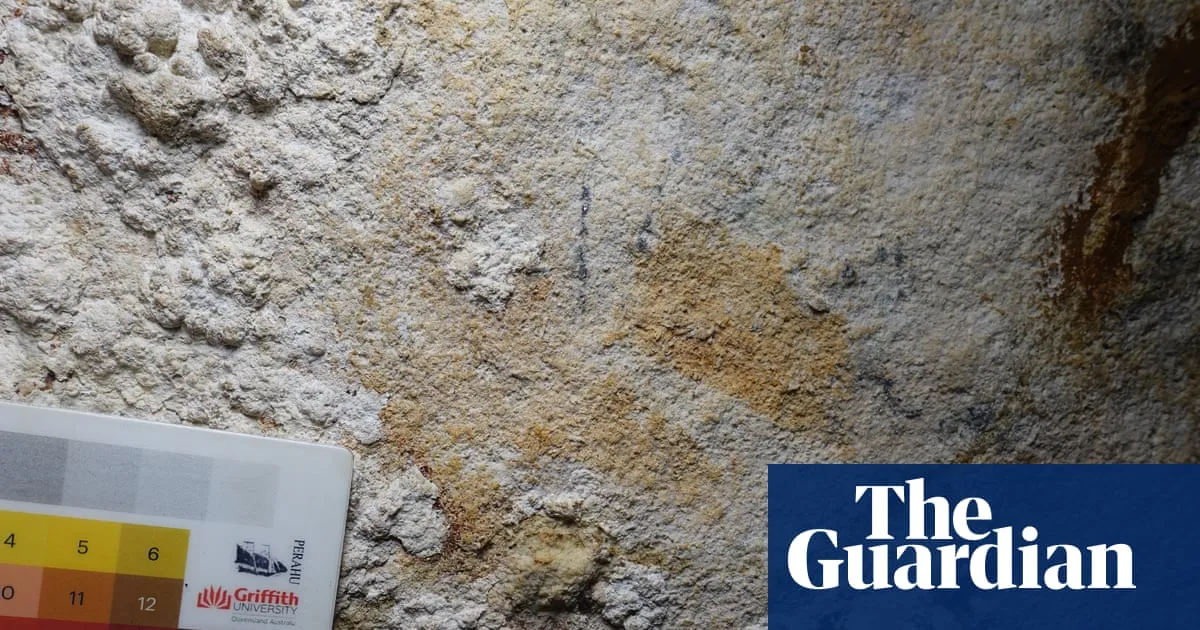
The faded outline of a hand on a cave wall in Indonesia may be the world’s oldest known rock art, according to archaeologists who say it was created at least 67,800 years ago.The ancient hand stencil was discovered in a limestone cave popular with tourists on Muna Island, part of south-eastern Sulawesi, where it had gone unnoticed between more recent paintings of animals and other figures.Beyond providing a minimum age for the cave art, the work furthers thinking on how and when Australia first became settled, with the stencil most likely created by the ancestors of Indigenous Australians.“There’s a lot of rock art out there but it’s really difficult to date,” said Prof Maxime Aubert, an archaeologist at Griffith University in Queensland. “When you can date it, it opens up a completely different world. It’s an intimate window into the past, and an intimate window into these people’s minds.”An enhanced image showing the narrow, pointy fingers of the stencil. Photograph: NatureFieldwork led by Aubert and Prof Adam Brumm, also at Griffith, has revealed a rich history of cave paintings in Sulawesi, mostly on the island’s south-western peninsula. In one cave, a narrative scene depicting three human-like figures and a wild pig was dated to at least 51,200 years ago.The latest hand stencil was spotted at Liang Metanduno, a cave on Sulawesi’s south-eastern peninsula. Though faded and partially obscured by a more recent motif on the wall, it was ascribed a minimum age after the team dated tiny calcite deposits that had formed over the top. Humans have painted in the cave for millennia, with fresh images adorning the walls for at least 35,000 years.It is unclear how humans first migrated from Sunda, the south-east Asian landmass that once connected Borneo, Sumatra and Java, to Sahul, which connected Australia, New Guinea and Tasmania. But the rock art suggests some humans travelled on a northern route that crossed Sulawesi.The fieldwork to date the cave art was led by a team from Australia’s Griffith University. Photograph: NatureBecause sea levels were much lower at the time, land bridges opened up between some neighbouring islands, but humans would still have needed to island hop to spread across the region. Researchers contest when humans reached Sahul, but Brumm believes the rock art supports evidence that northern Australia was settled at least 65,000 years ago.The hand stencils were made by spraying mouthfuls of ochre mixed with water over a hand pressed to the cave wall. Like some others on Sulawesi, the Liang Metanduno stencil has narrow, pointy fingers, which the researchers believe was an intentional modification.Brumm said: “Whether they resemble animal claws or more fancifully some human-animal creature that doesn’t exist, we don’t know, but there’s some sort of symbolic meaning behind them.”Prof Maxime Aubert working in the cave. Photograph: NatureWriting in Nature, the authors argue that the tweaks to the hand stencil make the rock art “complex” and so probably the work of Homo sapiens, but other long-gone human species cannot be ruled out. Archaeologists working in Spanish caves have dated ochre wall markings, including hand stencils, to at least 64,000 years ago, making them the work of Neanderthals. The related but little known Denisovans occupied a vast area of Asia and reached as far as Indonesia.Prof Paul Pettitt, of Durham University, who worked on the Spanish cave markings, said it was not clear whether the pointy-fingered hand stencils in Sulawesi were made on purpose or simply caused by the creator moving their fingers. “To call this complex is rather over-interpreting the hand stencil,” he said.“In any case, Neanderthals were modifying hand stencils, so why this should be a behaviour restricted to Homo sapiens, and why other potential human groups such as the poorly understood Denisovans couldn’t have created it, is unclear,” he added. “Before writing grand narratives about the complexity and success of Homo sapiens, we really should consider other, potentially more interesting explanations of this fascinating phenomenon.”
SRCThe Guardian - World News
LANGEN
LEANCenter-Left
WORDS653
ENT10
WED · 2026-01-21 · 16:00 GMTBRIEF NSR-2026-0121-9400
NSR-2026-0121-9400News Report·EN·Human Interest
Hand shape in Indonesian cave may be world’s oldest known rock art
Archaeologists have discovered a hand stencil in a cave on Muna Island, part of Sulawesi, Indonesia, that may be the world's oldest known rock art, dating back at least 67,800 years. The discovery was made in Liang Metanduno cave, where the stencil had been unnoticed among more recent paintings.
Ian Sample Science editorThe Guardian - World NewsFiled 2026-01-21 · 16:00 GMTLean · Center-LeftRead · 3 min
The Guardian - World NewsFIG 01
Reading time
3min
Word count
653words
Sources cited
2cited
Entities identified
10entities
Quality score
100%
§ 01
Briefing Summary
AI-generatedNEWSAR · AI
Archaeologists have discovered a hand stencil in a cave on Muna Island, part of Sulawesi, Indonesia, that may be the world's oldest known rock art, dating back at least 67,800 years. The discovery was made in Liang Metanduno cave, where the stencil had been unnoticed among more recent paintings. Researchers from Griffith University dated calcite deposits that formed over the stencil to determine its age. The finding supports the theory that early humans migrated through Sulawesi on a northern route to Sahul, the landmass connecting Australia, New Guinea, and Tasmania. This discovery also provides evidence that northern Australia was settled at least 65,000 years ago. The hand stencils were created by spraying ochre mixed with water over a hand pressed to the wall.
Confidence 0.90Sources 2Claims 5Entities 10
§ 02
Article analysis
Model · rule-basedFraming
Human Interest
Technology
Tone
Measured
AI-assessed
CalmNeutralAlarmist
Factuality
0.80 / 1.00
Factual
LowHigh
Sources cited
2
Limited
FewMany
§ 03
Key claims
5 extracted01
When you can date it, it opens up a completely different world. It’s an intimate window into the past, and an intimate window into these people’s minds.
quoteProf Maxime Aubert
Confidence
1.00
02
In one cave, a narrative scene depicting three human-like figures and a wild pig was dated to at least 51,200 years ago.
factualnull
Confidence
0.90
03
A hand stencil in an Indonesian cave may be the world’s oldest known rock art, created at least 67,800 years ago.
factualarchaeologists
Confidence
0.80
04
The rock art supports evidence that northern Australia was settled at least 65,000 years ago.
factualBrumm
Confidence
0.70
05
The stencil was likely created by the ancestors of Indigenous Australians.
factualnull
Confidence
0.70
§ 04
Full report
3 min read · 653 words§ 05
Entities
10 identifiedKey playerOppositionContextPositiveNeutralNegative
Organizations1
§ 06
Keywords & salience
9 termsrock art
1.00
cave painting
0.90
hand stencil
0.80
sulawesi
0.70
archaeology
0.60
indigenous australians
0.50
dating
0.50
migration
0.40
calcite deposits
0.40
§ 07
Topic connections
Interactive graph Network visualization showing 51 related topics
View Full Graph Person Organization Location Event|Click node to navigate|Edge numbers = shared articles