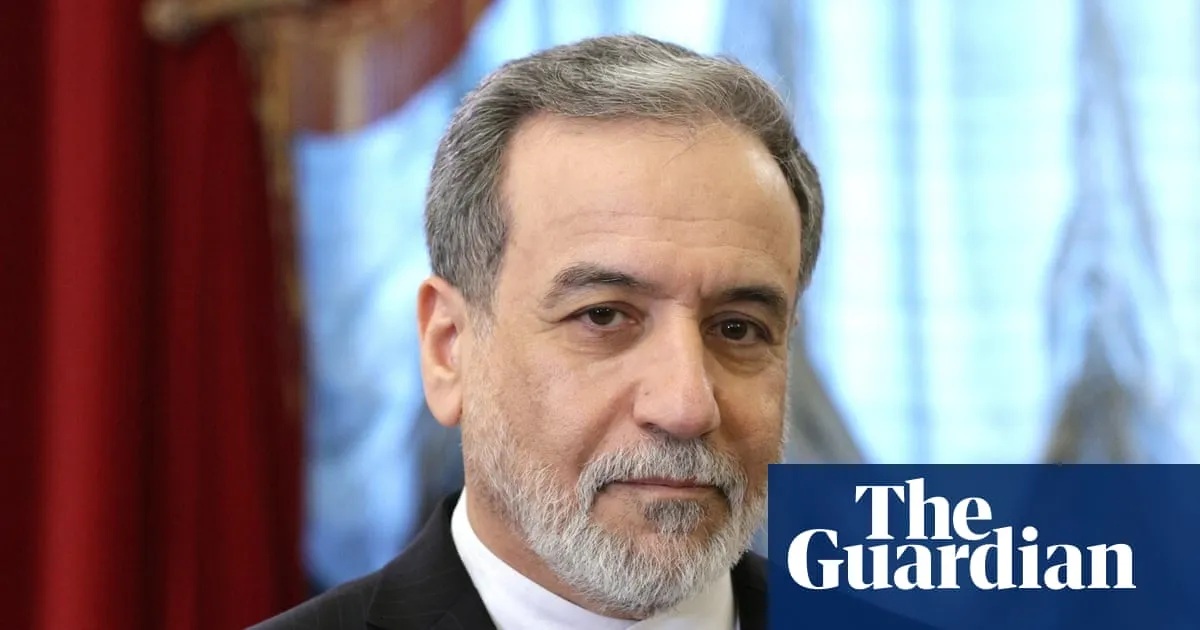
Iran’s foreign minister, Abbas Araghchi, has described how he was pulled from the rubble of a leadership compound after the US-Israeli airstrike that killed the country’s supreme leader, Ali Khamenei, on the first day of the war, and has survived since by constantly moving around the capital, Tehran, by car.In an interview with the Iranian journalist Javad Mogouyi, Araghchi confirmed Israel and the US had accurate intelligence on the location of Khamenei and other officials, enabling them to target Iran’s senior leadership.He said he had yet to meet the country’s new leader, Khamenei’s son Mojtaba, but said his appointment sent “a very important message to the world that there would be no change in the regime’s policies and ideals”.Speaking to Mogouyi before the resumption of all-out hostilities 10 days ago, Araghchi said he had always doubted that negotiations with the US earlier this year would work, but said they had been necessary, even if there was only a 10% chance of success – not least to ensure there was no room for doubt that Iran had pursued diplomacy. “No one would be able to tell us that it was our fault,” he said.In the interview published online on Sunday, Araghchi confirmed that Iran had offered the US a deal on its nuclear programme in the final round of talks in Geneva, but said Oman’s foreign minister, Badr Albusaidi, told him the following day that the mood in Washington had suddenly become more bellicose.The joint US-Israeli strikes began shortly after 9am the next day, when senior officials had gathered for meetings at the ministry of intelligence, the strategic council on foreign policy, and the defence council.“What matters, in my view, is the fact that Israel had intelligence about these meetings,” Araghchi said, adding: “This may point to a security gap that probably still exists. This needs to be fixed.”Araghchi was reporting back to Khamenei’s deputy chief of staff, Ali Asghar Hijazi, when the building was shaken by three blasts within seconds – each closer than the last, he said. “The third explosion was almost next to our building. The section where Mr Hijazi’s office was located was directly hit, and the left side of the building was completely destroyed.”Hijazi’s secretary was killed instantly, but Araghchi and Hijazi escaped the full force of the detonation.“We were on the other side of the building, and after the explosion, the ceiling, walls, and everything collapsed on us. I grabbed Mr Hijazi’s hand, and we made our way through the beams and boards and pieces of wood, hearing the cries for help. Water was pouring from the ceiling. Everything was wrecked. We eventually got out, and I saw that various parts of the compound had been targeted.”Araghchi was rushed to the foreign ministry by a passerby since his official car had been hit.“For three days we were cut off from everything trying to find out who was alive and who had been martyred,” he said. “The enemy thought they could paralyse us by targeting leadership, but they failed.”Abbas Araghchi (second left) and other top officials attending the state ceremony for the former Iranian leader Ali Khamenei, killed on 28 February. Photograph: Anadolu/Getty ImagesAraghchi said Iran had been prepared for such an attack, and had already drawn up plans to close the strategic strait of Hormuz if the supreme leader was targeted. The codename for such a scenario was “Code 110”, a reference to the clause of Iran’s constitution that lays out the supreme leader’s powers.Araghchi said the US had decided to attack because it believed Iran’s government had been weakened abroad by blows to its proxies in Syria and Lebanon, and at home by economic protests – the speed and scale of which he admitted had surprised him.Araghchi said regional governments had counselled Donald Trump against war, saying that attacking Iran would not be as easy as the US raid on Venezuela to abduct the then president, Nicolás Maduro. “Iran is different. Its support is a several-thousand-year civilisation, combined with Shia thought and beliefs about martyrdom. When these combine, they create something that cannot be easily defeated,” he said.He told Mogouyi that Iran had warned neighbouring governments that any attack would be met with retaliation against targets in the region. “If Israel hits our nuclear facilities, we will hit theirs. Our missiles do not reach America, so we will hit their bases, which are unfortunately in your countries. If they hit our oil facilities, we will ensure that nobody in the region can sell oil,” he said.He also said warnings to the Turkish government had prompted Ankara to shut down Trump’s plan to encourage a Kurdish revolt from Iraq into Iran. Turkey’s foreign minister, Hakan Fidan, “talked to the Americans and adopted a very firm position in this regard. A series of efforts foiled this plot,” Araghchi said.He added that Iran was working to exacerbate divisions between the US and Israel. “There are sometimes conflicts of objectives and positions which can be played with,” he said, without giving details.Araghchi said that after Israel’s 12-day bombing campaign against his country in 2025, Iran had improved its missile capabilities, reducing the time needed to reactivate a base after an attack from 10–15 hours to 35–40 minutes.Discussing the choice of diplomacy or war, Araghchi said: “We do not fight unless the cost of not fighting is higher than the cost of fighting.”
SRCThe Guardian - World News
LANGEN
LEANCenter-Left
WORDS894
ENT12
WED · 2026-07-22 · 05:00 GMTBRIEF NSR-2026-0722-94932
NSR-2026-0722-94932News Report·EN·Conflict
Iran’s foreign minister describes moment of attack that killed Khamenei
Iran's Foreign Minister Abbas Araghchi described being pulled from rubble after a US-Israeli airstrike that killed Supreme Leader Ali Khamenei on the first day of a war. Araghchi stated that the US and Israel possessed accurate intelligence, enabling them to target Iran's senior leadership during meetings at various government compounds.
Patrick Wintour Diplomatic editorThe Guardian - World NewsFiled 2026-07-22 · 05:00 GMTLean · Center-LeftRead · 4 min
The Guardian - World NewsFIG 01
Reading time
4min
Word count
894words
Sources cited
2cited
Entities identified
12entities
Quality score
100%
§ 01
Briefing Summary
AI-generatedNEWSAR · AI
Iran's Foreign Minister Abbas Araghchi described being pulled from rubble after a US-Israeli airstrike that killed Supreme Leader Ali Khamenei on the first day of a war. Araghchi stated that the US and Israel possessed accurate intelligence, enabling them to target Iran's senior leadership during meetings at various government compounds. He has survived by constantly moving around Tehran by car. Araghchi also confirmed Iran had offered a nuclear deal to the US in Geneva, but the US mood shifted to more bellicose afterward. He noted that Iran had contingency plans, codenamed "Code 110," to close the Strait of Hormuz if the supreme leader was targeted. Araghchi also mentioned Iran's efforts to sow division between the US and Israel and warned regional governments of retaliation if attacked.
Confidence 0.90Sources 2Claims 5Entities 12
§ 02
Article analysis
Model · rule-basedFraming
Conflict
National Security
Tone
Mixed Tone
AI-assessed
CalmNeutralAlarmist
Factuality
0.70 / 1.00
Factual
LowHigh
Sources cited
2
Limited
FewMany
§ 03
Key claims
5 extracted01
Iran's foreign minister, Abbas Araghchi, described being pulled from rubble after a US-Israeli airstrike killed Supreme Leader Ali Khamenei.
quoteAbbas Araghchi
Confidence
0.90
02
Joint US-Israeli strikes began shortly after 9 am when senior officials were gathered for meetings.
factualAbbas Araghchi
Confidence
0.85
03
Iran offered the US a deal on its nuclear program in the final round of talks in Geneva.
factualAbbas Araghchi
Confidence
0.85
04
Araghchi confirmed Israel and the US had accurate intelligence on the location of Khamenei and other officials.
factualAbbas Araghchi
Confidence
0.85
05
Khamenei's son, Mojtaba, has been appointed as the new leader, signaling no change in regime policies.
factualAbbas Araghchi
Confidence
0.80
§ 04
Full report
4 min read · 894 words§ 05
Entities
12 identifiedKey playerOppositionContextPositiveNeutralNegative
People6
§ 06
Keywords & salience
8 termsali khamenei
1.00
us-israeli airstrike
1.00
iran's foreign minister
0.90
regime's policies
0.80
nuclear programme
0.70
leadership compound
0.60
security gap
0.50
diplomacy
0.40
§ 07
Topic connections
Interactive graph Network visualization showing 51 related topics
View Full Graph Person Organization Location Event|Click node to navigate|Edge numbers = shared articles