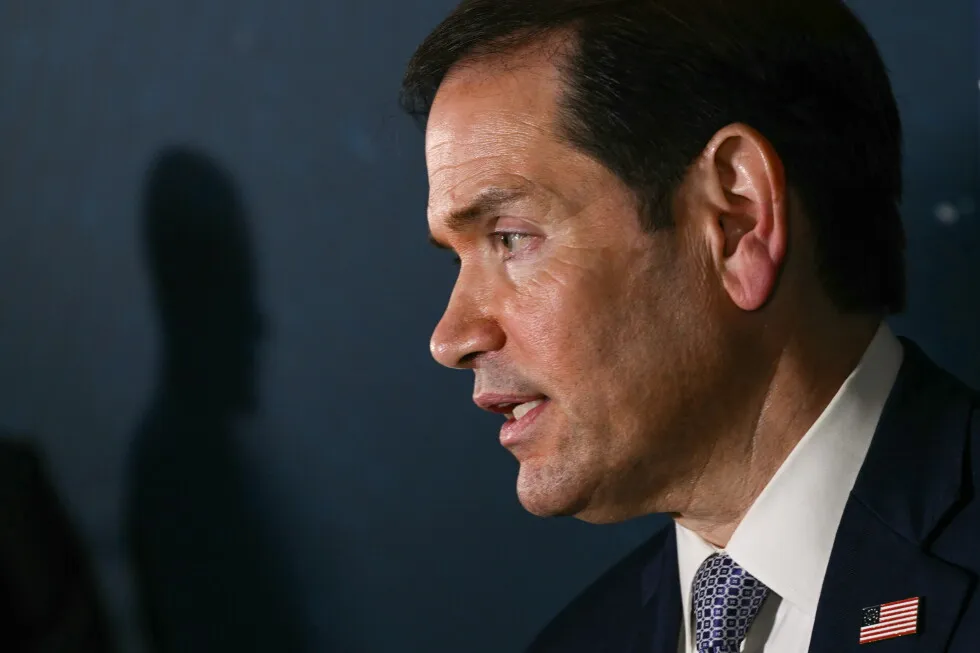
US and Saudi Arabia sign new nuclear agreement that could pave way for kingdom to enrich uranium 1 of 3 | U.S. President Donald Trump has approved an agreement with Saudi Arabia that could potentially provide the kingdom with Uranium enrichment capability for its Civilian nuclear program, according to two people familiar with the matter. The people, who were not authorized to comment publicly about the yet to be formally announced decision, said the agreement is expected to be announced as early as Wednesday. 2 of 3 | Secretary of State Marco Rubio speaks during a press conference on the sidelines of the Association of Southeast Asian Nations (ASEAN) Foreign Ministers’ Meeting in Pasay, Metro Manila, Philippines Wednesday, July 22, 2026. (Brendan Smialowski/Pool Photo via AP) 3 of 3 | President Donald Trump speaks while meeting with Lebanese President Joseph Aoun in the Oval Office at the White House, Tuesday, July 21, 2026, in Washington. (AP Photo/Mark Schiefelbein) 1 of 3 U.S. President Donald Trump has approved an agreement with Saudi Arabia that could potentially provide the kingdom with Uranium enrichment capability for its Civilian nuclear program, according to two people familiar with the matter. The people, who were not authorized to comment publicly about the yet to be formally announced decision, said the agreement is expected to be announced as early as Wednesday. Add AP News on Google Add AP News as your preferred source to see more of our stories on Google. Share 2 of 3 | Secretary of State Marco Rubio speaks during a press conference on the sidelines of the Association of Southeast Asian Nations (ASEAN) Foreign Ministers’ Meeting in Pasay, Metro Manila, Philippines Wednesday, July 22, 2026. (Brendan Smialowski/Pool Photo via AP) 2 of 3 Secretary of State Marco Rubio speaks during a press conference on the sidelines of the Association of Southeast Asian Nations (ASEAN) Foreign Ministers’ Meeting in Pasay, Metro Manila, Philippines Wednesday, July 22, 2026. (Brendan Smialowski/Pool Photo via AP) Add AP News on Google Add AP News as your preferred source to see more of our stories on Google. Share 3 of 3 | President Donald Trump speaks while meeting with Lebanese President Joseph Aoun in the Oval Office at the White House, Tuesday, July 21, 2026, in Washington. (AP Photo/Mark Schiefelbein) 3 of 3 President Donald Trump speaks while meeting with Lebanese President Joseph Aoun in the Oval Office at the White House, Tuesday, July 21, 2026, in Washington. (AP Photo/Mark Schiefelbein) Add AP News on Google Add AP News as your preferred source to see more of our stories on Google. Share Updated [hour]:[minute] [AMPM] [timezone], [monthFull] [day], [year] Washington (AP) — The U.S. and Saudi Arabia on Wednesday forged a new agreement that could potentially provide the kingdom with Uranium enrichment capability for its Civilian nuclear program. U.S. Energy Secretary Chris Wright and Saudi Minister of Energy Abdulaziz bin Salman formally signed the nuclear cooperation agreement, known as a “123 agreement,” alongside what the Trump administration described as a “bilateral safeguards agreement.”The U.S. administration released scant details of the deal, but the framework paves the way for the building of a Uranium enrichment facility in Saudi Arabia after a joint U.S.-Saudi study, according to a person familiar with the matter who was not authorized to comment publicly and spoke on the condition of anonymity.“These agreements reflect our two nations’ shared commitment to strengthening U.S.-Saudi commercial relations, delivering prosperity at home and security to our allies abroad,” Wright said in a statement. “Rest assured, these agreements uphold the highest standards of nuclear safety and nonproliferation, while relying on the world’s best nuclear technology and scientists, designed right here in the United States.” Earlier, Secretary of State Marco Rubio sought to head off emerging criticism of the decision under questioning by reporters about the risk that helping the Saudis fulfill their long-standing desire to enrich their own uranium could lead to new rounds of nuclear proliferation and competition in a volatile region.“The U.S. is not going to reach any agreement with any country in the world that leads to the risk of proliferation,” said Rubio, who was traveling in the Philippines on Wednesday. 2 MIN READ 2 MIN READ 1 MIN READ The agreement does not include the International Atomic Energy Agency ‘s Additional Protocol, which would allow for more monitoring, inspections and verification, according to a second person familiar with the decision. The deal is expected to last 30 years and involve U.S. firms in developing the program. The Energy Department in a statement said it will be submitted for review to Congress, where it could face opposition. The oil-rich kingdom’s Energy Ministry said the agreement bolsters “efforts to diversify energy sources, advance cutting-edge technologies, and expand opportunities for cooperation and investment in ways that serve the mutual interests of the two friendly countries.” The announcement comes during the war against Iran launched by the U.S. and Israel, in part, to wipe out Tehran’s ability to develop a nuclear weapon. Iran has insisted its nuclear enrichment program is peaceful.Ahead of the announcement, Alexander Bollfrass, a nuclear expert at the International Institute for Strategic Studies in London, called the deal “a revolutionary new approach” to nuclear nonproliferation policy.“The revolutionary aspect of this agreement is that the United States is not asking Saudi Arabia to abide by the highest possible safeguards, internationally monitored safeguards that are standard and are available today, but instead is willing to at least theoretically transfer highly sensitive technology without the same level of oversight that one would expect,” Bollfrass said.President Donald Trump, during his first term, and former President Joe Biden tried to reach a nuclear deal with the kingdom to share American technology. Enrichment could open the door to weaponizationNonproliferation experts warn any spinning centrifuges within Saudi Arabia could open the door to a possible weapons program for the kingdom, something its assertive de facto leader, Crown Prince Mohammed bin Salman, has suggested he could pursue if Tehran obtains an atomic bomb.Wright traveled to Saudi Arabia last year shortly before Trump visited and discussed building out the kingdom’s commercial nuclear power industry with his Saudi counterpart. The U.S. Department of Energy has not responded to multiple requests for comment.Already, Saudi Arabia and nuclear-armed Pakistan signed a mutual defense pact after Israel launched an attack on Qatar targeting Hamas officials. Pakistan’s defense minister then said his nation’s nuclear program “will be made available” to Saudi Arabia if needed, something seen as a warning for Israel, long believed to be the Middle East’s only nuclear-armed state. Some lawmakers are hesitant about giving Saudis enrichment capability Enrichment isn’t an automatic path to a nuclear weapon — a nation also must master other steps, including the use of synchronized high explosives, for instance. But it does open the door to weaponization, which has fueled the West’s concerns over Iran’s program.The United Arab Emirates, a neighbor to Saudi Arabia, signed a 123 agreement with the U.S. to build its Barakah nuclear power plant with South Korean assistance. But the UAE did so without seeking enrichment, something nonproliferation experts have held up as the “gold standard” for nations wanting atomic power.Rubio, as a Republican senator representing Florida, backed a bipartisan 2018 proposal that called for requiring Congress to approve any 123 agreement with Saudi Arabia. The bill was reintroduced by a group of Democratic lawmakers in March but has not passed into law. Typically, 123 agreements — which authorize U.S. companies to sell nuclear technology abroad — go into effect unless veto-proof majorities of Congress pass joint resolutions of disapproval. Rosemary Kelanic, the Middle East director at Defense Priorities, a Washington think tank, said that Uranium enrichment capability could give Saudi Arabia “a potent source of leverage to extract future concessions from Washington, including new security guarantees, by threatening to weaponize its program unless the United States promises enhanced military protection.”US firms could be winners in expected dealRep. Brad Sherman, a California Democrat, predicted the deal would benefit U.S. nuclear giant Westinghouse, which builds the large light-water reactors Saudi Arabia is seeking.The Trump administration said last month it is providing $17.5 billion in loans to speed development of 10 new large nuclear reactors designed by Westinghouse to meet skyrocketing power demand from massive data centers. The new reactors could use the same design, Westinghouse’s AP1000, in the planned Saudi deal.Sherman said the U.S. military is “bombing Iran because they insist upon enriching and reprocessing” nuclear material.Now it appears that U.S. officials “are entering into an agreement with Saudi Arabia, giving them the green light to reprocess and to enrich, and the only difference I see here is that Westinghouse stands to make an awful lot of money on this deal, whereas the Iranians were not enriching American companies,” Sherman said at a House Foreign Affairs Committee hearing Wednesday.___Price reported from Manila, Philippines. Associated Press writers Danica Kirka in London and Will Weissert contributed to this report. Madhani is a White House reporter for the Associated Press whose reporting focuses on U.S. foreign policy. Contact him securely on Signal at aamermadhani.39 Price covers the White House. She previously covered the 2024 presidential campaign and politics, government and other news in New York, Nevada, Utah and Arizona. She is based in Washington. Daly covers climate, environment and energy policy for The Associated Press. He is based in Washington, D.C. Superville covers the White House for The Associated Press, with a special emphasis on first ladies and first families.
SRCAssociated Press (AP)
LANGEN
LeanCenter
WORDS1,575
ENT12
THU · 2026-07-23 · 11:23 GMTBRIEF NSR-2026-0723-95292
NSR-2026-0723-95292News Report·EN·National Security
US and Saudi Arabia sign new nuclear agreement that could pave way for kingdom to enrich uranium
The U.S. and Saudi Arabia have signed a new nuclear cooperation agreement, a "123 agreement," that could allow Saudi Arabia to enrich uranium for its civilian nuclear program.
By
AAMER MADHANI, MICHELLE L. PRICE, MATTHEW DALY and DARLENE SUPERVILLEAssociated Press (AP)Filed 2026-07-23 · 11:23 GMTLean · CenterRead · 7 min
Associated Press (AP)FIG 01
Reading time
7min
Word count
1,575words
Sources cited
2cited
Entities identified
12entities
NEWSAR · AI
The U.S. and Saudi Arabia have signed a new nuclear cooperation agreement, a "123 agreement," that could allow Saudi Arabia to enrich uranium for its civilian nuclear program. U.S. Energy Secretary Chris Wright and Saudi Minister of Energy Abdulaziz bin Salman formally signed the deal, which the Trump administration described as including a "bilateral safeguards agreement." While details are scarce, the framework suggests a future uranium enrichment facility in Saudi Arabia following a joint study. U.S. officials stated the agreement upholds nuclear safety and nonproliferation standards, though it does not include the IAEA's Additional Protocol for enhanced monitoring. The deal, expected to last 30 years, will be submitted for congressional review, where it may face opposition due to proliferation concerns.
Confidence 0.90Sources 2Claims 4Entities 12
Framing
National Security
Diplomatic
Tone
Measured
AI-assessed
CalmNeutralAlarmist
Factuality
0.70 / 1.00
Factual
LowHigh
Sources cited
2
Limited
FewMany
01
U.S. Energy Secretary Chris Wright and Saudi Minister of Energy Abdulaziz bin Salman formally signed the agreement.
factual
Confidence
0.95
02
The U.S. and Saudi Arabia forged a new agreement on Wednesday.
factual
Confidence
0.90
03
US President Donald Trump has approved an agreement with Saudi Arabia that could potentially provide the kingdom with uranium enrichment capability for its civilian nuclear program.
factualtwo people familiar with the matter
Confidence
0.80
04
The agreement is expected to be announced as early as Wednesday.
predictiontwo people familiar with the matter
Confidence
0.70
§ 04
Full report
7 min read · 1,575 wordsKey playerOppositionContextPositiveNeutralNegative
People3
Locations5
uranium enrichment
1.00
nuclear agreement
0.90
saudi arabia
0.80
civilian nuclear program
0.70
donald trump
0.60
us
0.50
capability
0.40
§ 07
Connections
Who appears together in the newsIn this articleWider coverageLine weight = articles in common
Laying out network…
Strongest ties articles in common
- 15,001
- 1,809
- 1,714
- 1,062
- 922
- 820
Recurring context not named in this article
- LIranlinks 10
- LIsraellinks 10
- LStrait of Hormuzlinks 10
- LMiddle Eastlinks 10
- OHouthislinks 8
- OEuropean Unionlinks 8
- LIndonesialinks 8
- OReuterslinks 8