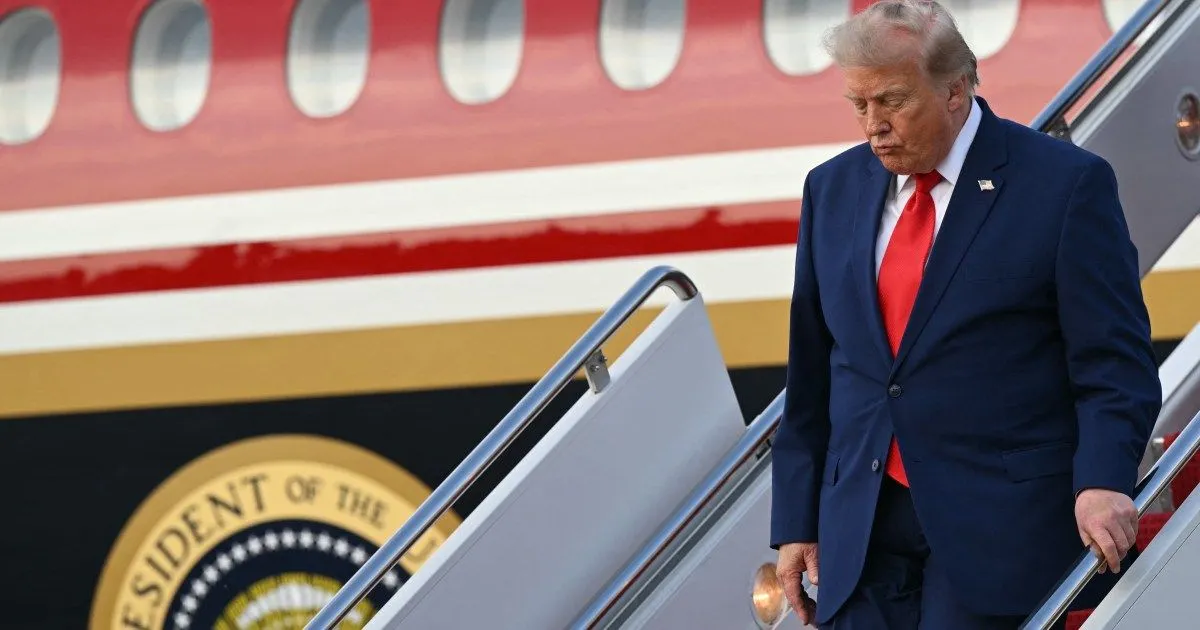
Claim casts further confusion over deal to launch US-supported civilian nuclear programme in Saudi Arabia.US President Donald Trump steps off Air Force One at Joint Base Andrews in Maryland, the United States [AFP]Published On 23 Jul 2026United States President Donald Trump has said that a civilian nuclear cooperation deal with Saudi Arabia is “totally subject” to the kingdom normalising relations with Israel as part of the Abraham Accords.Trump’s statement on Thursday, a day after the agreement was announced, has cast confusion over an already opaque deal, the full details of which have not been released.Recommended Stories list of 3 itemslist 1 of 3US and Saudi Arabia announce nuclear cooperation deallist 2 of 3Why is Iran still able to conduct deadly attacks on US military sites?list 3 of 3Saudi Arabia and US agree to landmark nuclear deal for civilian purposesend of listIn a post on his Truth Social Account, the US president wrote that the agreement “will be approved, but is totally subject to Saudi Arabia joining the very respected and successful Abraham Accords”.Saudi Arabia did not immediately respond to the claim. Any acceptance of normalising ties with Israel under the accords would represent a major pivot for Riyadh, which has long opposed such a prospect.Trump’s statement came a day after the US Department of Energy announced that Washington and Riyadh had signed “a peaceful nuclear cooperation agreement for a decades-long, multi-billion-dollar partnership” as well as a “bilateral safeguard agreement” related to the launching of a civilian nuclear programme.The deal will require approval from the US Congress.Several US media reports have suggested that the agreement will allow Saudi Arabia to enrich uranium domestically, as opposed to importing nuclear fuel.Such a provision would represent a major departure from how Washington has approached civilian nuclear programmes abroad. It has long opposed providing enrichment technology and knowledge to countries that do not already possess it.But in his statement on Thursday, Trump appeared to deny the report, writing without further context: “There will be no enrichment of material!”“The United States is not opposed to Civil (Non-Enriched) Nuclear Facilities,” he added.Uranium enrichment is not prohibited under the Treaty on the Non-Proliferation of Nuclear Weapons (NPT), to which both the US and Saudi Arabia are signatories. Enrichment is needed to create nuclear fuel, but, when done at a much higher level, it is also the basis for creating nuclear weapons.Iran’s enrichment of nuclear material has been a major justification for the ongoing US-Israel war, launched on February 28. Tehran has long maintained it does not seek a nuclear weapon, while framing enrichment rights as a matter of sovereignty.Saudi Arabia has also long sought a civilian nuclear programme as it has pursued reducing its dependence on fossil fuels.Still, nuclear non-proliferation groups have heavily criticised the pact announced on Wednesday, with several lawmakers saying it could lead to a nuclear arms race in the Middle East, particularly if the deal allowed for domestic enrichment.Some have warned it could incentivise Iran to seek nuclear weapons. Israel has also for years been assessed to possess nuclear weapons, although the US government has long maintained a policy of ambiguity towards the ally.Turkiye, Egypt and the United Arab Emirates maintain civilian nuclear infrastructure to varying degrees.‘Many questions’Reporting from Washington, DC, Al Jazeera’s Mike Hanna said Trump’s latest claim on the Abraham Accords has cast further confusion over the agreement.“This…does not appear to be part of the original agreement either,” he said. “So there are many questions that arise, and no doubt there will be many questions in Congress.”Several Arab countries agreed to normalise ties with Israel as part of the Abraham Accords, initially signed by the UAE and Bahrain in December 2020, during Trump’s first term as US president.The move made the two countries the first in the region to recognise Israel since Jordan in 1994. Morocco and Sudan have also signed the accords, although Sudan has not ratified the agreement.Despite the agreements remaining in principle, Israel’s relations with the signatories have cratered amid its genocidal war in Gaza. Prior to the conflict, the accords were largely criticised for side-stepping the Palestinian issue.Both Trump and the administration of former US President Joe Biden have for years vociferously pushed for Saudi Arabia to join the accords.
SRCAl Jazeera
LANGEN
LEANCenter
WORDS702
ENT10
THU · 2026-07-23 · 14:57 GMTBRIEF NSR-2026-0723-95382
NSR-2026-0723-95382News Report·EN·Political Strategy
Trump says Saudi nuclear pact hinges on kingdom joining Abraham Accords
President Donald Trump stated that a US-supported civilian nuclear cooperation deal with Saudi Arabia is contingent on the kingdom normalizing relations with Israel through the Abraham Accords. This claim, made on Trump's Truth Social account, adds confusion to the recently announced agreement, the full details of which remain undisclosed.
Joseph StepanskyAl JazeeraFiled 2026-07-23 · 14:57 GMTLean · CenterRead · 3 min
Al JazeeraFIG 01
Reading time
3min
Word count
702words
Sources cited
1cited
Entities identified
10entities
Quality score
100%
§ 01
Briefing Summary
AI-generatedNEWSAR · AI
President Donald Trump stated that a US-supported civilian nuclear cooperation deal with Saudi Arabia is contingent on the kingdom normalizing relations with Israel through the Abraham Accords. This claim, made on Trump's Truth Social account, adds confusion to the recently announced agreement, the full details of which remain undisclosed. The deal, announced by the US Department of Energy, involves a decades-long partnership and a bilateral safeguard agreement for Saudi Arabia's civilian nuclear program, requiring US Congressional approval. Trump also denied reports that the agreement would permit domestic uranium enrichment, stating, "There will be no enrichment of material!" Nuclear non-proliferation groups have expressed concerns that the pact could lead to a nuclear arms race in the Middle East.
Confidence 0.90Sources 1Claims 5Entities 10
§ 02
Article analysis
Model · rule-basedFraming
Political Strategy
Diplomatic
Tone
Mixed Tone
AI-assessed
CalmNeutralAlarmist
Factuality
0.70 / 1.00
Factual
LowHigh
Sources cited
1
Limited
FewMany
§ 03
Key claims
5 extracted01
Uranium enrichment is needed to create nuclear fuel but can also be the basis for nuclear weapons.
factual
Confidence
1.00
02
There will be no enrichment of material in the Saudi nuclear deal.
quoteDonald Trump
Confidence
1.00
03
The agreement will require approval from the US Congress.
factual
Confidence
1.00
04
The US and Saudi Arabia signed a peaceful nuclear cooperation agreement for a decades-long, multi-billion-dollar partnership.
factualUS Department of Energy
Confidence
1.00
05
A civilian nuclear cooperation deal with Saudi Arabia is subject to the kingdom normalizing relations with Israel as part of the Abraham Accords.
quoteDonald Trump
Confidence
1.00
§ 04
Full report
3 min read · 702 words§ 05
Entities
10 identifiedKey playerOppositionContextPositiveNeutralNegative
Locations4
§ 06
Keywords & salience
10 termsabraham accords
1.00
saudi nuclear pact
1.00
civilian nuclear program
0.90
donald trump
0.80
saudi arabia
0.80
israel normalization
0.70
uranium enrichment
0.60
us congress approval
0.50
nuclear cooperation
0.50
treaty on the non-proliferation of nuclear weapons
0.40
§ 07
Topic connections
Interactive graph Network visualization showing 51 related topics
View Full Graph Person Organization Location Event|Click node to navigate|Edge numbers = shared articles