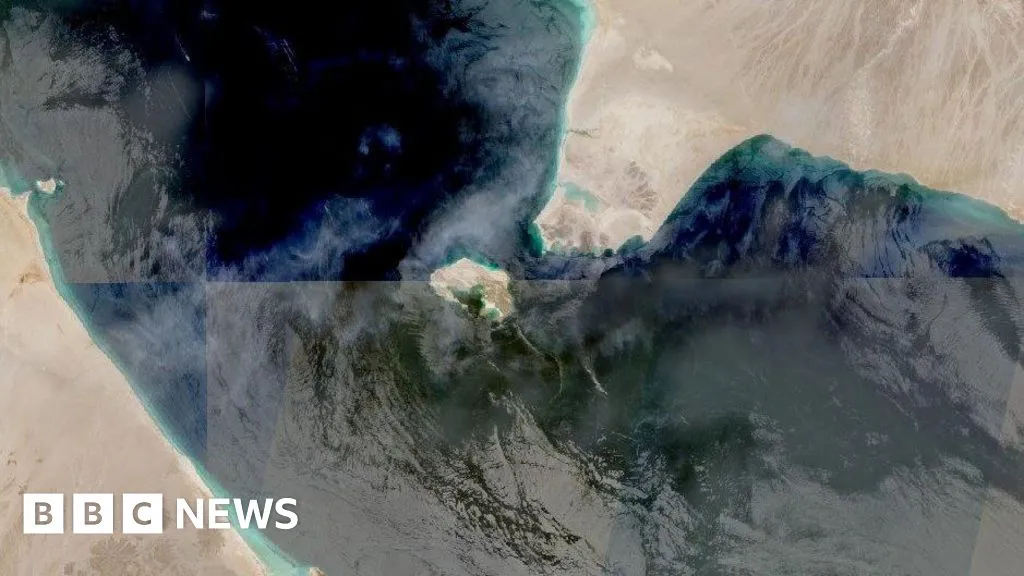
NASA Worldview/ReutersAttacks launched from Yemen could disrupt the vital Bab El Mandeb Strait shipping route, further restricting global tradeYemen's Houthi fighters claim to have attacked shipping in the Red Sea - a move that threatens to further escalate the already volatile situation in the Middle East.By forcing ships to turn back from the narrow Bab El Mandeb Strait, they have threatened to choke off the main maritime route from Europe to Asia. It comes as US-Iran strikes continue and while a deal to develop Saudi Arabia's nuclear industry prompts fears of an arms race. So is the Middle East becoming more dangerous?So far, 2026 is sadly proving to be one of the more violent years for parts of the Middle East. For 12 consecutive nights, US Central Command (Centcom) has carried out air strikes on Iranian coastal radar, drone and missile bases. The Gulf Arab states, in normal times a haven of low-crime tranquility and minimal taxation, are having to learn to live with constant attacks from their well-armed neighbour across the water: the Iran" class="entity-link entity-organization" data-entity-id="8614" data-entity-type="organization">Islamic Republic of Iran.And now the Iran-backed Houthis of Yemen have entered the fray, after a 2022 ceasefire with neighbouring Saudi Arabia appeared to have broken down. Two Saudi vessels were hit by missiles in the Red Sea this week, while the Houthis claim to have turned back 10 others after warning ships to avoid Saudi ports, disrupting shipping passing through the strategic Bab El Mandeb Strait that links the southern end of the Red Sea with the Indian Ocean.This matters because, on top of the ongoing disruption to global energy and fertiliser supplies caused by Iran effectively closing the Strait of Hormuz, it is a further obstacle to vital maritime trade that will soon impact the global economy.Saudi Arabia has been trying to distance itself from the Iran-US war and has been largely spared the Iranian drone and ballistic missile attacks that have rained down this month on Bahrain, Kuwait and Jordan. With the Strait of Hormuz closed, the Saudis have been able to partially mitigate the disruption to their oil exports by shipping millions of barrels a day through the East-West Pipeline that traverses the entire breadth of their huge country, from the oilfields of Eastern Province to the Red Sea export terminal at Yanbu' Al-Bahr. From there, they have been able to ship oil in bulk to customers in Asia using tankers that depart south, past Yemen and that Bab El Mandeb Strait, and out into the open Indian Ocean.But not anymore - at least not while the Houthis are threatening vessels that pass by their coast. US President Donald Trump has vowed to "take care of the Houthis" but that has not worked before - and without a deal, it will not work this time.The Houthis are a Shia tribal group from the far north of Yemen, based around the city of Saada. In 2014, taking advantage of the turmoil of the recent Arab Spring protests that rocked the Middle East, they marched south and took over the capital, Sanaa. They have since taken over most of the populated parts of Yemen, including the strategic port of Hodeidah.The Saudis went to war with the Houthis in 2015 in support of the legitimate but ousted Yemeni government, as they did not want an Iranian-backed militia in power on their southern border. They expected that their vastly superior, Western-supplied air force would soon be able to bomb the Houthis to the negotiating table and that the rebels would quickly sue for peace. But the Houthis never capitulated, despite horrific civilian casualties largely caused by years of air strikes, and today they are firmly entrenched in power.For two years, from 2023 to 2025, the Houthis attacked what they claimed was Israeli-linked shipping in the Red Sea, action which they said was in support of the Palestinians in Gaza. They also launched powerful modern missiles at the US and British warships that tried to subdue them. Just like the Iranian coastline around the Strait of Hormuz, Yemen's Red Sea coastal mountains contain an infinite number of caves, tunnels and hiding places for munitions that can be brought out at short notice to attack shipping.The Houthi campaign caused a major diversion of global shipping and higher shipping costs, and triggered military intervention by the US and UK to protect maritime commerce. There is now a fear this could happen again.ReutersThe Houthi group is closely allied with Iran and controls much of YemenSo what effect is all this having on the wider region?Firstly, it is important to note that two countries previously wracked by ruinous civil wars – Iraq and Syria – are now largely peaceful and stable, at least compared to where they were. The Gaza War is technically in a ceasefire, although Gazans continue to be killed in air strikes, while Israeli settlements, illegal under international law, are proliferating across the occupied West Bank. Israel's war with Hezbollah in Lebanon is on hold as the two countries continue negotiations.But right now it is the Gulf and the Arabian Peninsula that are worrying analysts the most. Trump has got himself into a war with Iran that he cannot seem to find a way out of. Night after night of US airstrikes are failing to force Iran's Revolutionary Guard Corps (IRGC) to give up control of the Strait of Hormuz. With every air strike, the IRGC hits back at those neighbouring Arab states that host US bases, trying to drive a wedge between them and Washington.From an economic perspective, the clock is ticking. Every day that Gulf oil, gas, fertiliser and other essential products cannot get through the Strait of Hormuz to markets puts pressure on global supply chains and eventually prices. If the Bab El Mandeb Strait is also going to be shut for some time then the impact on the world economy will be exacerbated further.From a military perspective, tensions have been raised another notch by the deal announced on Wednesday, paving the way for US firms to help Saudi Arabia develop its own domestic civil nuclear power programme. There is no indication that the Saudis will use this as a first step towards building a nuclear bomb.But there are still fears it could potentially trigger an arms race across the region in the future, with both Turkey and Egypt stepping up their own nuclear activities as they seek some form of deterrence and protection.The Middle East has suffered numerous spikes of violence in its recent history and this is not the worst of those. But taken together, there are a number of worrying strands here that - without a lasting, comprehensive deal between the US and Iran - could well indicate a prolonged period of instability for the region.
SRCBBC News - World
LANGEN
LEANCenter
WORDS1 124
ENT12
THU · 2026-07-23 · 17:06 GMTBRIEF NSR-2026-0723-95418
NSR-2026-0723-95418Analysis·EN·Economic Impact
Houthi attacks raise fears of wider Middle East conflict and more global economic damage
Yemen's Iran-backed Houthi group has escalated regional tensions by attacking shipping in the Red Sea, threatening the vital Bab El Mandeb Strait. This action disrupts the main maritime route between Europe and Asia, impacting global trade and potentially exacerbating economic damage already caused by other regional conflicts.
1 hour agoShareSaveAdd as preferred on GoogleFrank GardnerSecurity correspondentBBC News - WorldFiled 2026-07-23 · 17:06 GMTLean · CenterRead · 5 min
BBC News - WorldFIG 01
Reading time
5min
Word count
1 124words
Sources cited
2cited
Entities identified
12entities
Quality score
100%
§ 01
Briefing Summary
AI-generatedNEWSAR · AI
Yemen's Iran-backed Houthi group has escalated regional tensions by attacking shipping in the Red Sea, threatening the vital Bab El Mandeb Strait. This action disrupts the main maritime route between Europe and Asia, impacting global trade and potentially exacerbating economic damage already caused by other regional conflicts. The Houthis, who control much of Yemen, previously targeted Israeli-linked shipping and launched missiles at US and UK warships. These attacks come amid ongoing US-Iran strikes and fears of a nuclear arms race in the Middle East. Saudi Arabia, which previously used the Bab El Mandeb Strait for oil exports, is now facing further disruption to its trade routes.
Confidence 0.90Sources 2Claims 5Entities 12
§ 02
Article analysis
Model · rule-basedFraming
Economic Impact
Conflict
Tone
Sensational
AI-assessed
CalmNeutralAlarmist
Factuality
0.60 / 1.00
Mixed
LowHigh
Sources cited
2
Limited
FewMany
§ 03
Key claims
5 extracted01
The Bab El Mandeb Strait is a vital maritime route connecting the Red Sea to the Indian Ocean, crucial for trade between Europe and Asia.
factual
Confidence
0.95
02
US Central Command has conducted air strikes on Iranian coastal radar, drone, and missile bases for 12 consecutive nights.
factualUS Central Command (Centcom)
Confidence
0.90
03
Houthi attacks on shipping in the Red Sea threaten to escalate the Middle East situation and disrupt global trade.
factual
Confidence
0.90
04
Saudi Arabia has been mitigating oil export disruptions by using the East-West Pipeline to ship oil to the Red Sea for export to Asia.
factual
Confidence
0.85
05
US President Donald Trump has vowed to 'take care of the Houthis,' but past actions suggest this may not be effective.
quoteDonald Trump
Confidence
0.80
§ 04
Full report
5 min read · 1 124 words§ 05
Entities
12 identifiedKey playerOppositionContextPositiveNeutralNegative
Organizations3
Locations8
§ 06
Keywords & salience
10 termshouthi attacks
1.00
middle east conflict
1.00
bab el mandeb strait
0.90
global economic damage
0.90
global trade disruption
0.80
maritime trade
0.70
iran-us war
0.60
strait of hormuz
0.50
saudi arabia
0.40
yemen
0.40
§ 07
Topic connections
Interactive graph Network visualization showing 51 related topics
View Full Graph Person Organization Location Event|Click node to navigate|Edge numbers = shared articles