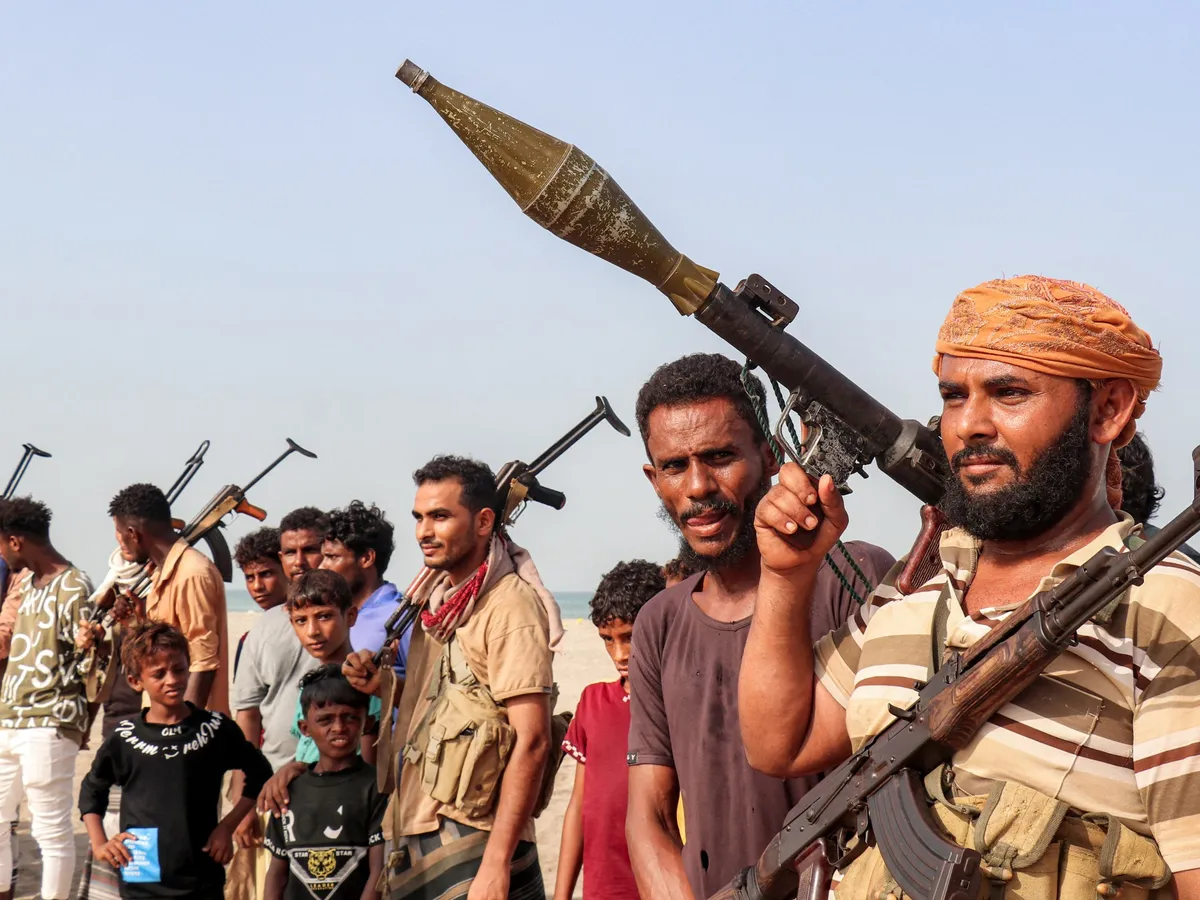
EDITOR'S ANALYSISWhat is the military balance of power in Yemen and the likelihood of confrontation between the government and the Houthis?Fighters supporting the Aden-based internationally-recognised Yemeni government gather along the Red Sea shore in Khokha, in Yemen's western Hodeidah province on July 20, 2026 [AFP]Published On 23 Jul 2026The conflict in Yemen has entered a new chapter with a declaration by the Houthis that they are imposing a maritime siege on all shipping to Saudi Arabia.The Yemeni rebel group, also known as Ansar Allah (or supporters of God), has attacked a number of Saudi tankers in the Red Sea.Recommended Stories list of 3 itemslist 1 of 3How shipping insurance rates are rising, as Hormuz, Bab al-Mandeb shut downlist 2 of 3Rubio says Iran ‘begging’ for a deal with US but not ready to make onelist 3 of 3Iran, Houthis strike tankers as US bombing continues: What’s the latest?end of listThis development has placed the Bab al-Mandeb Strait, the strategic waterway that connects the Red Sea to the Gulf of Aden and the wider Indian Ocean, at the heart of the war between the United States and Iran, and amplifies pressure on global trade routes.The Iranian-backed Houthis, who seized Yemeni capital Sanaa in 2014, have threatened to close the strait, the route through which much of Europe’s energy supplies pass. It is also a key passage for imports to Saudi Arabia.The Houthis’ decision to announce a maritime blockade cannot be separated from the turmoil created by the ongoing war between Washington and Tehran, which erupted on February 28 when the US and Israel attacked Iran.Houthis raise stakes for Saudi’s supportOn Monday, Yemen’s internationally recognised government claimed responsibility for an air strike on Sanaa airport, saying that it was a measure to prevent an Iranian plane from landing in Yemen’s Houthi-controlled capital. But the Houthis blamed Saudi Arabia for it.The Houthis responded by firing missiles into Saudi Arabia – a key backer of the Aden-based Yemeni government – and later upped the stakes by announcing a naval blockade on the kingdom.These developments mark a major escalation in Yemen’s civil war. Saudi Arabia, which has sought in recent years to avoid a new war on its southern borders, is facing a more complex equation with the threat shifting from land to sea, and the targeting of one of the most important alternative routes for its oil exports.All of this raises the question: will this escalation cause a new confrontation between the Yemeni government and the Houthis? And if so, what does the balance of power look like between the Houthi and government sides after more than a decade of war? Has the balance changed enough to increase the odds of a military resolution to the conflict?There has been talk of potential escalations in recent years, but this now seems more likely, especially since it intersects with local, regional and international events and the return of the US-Iran war.The Yemeni government has restructured its military with a single decision-making centre, and regional messages suggest the military option has not been shelved, as was once thought.So, will retaking Sanaa return to the table as a military objective to be thought of seriously, and what does that mean practically? And how ready are the parties, especially the Yemeni government, for battle?The structure of government-affiliated forcesThe anti-Houthi camp today comprises the National Army as the official framework of the Ministry of Defence, in addition to new formations with independent commands, such as the Giants Brigades, and the Guardians of the Republic forces in al-Makha, or Mocha, in the west.These different groupings – all on the anti-Houthi side in the conflict – have emerged over the years due to the weakening power of the central government, the growth of independent figures, and the backing of regional countries.The number of National Army personnel in the field is estimated at about 400,000, according to recent statements by the Defence Ministry. Its organisational structure includes Yemen’s seven military regions, but troop deployment is concentrated in Marib, Taiz and the country’s southern and eastern governorates, as a result of Houthi control over vast parts of the country’s northwest, including Sanaa.Also backing the army are the Emergency Forces, comprising between 30,000 to 40,000 personnel, and the Homeland Shield Forces, created in 2022 with between 30,000 and 40,000 recruits, and tasked with taking over camps in Hadramout and the southern governorates in December 2025, following the defeat of separatist forces who previously controlled those areas.Fighting late last year between the Yemeni government and affiliated forces on one side, and United Arab Emirates-backed separatists on the other, has led to changes in Yemen’s south and west.After the defeat of the 75,000-strong separatist Southern Transitional Council, following a Saudi intervention on the side of the government and the withdrawal of the UAE from Yemen, the group’s organisational cohesion has been impacted. But they have not been disarmed, and remain in many locations in the south, with some elements absorbed – even if nominally – into government structures.Another formerly-UAE backed force, the Tariq Saleh-led Guardians of the Republic, is estimated to number about 20,000 fighters. They are stationed primarily on the Red Sea coast and are considered among the most heavily armed formations, due to the past Emirati support.The Giants Brigades are among the most prominent combat formations in the anti-Houthi camp, with an estimated 20,000 fighters and a presence on the Red Sea coast, in Aden, and in some southern areas.Consequently, the total size of the forces affiliated with the government and the anti-Houthi camp is estimated at more than 500,000 personnel, albeit with a clear disparity in levels of training, discipline and institutional integration.Quality of armament and military equipmentThe types of weapons held by these forces do not differ as significantly as the level of their operation and management. The National Army relies on conventional weapons inherited from the Yemeni army pre-war, including light and medium weapons, armoured vehicles, tanks and field artillery, alongside various communication and transport capabilities.The Homeland Shield Forces, backed by Saudi Arabia, are considered among the most relatively well-equipped modern formations. They rely on tactical vehicles, light armoured vehicles, and superior communication systems suited for rapid deployment missions and the protection of institutions.The Emergency Forces rely on light to medium armament focused on urban operations and rapid deployment missions, more akin to a field military force with rapid intervention duties, combining a security character with combat capability.The Giants Brigades rely on medium and heavy armament, armoured vehicles and fire support units, and they are recognised for their capability to conduct offensive ground operations compared with other forces.As for the formations affiliated with the Southern Transitional Council, they rely on diverse weaponry, though readiness varies as a result of the organisational changes they have undergone.In recent years, the majority of government forces have also developed their drone capabilities, both within regular units and some irregular formations. These assets are now used for reconnaissance and surveillance missions, and occasionally for limited tactical support.Balance of power with the HouthisOfficial military records in Sanaa indicate that Houthi-affiliated army units comprise more than 200,000 fighters and can also mobilise tens of thousands of members from their volunteer Popular Committees for rapid intervention and support.However, these figures, much like the military rosters in the government camp, may not accurately reflect the actual combat strength on the ground due to the inclusion of reserve or inactive names in registries.Although government-affiliated forces may possess more manpower, the balance of power in Yemen is not determined solely by numbers.Despite sustaining significant damage to its forces and assets from US and Israeli strikes over the past few years, the Houthi side benefits from a more centralised command structure and possesses experience in managing asymmetric warfare.
SRCAl Jazeera
LANGEN
LEANCenter
WORDS1 284
ENT12
THU · 2026-07-23 · 16:17 GMTBRIEF NSR-2026-0723-95426
NSR-2026-0723-95426Analysis·EN·Conflict
Yemen faces a new challenge amid prospects of confrontation
Yemen faces a new escalation as the Houthi rebels declared a maritime siege on shipping to Saudi Arabia, attacking tankers in the Red Sea. This action, occurring amidst the US-Iran war, places the strategic Bab al-Mandeb Strait at the heart of regional tensions and impacts global trade.
Ahmed al-ShalafiAl JazeeraFiled 2026-07-23 · 16:17 GMTLean · CenterRead · 6 min
Al JazeeraFIG 01
Reading time
6min
Word count
1 284words
Sources cited
0cited
Entities identified
12entities
Quality score
100%
§ 01
Briefing Summary
AI-generatedNEWSAR · AI
Yemen faces a new escalation as the Houthi rebels declared a maritime siege on shipping to Saudi Arabia, attacking tankers in the Red Sea. This action, occurring amidst the US-Iran war, places the strategic Bab al-Mandeb Strait at the heart of regional tensions and impacts global trade. The internationally recognized Yemeni government claimed responsibility for an air strike on Sanaa airport, which the Houthis blamed on Saudi Arabia, prompting the missile attacks and subsequent blockade. This marks a significant shift in the conflict, moving the threat from land to sea and complicating Saudi Arabia's position. The Yemeni government has restructured its military, with estimates of around 400,000 National Army personnel, alongside other formations, suggesting a potential renewed focus on military objectives.
Confidence 0.90Claims 5Entities 12
§ 02
Article analysis
Model · rule-basedFraming
Conflict
Diplomatic
Tone
Mixed Tone
AI-assessed
CalmNeutralAlarmist
Factuality
0.60 / 1.00
Mixed
LowHigh
Sources cited
0
No named sources
FewMany
§ 03
Key claims
5 extracted01
The Houthis declared a maritime siege on all shipping to Saudi Arabia.
factualHouthis
Confidence
0.90
02
The Houthis threatened to close the Bab al-Mandeb Strait, a key passage for imports to Saudi Arabia.
factualHouthis
Confidence
0.80
03
The Houthis' decision to announce a maritime blockade is linked to the US-Iran war.
factual
Confidence
0.70
04
The Bab al-Mandeb Strait is at the heart of the war between the United States and Iran.
factual
Confidence
0.70
05
This escalation could cause a new confrontation between the Yemeni government and the Houthis.
prediction
Confidence
0.60
§ 04
Full report
6 min read · 1 284 words§ 05
Entities
12 identifiedKey playerOppositionContextPositiveNeutralNegative
Organizations3
§ 06
Keywords & salience
9 termshouthi blockade
1.00
yemen civil war
1.00
bab al-mandeb strait
0.90
red sea
0.80
iran-us conflict
0.70
global trade routes
0.60
saudi arabia
0.60
maritime siege
0.50
military balance of power
0.40
§ 07
Topic connections
Interactive graph Network visualization showing 51 related topics
View Full Graph Person Organization Location Event|Click node to navigate|Edge numbers = shared articles