Built in 1875 and modelled on the Chapelle Saint-Marc in Lyon, the church was originally intended to be the chapel for St Joseph University, which was opened by French Jesuits as part of France’s colonial-era “civilising mission”.Its pale stone facade rises above a busy Beirut street. Today, it remains under Jesuit stewardship, with Father Michael Petro leading the parish.“It’s an interesting space, because it is on the edge of Ashrafieh, a predominantly Christian, francophone area, which has plenty of wealthy Lebanese people living in it. But it also has their domestic workers. From the start of the first waves of migrants in the 70s, this place became known as a place for them,” he tells Al Jazeera.Every Sunday, during peacetime, the gravel car park is transformed into a cricket ground. Indian and Pakistani migrant workers play softball cricket while families sit on the sidelines sharing home-cooked food, catching up with friends and enjoying one of their few days away from work.Today, the atmosphere is very different.Instead of the crack of a plastic bat and Bollywood music spilling across the church grounds, rows of mattresses line the floors, and laundry hangs from railings. Men slouch on plastic chairs littered around the church, scrolling through their phones. Women carry blankets and washed clothes in plastic tubs. Only the children seem able to break the subdued mood, darting between adults and filling the space with bursts of laughter.“When the war escalated, we immediately had large groups of Sudanese and South Sudanese come here,” Father Michael says. “They showed up because they would ask community leaders what to do, and were told to come here, as it is the first place they trusted."On one hand, that's very beautiful, because people thought they would be welcome here, and they were."However, the strain of being a first port of call for so many displaced migrants is beginning to show.Supplies are low, and tensions occasionally flare among those sheltering at the church. Father Michael says the church reached its capacity of 250 people on just the second day of the war."We've turned away more than 100 people in the last few days,” he says. “It's a disaster.”Mohammad says daily life has become increasingly difficult, particularly since the arrival of their son.“We do not have enough clothes, especially now that the baby is growing. Also, my wife's nutrition is not great. Sometimes she gets constipated, and then the baby becomes ill. We need more protein and vegetables. The diet is a huge concern.”Living in crowded conditions, surrounded by uncertainty, has taken a toll on people’s mental wellbeing, Rufaida says.“Because of the atmosphere and mental health problems, small problems become big ones. I said good morning to someone, and they didn’t like it. There are no big fights, but there is an underlying tension.”Both say they understand why tempers sometimes fray. Many of those sheltering at the church have fled war, lost homes and spent months or years living with uncertainty. Small problems become big ones. by RUFAIDA, DISPLACED SUDANESE MOTHER Their gratitude is rooted partly in what happened when Rufaida sought maternity care.At Karatina Hospital, they say they were repeatedly overlooked by doctors in favour of Lebanese patients. “We were there to get papers so she could give birth in that hospital, but we were ignored, and Lebanese people were allowed into consultations first,” Mohammad says.After waiting for three hours, a worker from the Jesuit Refugee Service (JRS), who had accompanied them to the hospital, intervened and helped ensure they were seen.Through support coordinated by JRS and partner organisations, the entire cost of Rufaida’s pregnancy was covered, including prenatal care, the cesarean delivery and Ahmad’s vaccinations.“It gave me comfort and peace that I was able to deliver in a safe environment,” Rufaida says.Their experience is increasingly common among Sudanese migrants in Lebanon, many of whom have found themselves uprooted more than once — first by war in Sudan and then by conflict in Lebanon.Rufaida’s story is far from unique. According to figures published by the International Organization for Migration (IOM) in August 2025, there are 164,097 migrants living in Lebanon, of which 14,854 are Sudanese nationals.That number represents only a small fraction of the 4.4 million Sudanese who have fled their country since the outbreak of civil war in April 2023.Some, like Rufaida, arrived on tourist visas. Others found jobs as concierges or domestic workers, under Lebanon's kafala sponsorship system, which ties a migrant worker's legal residency to their employer.Human Rights Watch has described the system as, at its worst, a form of modern slavery.About 3,800 Sudanese have also found asylum in Lebanon as registered refugees with the UN Refugee Agency.For refugees in Lebanon, a UNHCR registration card can mean far more than a piece of paper. It offers a measure of protection from detention or deportation, can unlock access to aid and education where services exist, and, for many, represents their best hope of one day being resettled in another country.Among them is 30-year-old Roudaina Mustafa.
SRCAl Jazeera
LANGEN
LEANCenter
WORDS829
ENT12
FRI · 2026-07-24 · 15:16 GMTBRIEF NSR-2026-0724-95751
NSR-2026-0724-95751News Report·EN·Human Interest
‘I lost my home twice’: Sudanese mothers caught between two wars
Sudanese mothers in Lebanon are facing a second displacement due to escalating conflict, having previously fled war in their home country. Many are now sheltering at a church in Beirut, which has become a refuge for large groups of Sudanese and South Sudanese migrants.
Jahan de Bellaigue,Justus KonnekerAl JazeeraFiled 2026-07-24 · 15:16 GMTLean · CenterRead · 4 min
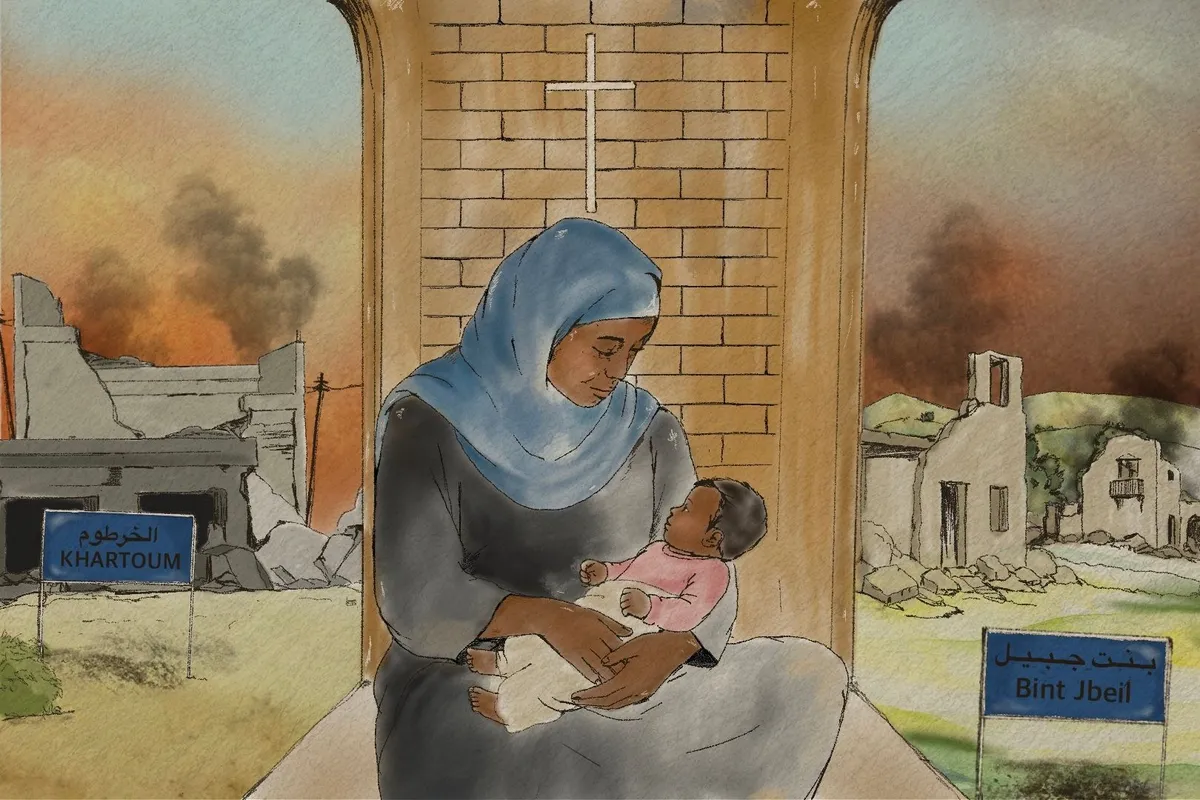
Al JazeeraFIG 01
Reading time
4min
Word count
829words
Sources cited
2cited
Entities identified
12entities
Quality score
100%
§ 01
Briefing Summary
AI-generatedNEWSAR · AI
Sudanese mothers in Lebanon are facing a second displacement due to escalating conflict, having previously fled war in their home country. Many are now sheltering at a church in Beirut, which has become a refuge for large groups of Sudanese and South Sudanese migrants. The church, originally built in 1875, is struggling to cope with the influx, having reached capacity and turned away over 100 people. Displaced individuals report difficulties with inadequate supplies, nutrition, and crowded living conditions, leading to heightened tensions. Some Sudanese migrants, like Rufaida, have also experienced discrimination when seeking essential services such as healthcare. The Jesuit Refugee Service and partner organizations are providing support, but the situation remains dire for many who have been uprooted multiple times.
Confidence 0.90Sources 2Claims 4Entities 12
§ 02
Article analysis
Model · rule-basedFraming
Human Interest
Conflict
Tone
Measured
AI-assessed
CalmNeutralAlarmist
Factuality
0.60 / 1.00
Mixed
LowHigh
Sources cited
2
Limited
FewMany
§ 03
Key claims
4 extracted01
Daily life for displaced migrants is difficult due to insufficient food, clothing, and crowded conditions, impacting mental well-being.
quoteMohammad and Rufaida
Confidence
1.00
02
The church reached its capacity of 250 people on the second day of the war and has turned away over 100 people.
statisticFather Michael Petro
Confidence
1.00
03
The church has become a refuge for displaced Sudanese and South Sudanese migrants fleeing escalating war.
quoteFather Michael Petro
Confidence
1.00
04
The church, built in 1875 and modeled on Chapelle Saint-Marc in Lyon, was originally intended as the chapel for St Joseph University, opened by French Jesuits.
factual
Confidence
1.00
§ 04
Full report
4 min read · 829 words§ 05
Entities
12 identifiedKey playerOppositionContextPositiveNeutralNegative
Organizations3
§ 06
Keywords & salience
8 termssudanese mothers
1.00
displaced migrants
0.90
church shelter
0.80
two wars
0.70
lebanon
0.60
migrant workers
0.50
domestic workers
0.40
french jesuits
0.40
§ 07
Topic connections
Interactive graph Network visualization showing 14 related topics
View Full Graph Person Organization Location Event|Click node to navigate|Edge numbers = shared articles