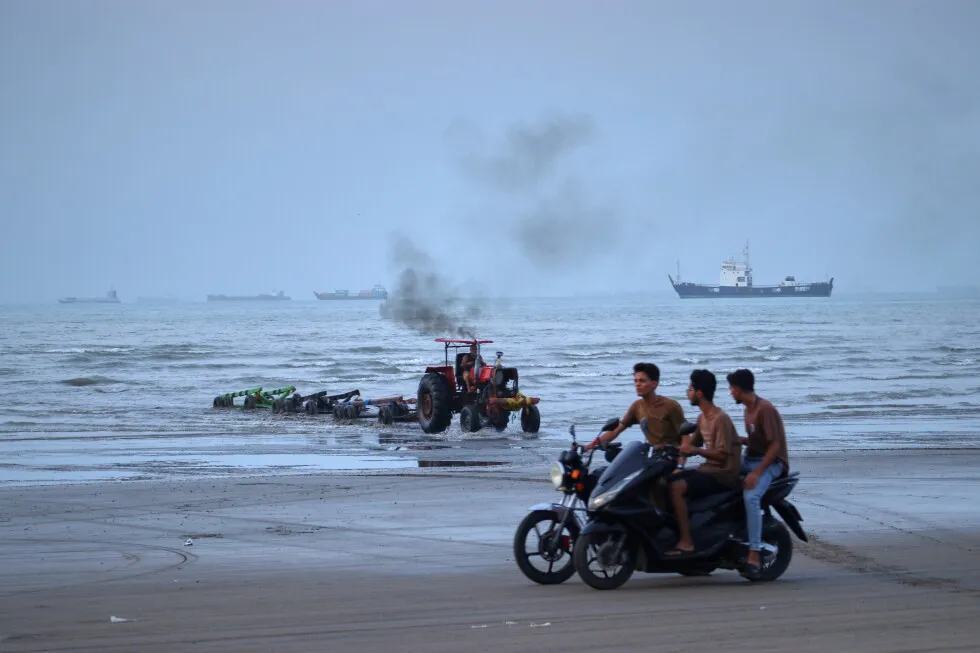
The US says it thwarted an Iranian missile attack that ended a brief pause in fighting 1 of 5 | Young men ride motorcycles along the shore as a tractor pulls equipment from the water and commercial vessels appear anchored in the Strait of Hormuz off Bandar Abbas, Iran, Monday, July 27, 2026. (Razieh Poudat/ISNA via AP) 2 of 5 | Small boats line the shore as cargo ships and other commercial vessels appear anchored in the Strait of Hormuz off Bandar Abbas, Iran, Monday, July 27, 2026. (Razieh Poudat/ISNA via AP) 3 of 5 | A man walks past anti-U.S. graffiti on the wall of the British Embassy in Tehran, Iran, Monday, July 27, 2026. (AP Photo/Vahid Salemi) 4 of 5 | A demonstrator prays as he holds an Iranian flag in a pro-government gathering at a square in Tehran, Iran, Tuesday, July 28, 2026. (AP Photo/Vahid Salemi) 5 of 5 | An Iranian pro-government demonstrator waves her country’s flag in a gathering at a square in Tehran, Iran, Tuesday, July 28, 2026. (AP Photo/Vahid Salemi) By BEN FINLEY Updated 1:19 AM MESZ, July 29, 2026 Leer en español Add AP News on Google Add AP News as your preferred source to see more of our stories on Google. Share Share Facebook Copy Link copied Print Email X LinkedIn Bluesky Flipboard Pinterest Reddit WASHINGTON (AP) — Iran launched multiple Ballistic Missiles at American forces in the Middle East on Tuesday, shattering a brief pause in fighting as mediators tried to get both sides back to negotiations and toward a ceasefire, the U.S. military said. All Iranian missiles were successfully intercepted, the U.S. Central Command said in a statement, adding that U.S. forces “remain vigilant and at a high state of readiness.” The United States and Iran had experienced a period of calm, during which neither announced attacks for days following weeks of escalation over the strategic Strait of Hormuz, the Persian Gulf waterway and narrow chokepoint through which 20% of the world’s oil normally flows. There was no immediate comment from Tehran on the U.S. military statement or the strikes. Iran effectively closed the strait when the war began by firing at freighters and tankers off its coast or threatening them. Following the signing of an interim ceasefire deal in June, a battle for control over the strait erupted. Iran demanded that ships use a route near its coastline and said it can potentially charge fees. Ships were increasingly navigating a southern route along the coast of Oman under a U.S. overwatch operation when Iran attacked some vessels. Saudi Arabia said earlier on Tuesday that it shot down drones fired by Iran-backed militias in Iraq for a second day, while Iran-backed Houthi rebels in Yemen claimed to have forced a Saudi oil tanker to turn around as part of their self-styled blockade of the kingdom. The kingdom’s Defense Ministry said in a statement that air defenses intercepted and destroyed several drones that had attempted to target petroleum facilities in the nation’s eastern region. It said the attacks were “once again launched from Iraqi territory and carried out by Iran-affiliated terrorist militias.” Iraqi Prime Minister Ali al-Zaidi ordered security agencies to investigate after the Saudis alleged a similar attack on Monday. The Iraqi military said in a statement that Iraq is committed to “preventing Iraqi territory from being used as a route or launching point for any attack targeting brotherly or friendly countries.” The Iraqi militias have denied any role in the drone attacks. The Islamic Resistance in Iraq, an umbrella group of Iran-backed armed groups, called the Saudi claims “fabrications” and implied that Monday’s attacks were carried out by the Houthis, who had themselves claimed to have attacked Saudi oil facilities. Mediators see progress in efforts to halt Iran war as drone attacks rattle region 2 MIN READ US military completes 11th night of strikes on Iran as attacks overshadow diplomacy 4 MIN READ US military launches new strikes on Iran as clashes escalate over shipping routes 4 MIN READ A Saudi oil tanker is targeted Meanwhile, the Houthis claim to have fired missiles at the Saudi oil tanker NCC Ghazal, forcing it to turn back. Last week, they announced a blockade of Saudi shipping, putting another key Middle Eastern waterway — through the Bab el-Mandeb strait leading to the Red Sea — at risk. The United Kingdom Maritime Trade Operations Center said a tanker reported hearing explosions while traveling in the southern Red Sea. It did not name the tanker but said the crew and vessel were safe. The rebels fired on at least one Saudi tanker in the Red Sea last week. Iran and the U.S. paused their fighting over the weekend, though tensions remain high even as officials said mediators achieved progress in getting the two sides back to negotiations. Iran said Tuesday that U.S. strikes during an earlier period of escalation destroyed an airport and a marine control tower, and caused damage to 12 bridges and two tunnels, among other infrastructure. Tuesday’s developments underscored fears that the U.S. and Iran were experiencing only a lull in hostilities. Recent strikes had erupted more than two weeks ago over control of the Strait of Hormuz, with the U.S. launching 13 nights straight of intensifying and expanding bombing campaigns against Iran, which also attacked American forces. Four nights without strikes followed, as mediators tried to draw both sides back to the negotiating table, before the most recent fighting broke out. Iran’s surprise strikes came as Israeli President Benjamin Netanyahu visited Washington and U.S. President Donald Trump. The U.S. and Israel launched the war against Iran on Feb. 28 but Israel has been notably absent from the recent fighting with the Islamic Republic. Netanyahu said he had an “excellent” meeting with Trump at the White House, their first sitdown since launching the war, which offered Netanyahu a chance to smooth out strains in their relationship. The closed-door meeting lasted nearly an hour and a half and was “positive and productive,” White House press secretary Karoline Leavitt said. The White House did not immediately offer more details. It comes as both leaders face growing pressures at home. Netanyahu is up for reelection and is embattled in part because of his deteriorating relationship with Trump. Trump is under pressure to end an unpopular war that has wreaked economic havoc and driven prices higher ahead of midterm elections this November. The U.S. ability to intercept Iran’s incoming strikes has become an increasingly salient issue as lawmakers, members of the military and experts raise concerns over the nation’s diminishing stockpiles of missile interceptors. The Center for Strategic and International Studies released an analysis Monday that said the nation’s shrunken inventories of Patriot and THAAD interceptors may force the U.S. and its Middle Eastern allies to take more risks to conserve those air defenses. For example, the Washington think tank said American forces may launch fewer missiles against incoming Iranian drones and missiles, raising the chance of one getting through. The Pentagon, however, pushed back against concerns that its capabilities have diminished. “America’s military is the most powerful in the world and has everything it needs to execute at the time and place of the President’s choosing,” Sean Parnell, the Pentagon’s chief spokesman, said in a statement Tuesday. The Pentagon also said that a new, separate category was created in its official casualty tally for those killed and wounded in the U.S.-Iran fighting because of the “Operation Epic Fury” — the military’s official name for combat operations in Iran — had concluded earlier. The Defense Casualty Analysis System has removed the four soldiers killed and dozens of troops wounded in the latest exchange of fire from its Iran war tally and placed them in a new category called “Overseas Operations.” A Pentagon official said Tuesday that since Operation Epic Fury has concluded, the military has decided to classify casualties tied to the latest strikes in the new category. The official, who spoke on condition of anonymity to discuss internal matters, did not offer a date for the formal end of the operation. U.S. Secretary of State Marco Rubio told reporters at a White House briefing in May that the operation had “concluded,” saying that “we achieved the objectives of that operation.” Associated Press journalists Konstantin Toropin in Washington and Christopher Weber in Los Angeles contributed to this report.
SRCAssociated Press (AP)
LANGEN
LEANCenter
WORDS1 394
ENT12
TUE · 2026-07-28 · 22:23 GMTBRIEF NSR-2026-0729-96953
NSR-2026-0729-96953News Report·EN·Conflict
Saudi Arabia says it shot down more drones as Houthis claim to have turned back tanker
Saudi Arabia reported shooting down drones launched from Iraq for a second consecutive day, which it attributed to Iran-affiliated militias. Concurrently, Houthi rebels in Yemen claimed to have forced a Saudi oil tanker to change course as part of their declared blockade of the kingdom.
Associated Press (AP)Filed 2026-07-28 · 22:23 GMTLean · CenterRead · 6 min
Associated Press (AP)FIG 01
Reading time
6min
Word count
1 394words
Sources cited
3cited
Entities identified
12entities
Quality score
100%
§ 01
Briefing Summary
AI-generatedNEWSAR · AI
Saudi Arabia reported shooting down drones launched from Iraq for a second consecutive day, which it attributed to Iran-affiliated militias. Concurrently, Houthi rebels in Yemen claimed to have forced a Saudi oil tanker to change course as part of their declared blockade of the kingdom. These incidents occurred despite a recent lull in direct confrontations between the U.S. and Iran. The Saudi Defense Ministry stated the drones targeted petroleum facilities in the eastern region. Iraq's Prime Minister ordered an investigation into the Saudi claims, while Iraqi militias denied involvement. The Houthis also claimed to have targeted a Saudi oil tanker in the Red Sea, an incident that a UK maritime authority confirmed involved a tanker hearing explosions, though the vessel and crew were safe.
Confidence 0.90Sources 3Claims 5Entities 12
§ 02
Article analysis
Model · rule-basedFraming
Conflict
Economic Impact
Tone
Measured
AI-assessed
CalmNeutralAlarmist
Factuality
0.80 / 1.00
Factual
LowHigh
Sources cited
3
Well sourced
FewMany
§ 03
Key claims
5 extracted01
The Strait of Hormuz is a chokepoint through which 20% of the world’s oil normally flows.
statistic
Confidence
1.00
02
All Iranian missiles were successfully intercepted by U.S. forces.
factualU.S. Central Command
Confidence
0.90
03
Iran launched multiple ballistic missiles at American forces in the Middle East.
factualU.S. military
Confidence
0.90
04
Saudi Arabia said it shot down drones fired by Iran-backed militias in Iraq.
factualSaudi Arabia
Confidence
0.80
05
Iran-backed Houthi rebels in Yemen claimed to have forced a Saudi oil tanker to turn around.
factualIran-backed Houthi rebels
Confidence
0.70
§ 04
Full report
6 min read · 1 394 words§ 05
Entities
12 identifiedKey playerOppositionContextPositiveNeutralNegative
Organizations3
Locations8
§ 06
Keywords & salience
10 termsiranian missile attack
1.00
strait of hormuz
1.00
us military
0.90
iran
0.90
ballistic missiles
0.80
ceasefire
0.70
negotiations
0.60
oil flow
0.50
tanker
0.40
drones
0.40
§ 07
Topic connections
Interactive graph Network visualization showing 51 related topics
View Full Graph Person Organization Location Event|Click node to navigate|Edge numbers = shared articles